Key Takeaways
- Engineer-guided agentic loop cut medical imaging latency by 34% and lifted throughput by 50.5% on NVIDIA Holoscan.
- Ablation data: full tooling (CLI, skills, docs) slashed token use by 45% versus missing skills and avoided 2.6x slower apps.
- The review-based workflow sets a new baseline for clinical-grade edge AI: human oversight plus structured tooling, not autonomy.
Table of Contents
NVIDIA’s Coding Agent Workflow Cut Medical Imaging Latency By 34 Percent
Today, the NVIDIA Developer Team published a detailed account of how engineers Wenqi Li, Tom Birdsong, and Julien Jomier guided a general-purpose coding agent through building a real-time endoscopic tool segmentation application.
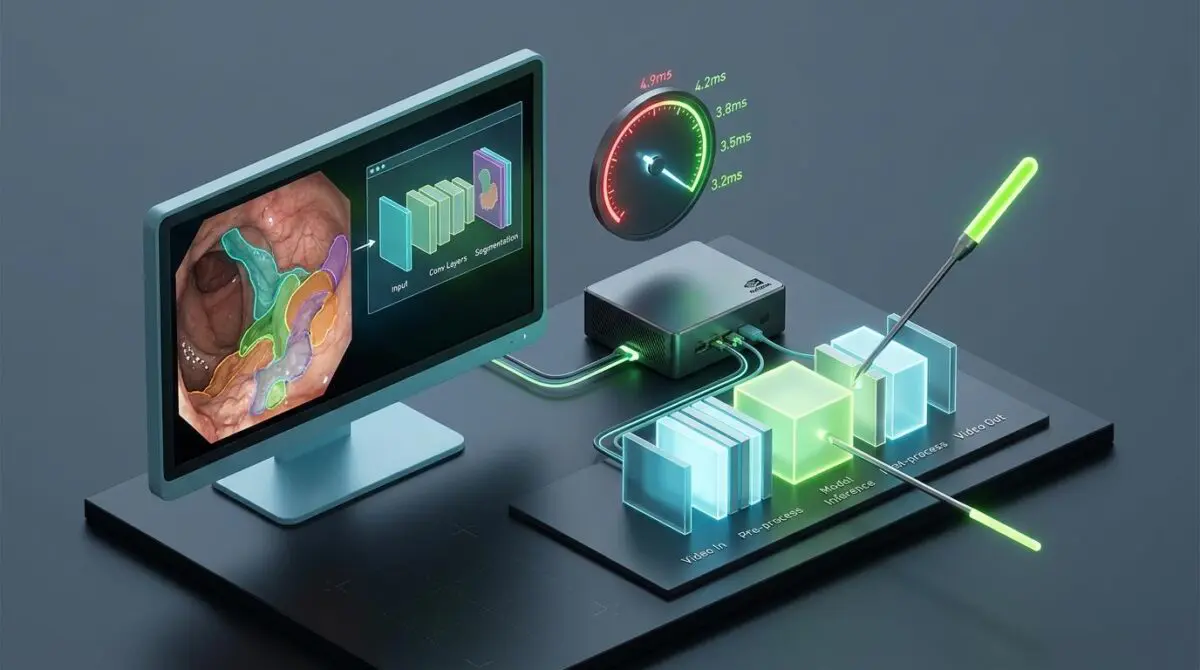
The resulting Holoscan pipeline delivered a 50.5 percent improvement in rendered throughput and a 33.6 percent reduction in mean application-path latency compared with the baseline implementation.
More important than the raw gains is the method: Holoscan CLI commands, HoloHub project skills, documentation, and examples served as the shared interface between human developers and an AI coding agent.
The engineering team did not treat the agent as an autonomous builder.
Instead, the agent operated inside a review loop where the engineer defined goals, constrained model reuse, and inspected code, outputs, and tests after every iteration.
Inside the Engineer-Guided Iteration Loop for Edge AI
NVIDIA Holoscan is a platform for building real-time AI applications at the edge, spanning medical imaging, robotics, and other high-bandwidth sensor domains.
HoloHub acts as its companion repository of reference applications and reusable components.
The overall objective was an end-to-end endoscopic tool segmentation application with real-time inference, live mask visualization, and statistical analysis rendering.
To reach that objective, the engineers decomposed the work into small, verifiable iterations.
Each iteration followed the same loop: define a goal and constraints, let the agent inspect relevant examples and implement code, then review outputs and tests before setting the next target.
The workflow itself is agent-agnostic; as documented on the NVIDIA Developer Blog, the published example used Codex with GPT-5.6 Sol at maximum reasoning effort and approximate agentic processing times.
The agent was also given Holoscan CLI with Bash execution permission, the HoloHub repository, and HoloHub development skills including holohub-app-lifecycle and holohub-debug-build-run.
Decomposing the Goal into Reviewable Topics
Iteration zero divided the end-to-end application into a sequence of reviewable questions.
Those questions covered environment configuration, model and video reuse, visual output quality, latency measurement, and rendering throughput.
- Environment validation — confirm whether a similar existing application runs locally.
- End-to-end model reuse — confirm the existing MONAI model and sample video can run in a separate application.
- Visual comprehension — determine whether the overlay presents meaningful segmentation information.
- Measurable latency — establish whether performance can be recorded repeatedly.
- Throughput optimization — improve rendering speed without feature regressions.
From Minimal Scaffold to Benchmark Mode
The first development prompt constrained the agent to reuse the MONAI endoscopic tool segmentation model, sample data, preprocessing, and inference.
The agent inspected relevant endoscopy, segmentation, HoloViz, recording, and testing patterns from nearby HoloHub projects.
It then invoked the Holoscan CLI to generate a standard application scaffold, implement the graph, and run the application.
The assembled pipeline linked video replay with preprocessing, TensorRT inference, mask postprocessing, telemetry, and HoloViz visualization into a single live dashboard.
The result was an engineering prototype built on an existing model, sample video, and Holoscan components.
Agentic processing for that first iteration took 40 minutes.
Making Performance Review Repeatable
The second prompt asked the agent to revise the visual output and add meaningful statistics such as tool area, mask motion, temporal intersection-over-union, edge entropy, FPS, and bounding box position.
The agent also removed values that remained unchanged during replay.
The final application exposed three named execution modes through the ./holohub run command.
- visual — run the full sample at source pace in an interactive window.
- smoke — run a quick 60-frame headless recording with a finite verdict.
- benchmark — process 300 frames offscreen and export measurements and plots.
In benchmark mode, the application relied on Holoscan Data Flow Tracking to trace the full path from the video source through preprocessing, inference, telemetry, offscreen HoloViz, and the final rendered-frame output.
Agentic processing for the benchmarking iteration took 20 minutes.
Latency Optimization Without Removing Inference
The third prompt asked the agent to check whether the deep learning model ran on every frame and to investigate latency reduction strategies.
The agent considered reusing masks across neighboring frames, but kept inference on every frame to avoid stale-output policy complexity.
It reduced dashboard overhead by caching HoloViz input specifications and static coordinate tensors while still refreshing text and dynamic geometry each frame.
It also moved the 10-value GPU-to-host telemetry copy into two pinned buffers and handled it asynchronously, rendering with the previous completed values.
Across five measured trials on the same test system, the optimized version was faster in every trial.
Rendered throughput rose from 204.0 FPS to 306.9 FPS, mean latency dropped from 4.891 ms to 3.247 ms, and P95 latency dropped from 6.273 ms to 4.554 ms.
After three iterations, a final handoff prompt committed the implementation and preserved benchmark logs.
The team reran the application and tests, verified output figures, and retained the commit hash and dependency versions through the Holoscan CLI environment checks.
Agentic processing for this optimization iteration took 30 minutes.
What the Ablation Data Reveals About Agent Tooling
The most revealing part of the published workflow is the ablation study, which compared the same development task under three tooling configurations.
The study, dated August 1, 2026, used Codex 0.146.0 with GPT-5.6 Sol at maximum reasoning effort and evaluated the first-iteration prompt goal for creating a new application.
In the full configuration with CLI, skills, documentation, and examples, the agent completed the task in 40 minutes using 11 million tokens.
It produced a separate application built on standard Holoscan operators.
When HoloHub development skills were removed but CLI guidance and docs remained, completion time stretched to 65 minutes and token consumption rose to 20 million.
The agent still produced a reviewable application, but it relied on generic Bash tools, more trial-and-error probing, and host-side validation retries.
When only docs and examples were available without explicit CLI guidance or HoloHub skills, the agent finished in 40 minutes with 15 million tokens, but the quality dropped substantially.
It embedded third-party model config and code incorrectly, created an unnecessary Dockerfile, and bypassed optimized Holoscan operators such as TensorRT inference.
The study found that version was 2.6 times slower than the other two settings.
The decisive insight is not that a single tool wins.
The combination of consistent execution commands, project-specific skills, and documentation examples produced the best developer experience with the lowest resource overhead.
The Market Signal for Real-Time Healthcare AI
For AI teams operating in regulated healthcare and edge computing, the NVIDIA demonstration points to a shift in how real-time medical applications can be built.
It quantifies a trade-off that many engineering leads already suspect: tooling context is not a convenience layer but a cost and quality lever for coding agents.
The ablation results show that adding HoloHub skills alongside CLI and docs reduced token usage by 45 percent compared with CLI plus docs alone.
A 45 percent token reduction may look like a narrow metric, but it compounds when multiplied across dozens of agentic build cycles and multiple product lines.
The docs-only condition is a warning in the other direction.
Its 2.6-times-slower application performance came from architectural choices, not model capability.
The agent ignored optimized Holoscan operators because nothing in the environment pushed it toward the correct abstraction.
Equally significant is the review pattern: the engineers did not rely on the agent’s own quality claims.
They required visual inspection, headless smoke tests, benchmark artifacts, and commit-level evidence before accepting each iteration.
That evidence chain mirrors the verification rigor expected in clinical AI workflows.
The finished application remains an engineering prototype, not a regulatory-approved medical device.
The published workflow still reinforces a broader point: general-purpose coding agents can assemble edge AI graphs, but only when the surrounding platform exposes operations in a structured, repeatable way.
Holoscan’s CLI and HoloHub skills become the interface layer that makes human review and agent execution share the same commands.
A New Baseline for Clinical-Grade Edge Development
The workflow is not a case for autonomous coding; it is a blueprint for engineer-led, evidence-based AI development at the edge. For teams engineering AI-assisted development pipelines that need to scale with repeatable quality, programmatic SEO AI automation is how Andres SEO Expert applies the same iterative constraint-driven logic to content systems — talk to the team here.
Frequently Asked Questions
How did NVIDIA’s coding agent workflow cut medical imaging latency by 34 percent?
The optimized Holoscan pipeline reduced mean application-path latency by 33.6% and improved rendered throughput by 50.5%. Engineers guided a coding agent through iterative optimizations such as caching HoloViz input specifications, moving GPU-to-host telemetry into pinned buffers, and handling telemetry asynchronously, while keeping inference on every frame.
What is the engineer-guided iteration loop for building edge AI applications?
The loop separates work into small, verifiable iterations. In each iteration, the engineer defines a goal and constraints, the agent inspects relevant examples and implements code, then the engineer reviews outputs, tests, and benchmark artifacts before setting the next target. The workflow uses shared interfaces like Holoscan CLI commands and HoloHub skills.
What did the ablation study reveal about AI coding agent tooling?
The full setup with CLI, skills, docs, and examples completed the task in 40 minutes with 11 million tokens. Removing skills increased time to 65 minutes and token use to 20 million. Using only docs produced poor quality and a 2.6-times-slower application, showing that the combination of consistent commands, project-specific skills, and documentation is critical.
What are the three execution modes in the optimized Holoscan application?
The three modes are visual, smoke, and benchmark. Visual mode runs the full sample at source pace in an interactive window. Smoke mode runs a quick 60-frame headless recording with a finite verdict. Benchmark mode processes 300 frames offscreen and exports measurements and plots.
How does tooling context affect token usage and performance in agentic AI development?
Adding HoloHub skills alongside CLI and docs reduced token usage by 45% compared with CLI plus docs alone. The docs-only condition led to architectural choices that made the application 2.6 times slower, demonstrating that tooling context is a major cost and quality lever for coding agents.
What market signal does this workflow send for real-time healthcare AI?
It shows that general-purpose coding agents can assemble edge AI graphs such as medical imaging pipelines when the platform exposes operations in a structured, repeatable way. The evidence-based review process (visual inspection, smoke tests, benchmark artifacts) mirrors clinical AI verification rigor, though the finished application remains an engineering prototype, not a regulatory-approved medical device.