Key Takeaways
- IBM Granite time series models are now accessible inside Confluent Cloud through Flink SQL functions, ending bespoke forecasting projects.
- A single SQL parameter swaps between four foundation models optimized for distributional forecasting, streaming state, low-parameter CPU, and frequency-domain anomaly detection.
- Post-acquisition, IBM is using Confluent as a native AI delivery layer to accelerate enterprise decisions on live data without dedicated GPU infrastructure.
Table of Contents
The Bespoke Forecasting Tax Is Over
Today, IBM opened early access for its Granite time series foundation models directly inside Confluent Cloud.
The integration lets teams call forecasting and anomaly detection functions from Flink SQL on live data, with Confluent Platform support planned for on-premises and hybrid environments.
Until now, real-time forecasting and anomaly detection typically meant building one bespoke model at a time, then paying months of expert work for every series a business needed to monitor.
Most enterprises covered the long tail with safety margins, extra inventory, and delayed responses because forecasting too many series at scale was not economically feasible.
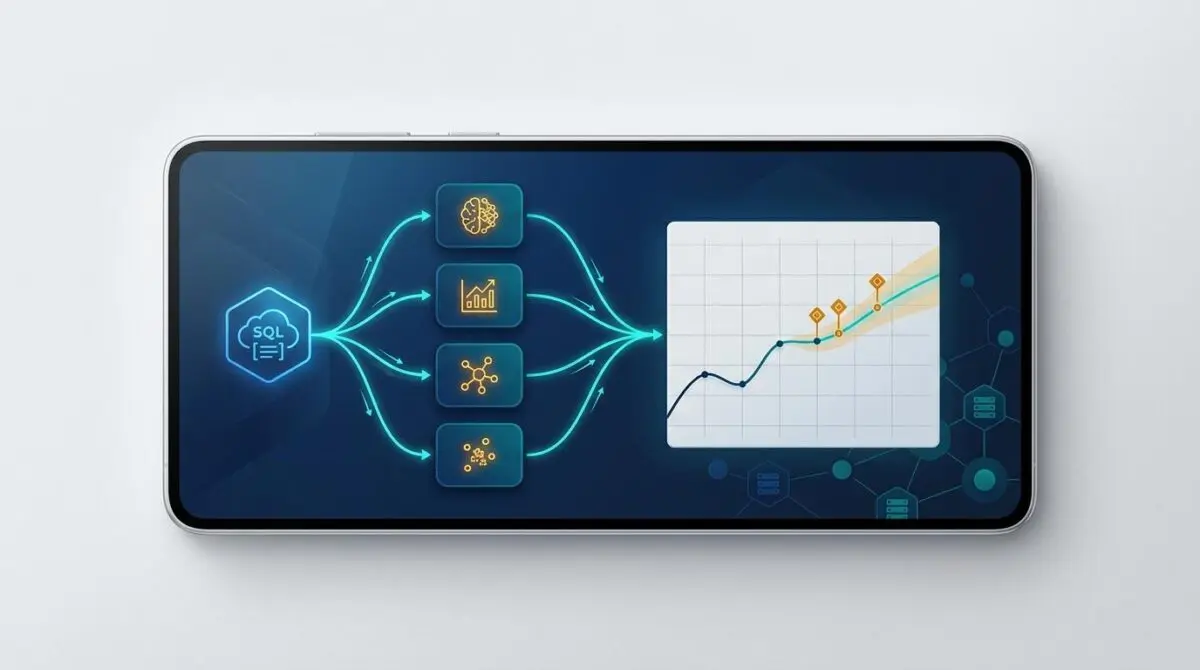
This release changes that economic equation by putting four foundation models behind two familiar Flink SQL functions — AI_FORECAST and AI_DETECT_ANOMALIES.
Four Models, One SQL Call, and the End of Pipeline Glue
The four-model portfolio covers the decision patterns enterprises actually face, rather than trying to force one architecture on every streaming workload.
- PatchTST-FM reads a series patch by patch and returns a full probability distribution, so planners can set thresholds off a chosen percentile instead of a single forecast line.
- FlowState keeps a running summary updated with every new point, with continuous-time dynamics that work across second-level SCADA telemetry and hourly market data.
- TTM replaces attention layers with compact mixing networks, allowing a low-parameter model to process thousands or hundreds of thousands of series nightly on CPU.
- TSPulse combines time-domain and frequency-domain views for anomaly detection, classification, gap-filling, and similarity search.
Switching between these models does not require a new pipeline or a different data store.
Users change a single SQL parameter in an AI_FORECAST or AI_DETECT_ANOMALIES call, and Confluent handles model serving, scaling, state management, and delivery through Kafka topics.
That design removes the glue code that usually connects data pipelines to model endpoints, and it keeps inference inside Confluent Cloud with no separate GPU infrastructure or cloud ingress and egress fees.
The models are deliberately small enough to run natively in the stream, and open weights are available on the Hugging Face Hub for teams that want to deploy on their own CPUs.
IBM Granite governance also carries model provenance and licensing transparency into the runtime.
The models arrive with more than 44 million downloads behind them, after IBM ran them in its own operations and with design partners in cement, steel, pulp and paper, food, and telecommunications.
IBM reports productivity gains of 5 to 10 times in those deployments, with forecasting, detection, optimization, and semantic intelligence arriving as functions rather than bespoke projects.
A grocery demand planner can point one shared model at a catalog of 100,000 SKUs, including items with no sales history, and receive distributional forecasts that feed replenishment, pricing, and markdown decisions.
A fraud analyst can score card transactions while they are still in flight, using a per-card sense of normal behavior that transfers across new products and corridors without waiting for labelled fraud cases.
Production engineers can use the same forecasts as a simulator, searching for operating setpoints that optimize energy, throughput, or yield against constraints they specify.
A Post-Acquisition Push When Enterprise AI Spending Is Shifting
This launch is not just a feature drop; it is a post-acquisition product move.
IBM completed its $11.6 billion acquisition of Confluent in March 2026, after Confluent had already crossed a $1 billion revenue run rate in late 2024.
The integration now turns Confluent’s streaming platform into a native delivery layer for IBM’s Granite models, which is precisely the kind of product synergy IBM signaled when it announced the deal.
IBM’s most recent quarterly report adds pressure to that strategy.
In July 2026, IBM reported second-quarter revenue of $17.2 billion, up only 1.1 percent year over year, while diluted earnings per share slipped to $2.30 from $2.36 a year earlier.
IBM had already warned in July that customer spending was rotating away from core software and mainframe deals toward AI infrastructure hardware such as servers, storage, and memory chips, delaying some large contract decisions.
Against that backdrop, a fully managed time-series intelligence layer inside Confluent Cloud gives IBM a way to attach AI value to operational data at the moment it is created, rather than waiting for customers to build a separate AI stack.
The early access also signals that IBM is aiming beyond individual model benchmarks and toward decision automation: forecasting, anomaly scoring, optimization, and semantic search packaged as functions that domain experts can call directly.
Time Series Intelligence Moves From Project to Function
For AI teams, the shift is from months of bespoke model building to SQL-level functions that run on live streams from day one, with early access open now at no charge. Teams turning real-time data into search-ready intelligence can apply the same automation discipline through Andres SEO Expert’s programmatic SEO and AI automation service — talk to the team here.
Frequently Asked Questions
What does the IBM Granite time series integration in Confluent Cloud offer to data teams?
The integration brings IBM Granite time series foundation models directly into Confluent Cloud, enabling teams to call forecasting and anomaly detection functions from Flink SQL on live streaming data without building bespoke models.
What are the four Granite time series foundation models available?
The four models are PatchTST-FM for distributional forecasting, FlowState for continuous-time dynamics, TTM for low-parameter CPU processing, and TSPulse for anomaly detection, classification, gap-filling, and similarity search.
How do AI_FORECAST and AI_DETECT_ANOMALIES simplify model deployment?
Users simply change a single SQL parameter in an AI_FORECAST or AI_DETECT_ANOMALIES call to switch between models, while Confluent handles model serving, scaling, state management, and delivery through Kafka topics.
How does the integration remove the need for separate GPU infrastructure?
The models are deliberately small enough to run natively inside Confluent Cloud, which eliminates separate GPU infrastructure, cloud ingress and egress fees, and the glue code usually needed to connect data pipelines to model endpoints.
Why is this launch tied to IBM’s recent Confluent acquisition?
IBM completed its $11.6 billion acquisition of Confluent in March 2026; the integration is a post-acquisition product move that makes Confluent’s streaming platform a native delivery layer for IBM Granite models amid shifting enterprise AI spending.
What enterprise use cases are demonstrated with these models?
Use cases include grocery demand planning across 100,000 SKUs, fraud analysis on in-flight card transactions, and production engineers using forecasts as simulators to optimize operating setpoints for energy, throughput, or yield.