Key Takeaways
- LangGraph gives Python teams unbounded graph control but leaves telemetry, retries, and credentials to DIY infrastructure.
- n8n offers visual auditability, workflow connectivity, and built-in observability, lowering maintenance for mixed teams.
- Total cost is engineering-hours, not licenses; the durable choice depends on your team’s future ability to maintain the system.
Table of Contents
The Production Agent Architecture Decision That Splits Engineering Teams
The choice between LangGraph and n8n has stopped being a question of whether an AI agent can be built. In 2026, both platforms carry enough horsepower to run production agentic systems.
n8n Lab’s analysis frames the decision as one between structural trade-offs: architectural control, production infrastructure, auditability, and long-term maintainability. The real question is where an engineering organization spends its operational cycles.
That makes this a decision for engineering leaders, not a debate between a developer tool and a basic no-code toy. Both LangGraph and n8n are legitimate enterprise-grade choices.
Where LangGraph and n8n Actually Diverge Under Load
As documented in n8n Lab’s comparison, the technical differences become visible only when agent logic moves beyond a simple sequential chain. LangGraph models workflows as stateful graphs in Python, with nodes for actions and edges for transitions.
LangGraph’s Code-First Edge and Its Hidden Cost
LangGraph is built on LangChain and gives engineers unbounded control over cyclical state management, multi-agent coordination, and custom persistence. That control is the reason Python-native teams choose it.
Its hidden cost is that it is a framework, not a platform. Production telemetry, retry logic, credential management, and deployment infrastructure remain the engineering team’s responsibility.
- Strongest fit: Bespoke multi-agent debate loops, dynamic routing, and deep Python ML integration.
- Weakest fit: Mixed teams that need visual auditability or built-in business-tool connectivity.
The absence of a native visual view also makes non-engineer review difficult. Teams without deep Python and LangChain fluency face a substantial ramp-up time.
n8n’s Built-In Production Surface and Its Limits
n8n approaches the same problem from the opposite direction: a node-based automation platform with mature AI Agent nodes. It supports tool-calling, multi-step reasoning, memory, and vector database integration out of the box.
Its visual canvas includes JavaScript and Python Code nodes, which makes it a hybrid tool rather than a locked no-code interface. That matters because it can absorb custom logic when the graph becomes complex.
- Strongest fit: Agents that need broad CRM, Slack, database, and ops-tool connectivity with minimal custom wrappers.
- Weakest fit: Deeply abstract algorithmic state manipulation where the visual node paradigm creates friction.
When logic becomes extremely bespoke, developers push computation into Code nodes. At that threshold the visual builder’s advantage shrinks for that specific segment, but the broader infrastructure benefits remain.
Total Cost of Ownership Is an Engineering-Hours Problem
License fees are a narrow way to compare these platforms. LangGraph is open source under the MIT license, while LangSmith’s Developer plan starts at $39 per seat per month for teams that want managed observability.
n8n’s Community Edition is free and self-hostable, with cloud plans starting at €20 per month and Pro at €50 per month. The self-hosted Business tier can run €667 per month for SSO and higher volume.
But the largest cost is engineering time. LangGraph teams must build credential vaults, execution dashboards, retry logic, and deployment pipelines internally, and that labor can consume thousands of dollars over one to three years.
n8n counts one execution as a complete workflow run, even when internal agent loops occur. That changes cost-per-query math for high-frequency automation teams, but it does not erase the cost of building LangGraph’s missing production layer.
For organizations that want production infrastructure without a DevOps build-out, self-hosted n8n can be materially cheaper in total cost of ownership. The variable is whether the team already owns mature Python infrastructure and LangChain expertise.
Maintainability Is the Quiet Decider
Maintainability often beats raw flexibility when a system must survive team turnover. A single-author LangGraph codebase with abstract cyclical state can become a liability if the principal engineer leaves.
n8n’s visual graph acts as living documentation, which is easier for product managers, operators, and junior developers to read. That reduces key-person risk for mixed teams.
But a stable Python and ML engineering group with mature CI/CD may find LangGraph’s lack of a platform ceiling more valuable. In that environment, introducing a visual platform could disrupt an already optimized workflow.
Market Data Forces a Reckoning on Code-First Versus Visual Orchestration
The agentic automation market is expanding fast enough to make this a board-level issue. MarketsandMarkets estimates the global AI agent market could climb from $7.8 billion in 2025 to more than $50 billion by 2030.
Gartner projects that 40% of enterprise applications will include task-specific AI agents by 2026, up from less than 5% in 2025. The same forecast carries a warning: over 40% of agentic AI projects may be scrapped by the end of 2027, usually because of cost or missing controls.
That failure rate is the real context for the LangGraph-versus-n8n decision. The risk is less about whether an agent can be built and more about whether the surrounding production controls and maintainability are funded correctly.
LangChain’s 2026 State of Agent Engineering report puts 57% of organizations in production with agents, up from 51% the prior year. McKinsey’s 2025 survey found only 23% of agents scaled beyond pilots, despite 62% of organizations experimenting.
This pilot-to-production gap is where n8n’s built-in telemetry and visual auditability reduce infrastructure burden. But Gartner has also estimated that 60% of organizations that start with low-code eventually need custom code.
That is the core tension: visual builders accelerate the first production release, while code-first frameworks offer a higher ceiling for bespoke logic. The market is not crowning a single winner; it is rewarding teams that match architecture to actual maintenance profiles and compliance surfaces.
Linux Foundation data suggests 68% of production AI agents run on open-source frameworks. Both LangGraph and n8n’s Community Edition fit that pattern, but the operational overhead of LangGraph’s DIY infrastructure still stalls teams that are not resourced for it.
Zapier’s AI research indicates 74% of stalled projects blame dependence on narrow, proprietary tools. Neither platform forces that dependence, yet LangGraph’s missing production layer can create its own form of stall for under-resourced engineering groups.
The 2026 Architect’s Path Through Agentic Infrastructure
The most expensive choice in 2026 is not picking the wrong platform; it is building an agent architecture your current team cannot maintain a year from now. LangGraph wins for stable Python teams with bespoke graph logic; n8n wins for mixed teams that need production infrastructure and business-system connectivity on day one. For teams formalizing agentic automation pipelines and content generation workflows, programmatic SEO AI automation is how Andres SEO Expert approaches that transition — start the conversation through contact.
Frequently Asked Questions
What is the core difference between LangGraph and n8n for production AI agents?
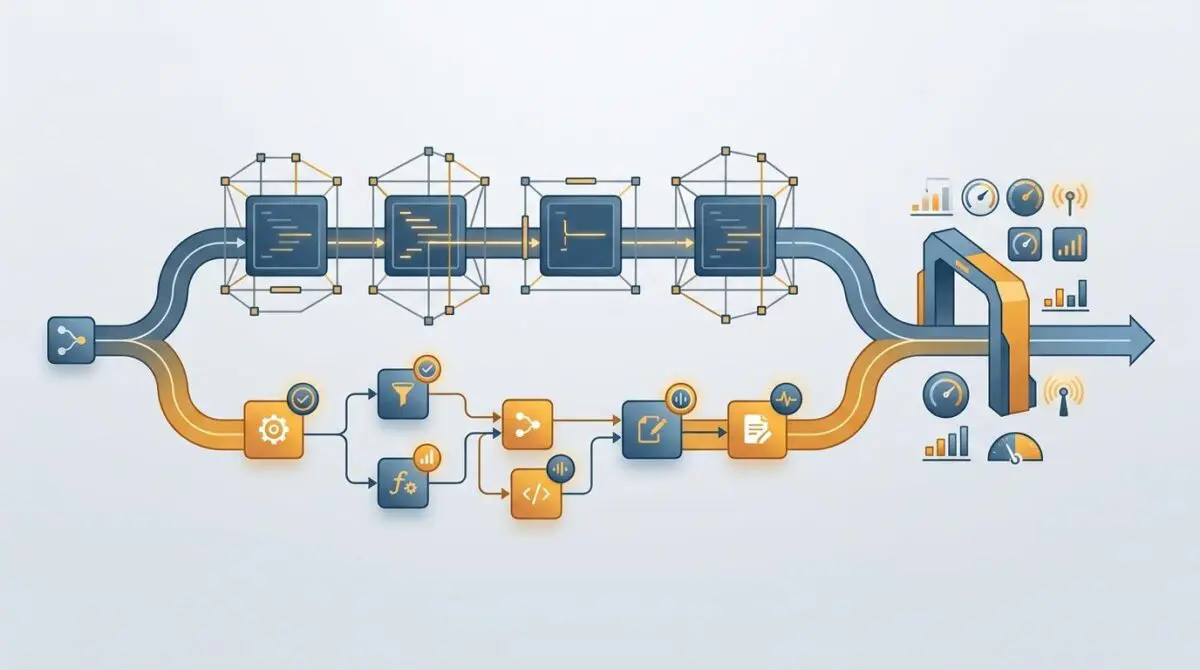
LangGraph is a code-first Python framework that gives engineers unbounded control over stateful graph workflows, multi-agent coordination, and custom persistence. n8n is a visual node-based automation platform with built-in AI Agent nodes, offering production infrastructure like telemetry and credential management out of the box.
When should engineering teams choose LangGraph over n8n?
LangGraph is the strongest fit for stable Python-native teams that need bespoke multi-agent debate loops, dynamic routing, and deep Python ML integration. It wins when the team already owns mature Python infrastructure, CI/CD, and LangChain expertise, and when the highest ceiling for custom code is required.
When is n8n a better fit than LangGraph?
n8n is better for mixed teams that need visual auditability, broad business-tool connectivity (CRM, Slack, database, ops tools), and built-in production infrastructure like retry logic and credential management on day one. Its visual graph acts as living documentation, reducing key-person risk and making it easier for non-engineers to review workflows.
How do LangGraph and n8n compare in total cost of ownership?
LangGraph is open source under MIT, but teams must build credential vaults, execution dashboards, retry logic, and deployment pipelines internally, which can consume thousands of dollars in engineering time. n8n’s Community Edition is free and self-hostable, with paid cloud plans starting at €20 per month. Self-hosted n8n can be materially cheaper when you consider the missing production layer in LangGraph.
What role does maintainability play in the LangGraph vs n8n decision?
Maintainability often beats raw flexibility. A single-author LangGraph codebase with abstract cyclical state can become a liability if the principal engineer leaves. n8n’s visual graph is easier for product managers, operators, and junior developers to read, which reduces key-person risk for mixed teams, while a stable Python team may prefer LangGraph’s lack of a platform ceiling.
What market data should architects consider when choosing between LangGraph and n8n?
Gartner projects 40% of enterprise applications will include task-specific AI agents by 2026, but warns over 40% of agentic AI projects may be scrapped by 2027 due to cost or missing controls. McKinsey found only 23% of agents scaled beyond pilots. This suggests the decision should focus on production controls and maintainability, not just raw build capability. Both platforms are open-source, aligning with Linux Foundation data that 68% of production AI agents run on open-source frameworks.
![Ultimate AI Agent Database Stack in 2026 [Full List + Comparison]](https://andresseo.expert/wp-content/smush-webp/2026/09/postgresql-first-agent-memory-earn-vector-graph-and-redis-when-needed-380x212.jpg.webp)