Key Takeaways
- Cloudflare’s new AI service pairs OpenAI Daybreak models with live traffic metadata to find active code risks.
- All fixes stay human-approved; the model can only suggest patches or WAF rules.
- Context-aware profiling proves whether a vulnerability is truly exposed, not just a static finding.
Table of Contents
Cloudflare Connects Code Risk to Live Attack Context
Cloudflare’s engineering team has published a detailed breakdown of Vulnerability Discovery and Remediation, a new invitation-only early access service inside Cloudflare Managed Defense that moves security teams from raw vulnerability counts to prioritized, evidence-backed fixes.
Running through OpenAI’s Daybreak Defense Network, the service pairs Daybreak models—including GPT-5.6 Cyber—with live traffic metadata, WAF controls, and Workers Observability data to find weaknesses in authorized codebases and propose both code patches and edge mitigations.
The customer remains the final decision point: Cloudflare proposes, engineering teams review, and nothing changes without explicit authorization.
Inside the Context-Aware Workflow
As outlined in Cloudflare’s engineering blog, Vulnerability Discovery and Remediation runs across Cloudflare Workers and proxied applications, but the core shift is contextual evidence rather than raw static findings.
Web Assets and WAF serve as the first two pillars, providing a snapshot of active routes, request volumes, and security events tied to those routes.
For Workers, the latest source version and configured routes are matched to Web Assets and Workers Observability metadata, tying the exact source under review to the endpoints it handles in production.
Routes carrying high request volume become hot paths, and code deployed there receives stricter security profiling.
From Route Context to Hot-Path Profiling
Source code analysis alone cannot show which routes reach a flaw, how much traffic they carry, or which protections already apply.
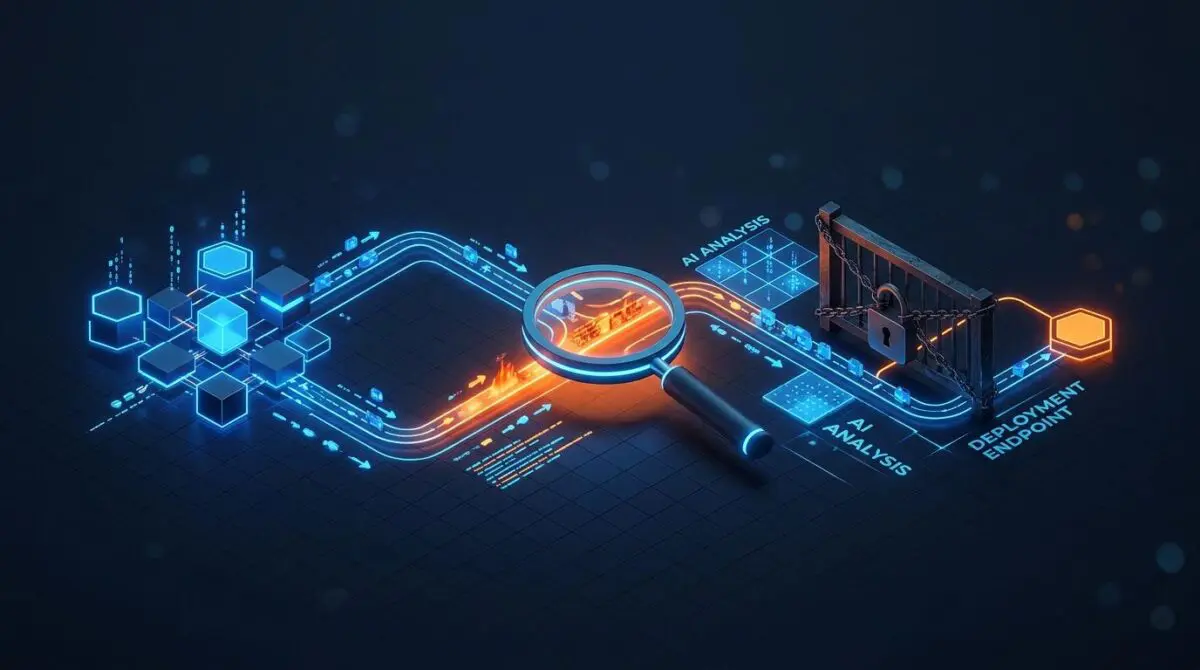
A reconnaissance agent maps request paths to code sections, and hunter agents inspect customer-authorized code with network context available to focus attention on active or recently targeted routes.
That context can direct scrutiny, but it never establishes a vulnerability; every finding must be corroborated by source-code evidence.
Validation then checks proposed mitigations and assigns an initial risk rating based on source code.
Network evidence—such as significant traffic or signs of active probing—can raise that rating further.
The result is a prioritized list, each item carrying a recommended code patch and, where supported, a scoped WAF Custom rule.
If a route pattern contains only variables and wildcards, Cloudflare declines to suggest a rule rather than claim a connection the evidence cannot support.
Where the Model Runs—and Where It Stops
The harness runs on Cloudflare and sends prompts through Cloudflare AI Gateway to OpenAI Daybreak models on OpenAI servers.
GPT-5.6 Cyber is used during reconnaissance, hunting, and validation, but no model inference runs at Cloudflare’s edge.
The model cannot apply any patch or rule it proposes; every change moves through review and validation.
Before context reaches the model, unnecessary data is removed and configured redaction controls are applied.
Source code, logs, and request metadata are treated as evidence, not instructions.
Tool access is logged and checked against the investigation’s access policy before each call, and proposals must pass checks implemented outside the model.
Edge-defense suggestions are validated against synthetic fixtures rather than customer traffic, and any failure halts the workflow before review.
Passing checks still does not change a customer environment; Cloudflare’s team validates output before the patch and rule are prepared.
The early access program is invitation-only through Managed Defense, starting with one authorized application per engagement and using read access to Web Assets, WAF controls, and Workers Trace Events Logpush where available.
The workflow is semi-automated, and customers review every result before deciding whether to test or deploy a change.
Why Agent Harnesses Are Redrawing Security Workflows
Cloudflare’s design places a hard boundary between model-generated proposals and production changes, which matters more as security teams face a widening gap between AI-accelerated discovery and operational capacity.
Recent industry analysis puts the share of AI tools able to complete a full occupational task at just 2.6 percent—a stark ceiling for any service that claims to reduce security workload rather than create a new review pipeline.
Vulnerability Discovery and Remediation is not positioned as fully autonomous remediation; it is a supervised harness that converts model output into scoped, validated actions.
That pattern fits a broader shift in AI infrastructure: the industry is moving beyond single-shot chatbot interfaces toward loops, squads, and harnesses that orchestrate multiple agents around a bounded workflow.
For AI and security professionals, the differentiator is not the model itself but the evidence layer around it—live route activity, existing WAF coverage, and detection triggers becoming part of the ranking logic.
A generic scanner can report a critical handler flaw; Cloudflare’s approach attempts to prove whether that code is deployed, actively reached, and currently unprotected.
That distinction may redefine what counts as a high-priority vulnerability inside large codebases.
From Finding to Fix, With Human Control Intact
Cloudflare’s early access program pushes security operations past the discovery bottleneck by making live production context part of the verdict—and by keeping final approval in human hands. For teams building agent-driven security and automation workflows that need to scale, programmatic SEO and AI automation is how Andres SEO Expert approaches operationalizing AI processes — contact the team.
Frequently Asked Questions
What is Cloudflare Vulnerability Discovery and Remediation?
Cloudflare Vulnerability Discovery and Remediation is an invitation-only early access service inside Cloudflare Managed Defense. It pairs OpenAI Daybreak models, including GPT-5.6 Cyber, with live traffic metadata, WAF controls, and Workers Observability data to find weaknesses in authorized codebases and propose code patches and edge mitigations.
How does Cloudflare Vulnerability Discovery and Remediation work?
The service runs a semi-automated workflow where reconnaissance agents map request paths to code sections and hunter agents inspect authorized code with network context. Each finding must be corroborated by source-code evidence, then validation checks proposed mitigations and assigns an initial risk rating. Network evidence can raise that rating, resulting in a prioritized list with recommended code patches and, where supported, scoped WAF Custom rules.
How does Cloudflare prioritize vulnerabilities?
It prioritizes by combining source-code evidence with live context: routes carrying high request volume become hot paths and receive stricter security profiling. Web Assets and WAF show active routes and security events, and Workers Observability ties source to endpoints. Network evidence such as significant traffic or active probing can also raise an initial risk rating.
What role do OpenAI Daybreak models play in the service?
The service uses OpenAI Daybreak models, including GPT-5.6 Cyber, for reconnaissance, hunting, and validation. Prompts are sent through Cloudflare AI Gateway to OpenAI servers; no model inference runs at Cloudflare’s edge. The model only proposes patches and rules and cannot enforce them.
Does Cloudflare automatically patch vulnerabilities?
No. Every proposed change must pass validation and review outside the model. The customer remains the final decision point, and nothing changes without explicit authorization. Cloudflare’s team validates output before patch and rule are prepared.
How does early access for Cloudflare Vulnerability Discovery and Remediation work?
Early access is invitation-only through Managed Defense, starting with one authorized application per engagement. It uses read access to Web Assets, WAF controls, and Workers Trace Events Logpush where available. The workflow is semi-automated, and customers review every result before testing or deploying.
How is this different from generic vulnerability scanners?
Generic scanners report flaws based only on source code; Cloudflare’s approach attempts to prove whether the code is deployed, actively reached, and currently unprotected. It integrates live route activity, existing WAF coverage, and detection triggers into ranking logic, connecting code risk to real attack context.