

Key Takeaways
- AI-GUIDE, a handheld AI-guided vascular access device from MIT Lincoln Laboratory and Massachusetts General Hospital, won the Federal Laboratory Consortium’s 2026 Excellence in Technology Transfer Award.
- The prototype reached a working proof-of-concept and spun out AutonomUS Medical Technologies in just three years, backed by FDA Breakthrough Device Designation, an Air Force SBIR grant, and NIH funding.
- Regulatory approval, real-world field validation, and scaled manufacturing remain unproven, while peripheral nerve block technology stays in the development pipeline.
Table of Contents
A hand-held trauma tool wins federal validation — and a startup path
MIT News reported on September 11 that the Federal Laboratory Consortium has selected AI-GUIDE for its 2026 Excellence in Technology Transfer Award.
The handheld catheterization device was developed jointly by MIT Lincoln Laboratory and Massachusetts General Hospital, with funding from the U.S. Army’s Combat Casualty Care Research Program.
The award certifies a technology transfer path that is already moving toward commercial deployment through AutonomUS Medical Technologies, the startup founded to bring the prototype to market.
It also places a clear institutional stamp on a device built for pre-hospital trauma response, where vascular access can determine survival before evacuation.
Why AI-GUIDE rewrites pre-hospital vascular access
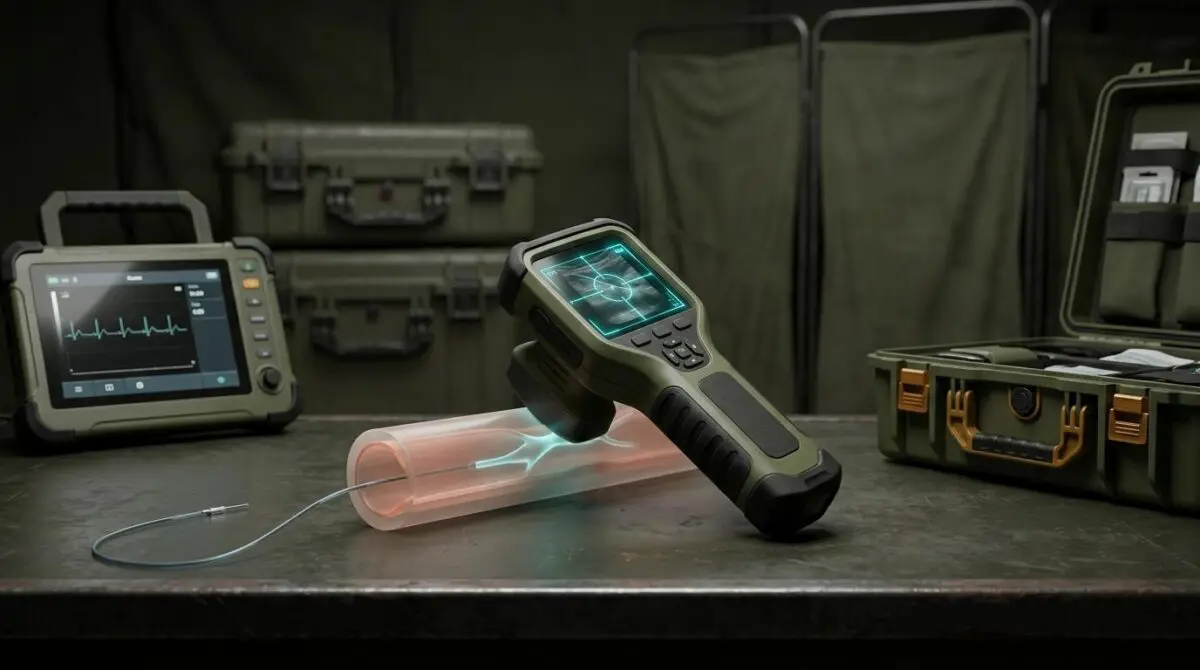
AI-GUIDE pairs custom-developed AI software with a commercial handheld ultrasound platform to help users insert a guidewire and catheter into a patient’s blood vessel.
That capability is designed for pre-hospital settings where traditional hospital ultrasound systems are too large and immobile for field use.
For military medics, the device can extend advanced vascular access far beyond fixed medical facilities, potentially keeping injured service members alive during extended evacuation windows.
The system is engineered so that personnel with minimal specialized training can perform interventions that would otherwise require hospital-level imaging and clinical support.
Clinical testing at Massachusetts General Hospital demonstrated the prototype’s viability before the team moved toward regulatory and commercial milestones.
That combination of portability, AI guidance, and low training burden is what differentiates AI-GUIDE from conventional hospital ultrasound equipment.
The technology transfer stack that moved from idea to startup in three years
AI-GUIDE moved from an idea proposed by the Combat Casualty Care Research Program to a fully working proof-of-concept with its own startup company in three years.
That speed reflects a coordinated handoff among MIT Lincoln Laboratory, Massachusetts General Hospital, the MIT Technology Licensing Office, and the Lincoln Laboratory Technology Transfer Office.
Once the prototype was developed, clinical testing at Massachusetts General Hospital validated its use case and paved the way for the founding of AutonomUS Medical Technologies.
The company then secured a U.S. Food and Drug Administration (FDA) Breakthrough Device Designation, a fast-track regulatory pathway reserved for highly innovative technologies with lifesaving potential.
Additional early-stage support included a Small Business Innovation Research grant from the U.S. Department of the Air Force, private investment, a defense research grant, and National Institutes of Health funding.
Key milestones include:
- FDA Breakthrough Device Designation: fast-track pathway for highly innovative, lifesaving technologies.
- U.S. Department of the Air Force SBIR grant: early government-backed commercialization funding.
- Private and federal research funding: support from defense and National Institutes of Health channels.
Lincoln Laboratory’s chief technology transfer officer Asha Rajagopal pointed to the alignment between operational need, clinical expertise, and engineering capability.
This recognition reflects what effective technology transfer looks like — aligning the Army’s operational need with Mass General’s clinical expertise and Lincoln Laboratory’s engineering capabilities to deliver a solution with a clear path to impact.
According to MIT News, the technology has also received a Lincoln Laboratory Best Invention Award and an R&D 100 Award.
Former Lincoln Laboratory staff member Matt Johnson now serves as vice president of engineering at AutonomUS, a personnel transfer that underscores the startup’s direct access to institutional knowledge.
Market pressure: defense health budgets meet portable AI diagnostics
The award lands at a moment when defense health agencies are under pressure to field portable, dual-use medical technologies that reduce medevac dependency and stabilize patients closer to the point of injury.
AI-GUIDE’s commercial pathway through AutonomUS suggests that federal laboratories are now treating medical device spinouts as full-fledged startup operations rather than research side projects.
The FDA Breakthrough Device Designation is more than a regulatory milestone; it is a market signal that can shorten development timelines and attract follow-on investment.
For business leaders in the defense health supply chain, the AI-GUIDE case illustrates how federal research dollars can be converted into intellectual property, startup equity, and civilian trauma-care products with a single coordinated transfer process.
Massachusetts General Hospital, Lincoln Laboratory, and AutonomUS have already moved the initial vascular access work forward, while additional capabilities, including peripheral nerve block technology for trauma care and pain management, remain in the development pipeline.
That pipeline turns a single device award into a broader trauma-care platform play, with implications for both military procurement and civilian emergency medicine.
What AutonomUS must prove next
What the award does not guarantee is regulatory approval or scaled manufacturing; AutonomUS still must prove the device in real-world field conditions and build production capacity.
For teams tracking AI medical device commercialization, programmatic SEO and AI automation helps surface the exact search demand behind companies like AutonomUS — contact Andres SEO Expert to build that intelligence engine.
Frequently Asked Questions
What is AI-GUIDE and what does it do?
AI-GUIDE is a hand-held catheterization device developed by MIT Lincoln Laboratory and Massachusetts General Hospital. It pairs custom AI software with a commercial handheld ultrasound platform to help users insert a guidewire and catheter into a patient’s blood vessel, enabling advanced vascular access in pre-hospital trauma settings.
Why is AI-GUIDE important for military medics and pre-hospital trauma care?
AI-GUIDE is designed for pre-hospital settings where traditional hospital ultrasound systems are too large and immobile. For military medics, it can extend advanced vascular access far beyond fixed medical facilities, potentially keeping injured service members alive during extended evacuation windows. It also allows personnel with minimal specialized training to perform interventions that would otherwise require hospital-level imaging and clinical support.
What award did AI-GUIDE receive from the Federal Laboratory Consortium?
The Federal Laboratory Consortium selected AI-GUIDE for its 2026 Excellence in Technology Transfer Award. The award certifies a technology transfer path that is already moving toward commercial deployment through AutonomUS Medical Technologies.
How did AI-GUIDE go from an idea to a startup in three years?
AI-GUIDE moved from an idea proposed by the U.S. Army’s Combat Casualty Care Research Program to a working proof-of-concept and startup in three years. That speed came from a coordinated handoff among MIT Lincoln Laboratory, Massachusetts General Hospital, the MIT Technology Licensing Office, and the Lincoln Laboratory Technology Transfer Office. Clinical testing at Massachusetts General Hospital validated the use case and paved the way for founding AutonomUS Medical Technologies.
What is AutonomUS Medical Technologies?
AutonomUS Medical Technologies is the startup founded to bring the AI-GUIDE prototype to market. It secured an FDA Breakthrough Device Designation and early-stage support including a U.S. Department of the Air Force SBIR grant, private investment, a defense research grant, and National Institutes of Health funding. Former Lincoln Laboratory staff member Matt Johnson serves as vice president of engineering at AutonomUS.
What is FDA Breakthrough Device Designation and why does it matter for AI-GUIDE?
FDA Breakthrough Device Designation is a fast-track regulatory pathway reserved for highly innovative technologies with lifesaving potential. For AI-GUIDE, it is both a regulatory milestone and a market signal that can shorten development timelines and attract follow-on investment.
What must AutonomUS prove next for AI-GUIDE to succeed?
The award does not guarantee regulatory approval or scaled manufacturing. AutonomUS must still prove the device in real-world field conditions and build production capacity. Additional capabilities, including peripheral nerve block technology for trauma care and pain management, remain in the development pipeline.