Key Takeaways
- Hetzner CCX41 dedicated vCPU tiers deliver production-grade compute for roughly one-third of a comparable DigitalOcean Droplet.
- Hostinger is fastest to a working n8n instance, but renewal pricing near $50 to $60 per month reshapes multi-year cost models.
- Managed AI agent layers now challenge the VPS assumption itself — the real cost variable is DevOps time, not the server invoice.
Table of Contents
The Real Cost of Self-Hosting AI Agents Is Not the Server
Growth-stage automation teams are hitting a hard wall.
SaaS platforms cap execution volume and data control precisely when production AI agent workloads begin to scale.
By September 2026, the Hetzner vs Hostinger vs DigitalOcean decision is no longer a thin pricing argument.
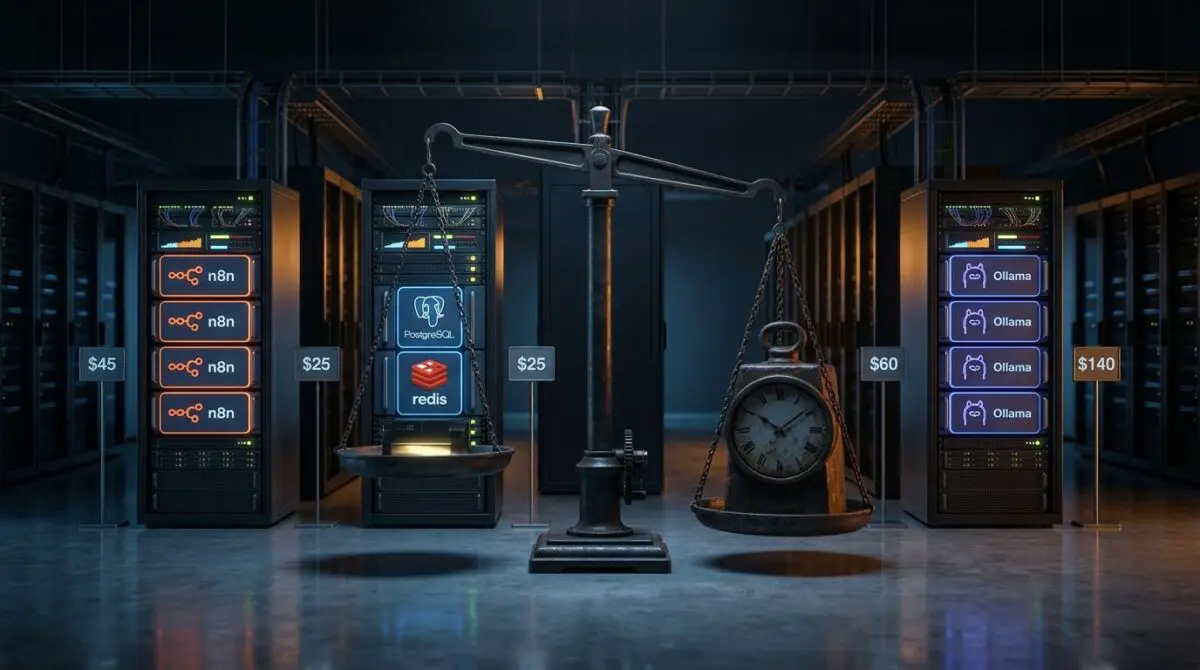
It is a strategic infrastructure bet involving n8n orchestration, PostgreSQL, Redis, and occasional local model inference through Ollama, as detailed in the n8nlab comparison.
Hetzner’s CCX41 dedicated vCPU tier delivers equivalent compute for roughly one-third of DigitalOcean’s cost at production specs.
Hostinger’s first-year pricing looks attractive, but renewal economics shift the long-term picture.
The real cost variable is DevOps time, not the server invoice.
Inside the Three-Way VPS Fight: Compute, Control, and Ecosystem
Hetzner, Hostinger, and DigitalOcean share a shortlist only because all three can run a Dockerized AI agent stack.
The decisive differences appear once n8n, PostgreSQL, Redis, and Ollama sit under sustained load.
Hetzner: The Performance Play with No Guardrails
Hetzner is a German provider whose CPX and CCX lines offer shared and dedicated vCPU instances on NVMe storage.
The CCX41 configuration, with 8 dedicated vCPUs and 32GB RAM, costs roughly $45 per month.
That dedicated-core design matters because n8n data processing loops stay consistent under heavy execution volume.
EU data residency is native across Nuremberg, Falkenstein, and Helsinki.
The tradeoff is operational: there is no beginner control panel, and support is ticket-based.
Hostinger: The Fastest Path to a Working Agent
Hostinger wraps KVM infrastructure in an AI-assisted hPanel and one-click templates for Docker and n8n.
That lowers first-deployment friction for solo founders and agencies without dedicated DevOps staff.
The KVM 8 plan carries an attractive promotional first-year price near $20 to $25 per month.
Renewal pricing rises to roughly $50 to $60 per month, which must be factored into multi-year cost models.
Hostinger has no GPU VPS plans, and higher KVM tiers do not guarantee dedicated-core performance in the same way as Hetzner’s CCX line.
DigitalOcean: The Developer Platform, Priced Accordingly
DigitalOcean built its reputation on developer experience, extensive documentation, and a native growth path into managed services.
A comparable General Purpose Droplet with 8 vCPUs and 32GB RAM runs about $140 per month.
Managed PostgreSQL, Redis, Kubernetes, and Spaces add operational leverage but increase total cost quickly.
GPU Droplets exist, but the pricing scales fast; for heavy local model hosting, Vultr remains the stronger specialist.
The platform wins for teams planning to move from one node to a distributed deployment inside a private VPC.
The Decisive Hardware and Operations Categories
No single provider wins every comparison column.
- Price-to-performance: Hetzner leads at production specs; DigitalOcean carries a meaningful premium.
- First-deployment speed: Hostinger is fastest for non-DevOps teams.
- Documentation: DigitalOcean remains the reference standard.
- EU data residency: Hetzner makes it the default posture.
- Managed databases: DigitalOcean is unmatched among the three.
- GPU availability: DigitalOcean is the least bad option, but Vultr is the actual specialist.
For a solo founder running 200 to 500 daily executions, Hostinger’s managed panel is the fastest route to a working n8n instance.
For an agency processing 10,000 or more daily executions with EU clients, Hetzner’s dedicated-core economics win.
For an engineering team planning managed databases and Kubernetes within 12 months, DigitalOcean justifies its premium.
The Managed AI Agent Wave Is Reshaping the Decision
Late August 2026 brought two signals that should change how automation teams evaluate these three providers.
New cost modeling from McKinsey’s QuantumBlack practice shows token spending is often only 20 to 25 percent of variable run costs for customer-facing agents.
Human oversight absorbs 70 to 75 percent of those costs.
For a banking customer-service workflow, the same research found completed onboarding costs can drop from $50 to $150 per customer down to $10 to $30 using agentic workflows.
The research also flags that customer-facing agent workflows in some banks reach $20,000 to $30,000 for a single agent and $100,000 to $200,000 for multiagent teams.
That math means a $45 Hetzner VM versus a $140 DigitalOcean Droplet matters, but it is not the largest line item in a serious agent deployment.
The larger economic lever is still operational discipline and orchestration capacity.
DigitalOcean’s Cloudways unit sharpened its positioning in August with the general availability of Managed AI Agents.
The service removes VPS provisioning, gateway configuration, and runtime patch responsibility for OpenClaw and Hermes deployments.
Each deployment is isolated, and Cloudways validates runtime updates before rollout.
A one-click MCP integration lets those agents act on servers and applications already running on Cloudways.
That is a direct challenge to the self-managed VPS assumption at the center of this comparison.
For teams that do not need deep control over PostgreSQL schemas, Redis queues, or custom n8n containers, a managed agent layer can compress the operational burden.
But for automations built on a tightly coupled n8n, PostgreSQL, Redis, and Ollama stack, the VPS remains the unit of architectural control.
Public entry-tier VPS pricing now starts as low as $2.50 monthly and clusters around $4 to $6 for Contabo, Hostinger, and Hetzner.
Hetzner has also seen recent price increases that narrow its low-end advantage, though its dedicated-core CCX tiers still hold the production price-to-performance lead.
Contabo continues to win the raw memory-to-dollar race, while Vultr holds the GPU scalability edge.
Strict contractual uptime requirements push the decision beyond these three providers entirely.
Infrastructure Choices That Survive Scale
The sustainable choice in 2026 is not the cheapest entry price or the richest dashboard; it is the platform that aligns compute cost, data residency, and operational capacity with the agent workload you will actually run.
For automation teams ready to separate infrastructure economics from DevOps burnout, Andres SEO Expert builds intelligent automation pipelines with that same production calculus — start with a consultation.
Frequently Asked Questions
Which VPS is best for self-hosting n8n AI agents in 2026?
It depends on your workload. Hetzner CCX41 with 8 dedicated vCPUs and 32GB RAM costs roughly $45 per month and leads on production price-to-performance. Hostinger is fastest for non-DevOps teams with its AI-assisted hPanel and one-click n8n templates, but renewal pricing rises to about $50 to $60 per month. DigitalOcean offers the best developer experience and managed services, but a comparable 8 vCPU and 32GB Droplet runs about $140 per month.
Is Hetzner cheaper than DigitalOcean for AI agent workloads?
Yes at production specs. Hetzner CCX41 delivers equivalent compute for roughly one-third of DigitalOcean cost, with 8 dedicated vCPUs and 32GB RAM around $45 per month versus about $140 per month for a comparable DigitalOcean General Purpose Droplet. However, the larger cost variable is DevOps time, not the server invoice.
What is the hidden cost of self-hosting AI agents on a VPS?
The hidden cost is DevOps time and operational discipline. You must manage n8n orchestration, PostgreSQL, Redis queues, runtime updates, scaling, and monitoring. McKinsey QuantumBlack cost modeling shows token spending is often only 20 to 25 percent of variable run costs for customer-facing agents, while human oversight absorbs 70 to 75 percent.
Does Hostinger support GPU VPS plans for local model inference?
No. Hostinger has no GPU VPS plans. For local model inference through Ollama, GPU availability becomes a separate infrastructure decision. DigitalOcean GPU Droplets exist but pricing scales fast, while Vultr remains the stronger specialist for heavy local model hosting.
Which provider is best for EU data residency and n8n automation?
Hetzner is the strongest default for EU data residency because Nuremberg, Falkenstein, and Helsinki are native locations. Its dedicated-core CCX economics also suit agencies processing 10,000 or more daily executions with EU clients. Hostinger and DigitalOcean can run the stack, but Hetzner makes EU residency a default posture rather than an add-on.
Are managed AI agents from DigitalOcean Cloudways a replacement for self-hosted VPS?
Not always. Cloudways Managed AI Agents remove VPS provisioning, gateway configuration, and runtime patch responsibility for OpenClaw and Hermes deployments, with isolated environments and one-click MCP integration. But if you need deep control over PostgreSQL schemas, Redis queues, or custom n8n containers, the VPS remains the unit of architectural control.
What VPS should a solo founder use for 200 to 500 daily n8n executions?
For a solo founder running 200 to 500 daily executions, Hostinger is the fastest route to a working n8n instance because its managed panel and templates lower first-deployment friction. The KVM 8 plan often starts near $20 to $25 per month in year one, then renews around $50 to $60 per month. As execution volume grows, evaluate Hetzner dedicated-core tiers for better production economics.