Key Takeaways
- The September 2026 n8n guide splits process orchestration into deterministic, dynamic, and agentic execution — and the model you pick shapes retries, failure isolation, and observability more than any tool choice.
- Salesforce’s EDGE framework hit 98.89% node trajectory consistency on a constrained agent, yet response consistency stayed between 2.25 and 3.13, proving structured transitions alone do not guarantee semantically reliable output.
- AMD PACE’s step-by-step deterministic replay and Microsoft’s minimal-complexity guidance converge on one bar: if you cannot replay an agentic run step-for-step, it is not production-grade.
Table of Contents
The Three Execution Models Reshaping Process Orchestration
Every production workflow ultimately commits to a hidden contract: how much autonomy the orchestrator can exercise when a process steps outside the expected path.
On September 11, 2026, the n8n team published a technical guide that splits that contract into three execution models — deterministic, dynamic, and agentic — and argues the choice determines retries, failure isolation, and observability more than any tool selection.
That distinction matters because process orchestration is no longer a simple debate between centralized and decentralized control. The execution model sets the fundamental guarantees for how a system handles decisions on its own.
For automation teams, choosing the wrong model turns a reliable pipeline into a fragile coordination layer — a risk the n8n process orchestration guide examines in detail.
Deterministic, Dynamic, and Agentic Execution Under the Hood
Process orchestration coordinates people, systems, and tasks through a central control plane. The orchestrator defines workflow logic, tracks progress, and manages exceptions across endpoints that often include legacy systems, modern APIs, and human approvals.
This coordination is most valuable for three process profiles: workflows with diverse endpoint dependencies, processes with complex conditional logic and exception paths, and long-running stateful operations that span hours or weeks.
In heterogeneous environments, n8n exposes more than 1,000 integrations and a flexible HTTP Request node to connect tools without custom middleware. The platform keeps logic separate from service endpoints so teams can coordinate across legacy and modern systems through a visual node-based interface.
For long-running stateful processes, the Wait node and execution history allow durable workflows to persist across hours or days and resume where they left off.
Deterministic Execution: Auditability at the Cost of Brittleness
Deterministic orchestration executes a fixed graph with predefined logic. Every path is mapped before runtime, which makes the model highly auditable and well suited to compliance-heavy processes.
That predictability has a structural downside. Anything outside the mapped execution triggers failure and often requires manual intervention or custom exception-handling logic to restore consistency.
Dynamic Execution: Real-Time Feedback With Moving State
Dynamic orchestration adjusts workflow paths based on feedback from real-time conditions and changing business needs. It fits shifting workloads and resource constraints in cloud or edge environments.
State management becomes harder because the orchestrator continuously readjusts. Failures are also more difficult to diagnose since autonomous decisions can create downstream issues that standard monitoring tools cannot easily trace.
Agentic Execution: Autonomy Inside Strict Guardrails
Agentic orchestration blends deterministic steps with autonomous AI agents. Predictable work follows predetermined logic while unstructured tasks are delegated to agents that can act without preset instructions.
In n8n, AI agent nodes allow agentic execution within the deterministic guardrails of a larger workflow. That structure provides flexibility for complex case management while preserving more transparency than a purely dynamic model.
Agent decisions still carry uncertainty. The guide recommends configuring structured outputs that include underlying reasoning alongside agent responses to improve explainability.
Four Production Failure Points Engineers Keep Hitting
Production orchestration tends to fail in four predictable places.
- Orchestrator bottlenecks: Centralized engines can stall under high event volumes unless they use event-streaming and a single-writer principle.
- State corruption or partial failure: Broken multi-step workflows leave systems inconsistent; saga patterns can roll back completed steps.
- Schema drift across services: Independent API changes break downstream integrations; schema registries and separation of logic from endpoints help.
- Debugging distributed failures: Low visibility makes root-cause analysis difficult; observability metadata over the orchestration layer is the fix.
n8n addresses these failure points through a visual control plane that exposes conditional branches and merges. The Code node supports native JavaScript and Python for complex transformations, while execution history captures full data flow, LLM prompts, and completions for every action.
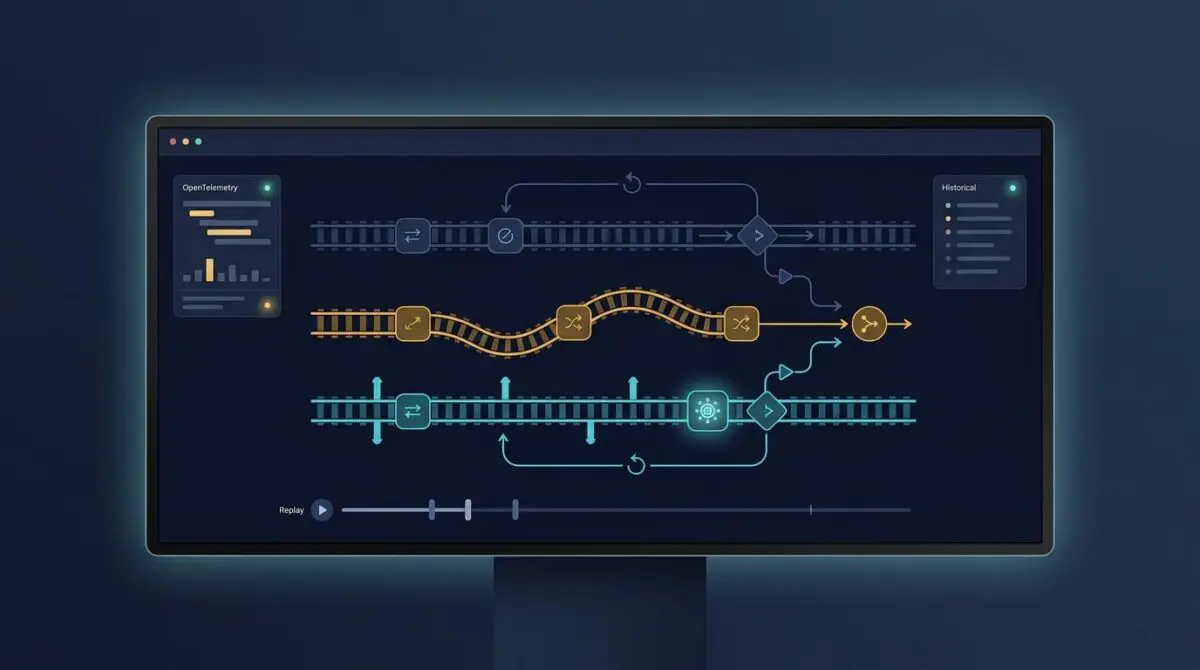
For distributed systems, n8n can export executions to OpenTelemetry and connect to LLM tracing platforms such as LangSmith. Those capabilities make AI agent nodes auditable at the step level.
What New Evaluations Reveal About Consistency and Production Trust
The real tension in orchestration is not whether agents can act autonomously. It is whether the system can prove that a given run is consistent, reproducible, and safe to operate at production scale.
A Salesforce-authored paper published on arXiv introduces EDGE, a framework that evaluates determinism and behavioral consistency in graph-based agent orchestration using a domain-specific language called AgentGraph.
EDGE exhaustively enumerates conversational paths through a depth-first traversal of the agent graph. It then replays those paths exactly and with linguistic variants to compare outputs and state transitions against the DSL specification.
The results are telling. A recruitment agent with constrained node transitions reached 98.89% node trajectory consistency and 98.62% node trajectory coverage, while an unconstrained baseline scored 90.19% and 91.88%. A Honda dealer LangGraph agent with only four nodes dropped to 78.89% consistency.
Yet response consistency scores remained low across the board: 2.25 to 3.13 on the paper’s scale. That gap confirms a critical caveat: structured transitions improve deterministic execution, but high trajectory consistency does not guarantee semantically consistent responses.
AMD PACE Targets Non-Determinism With Step-by-Step Replay
AMD’s official technical article now positions PACE as an agentic AI orchestrator with LangGraph as its native orchestration layer. It dispatches nodes, routes edges, shares threaded state, and manages tool calls while mapping LLM execution to optimized CPU backends or external accelerators.
The most relevant capability for automation teams is deterministic replay mode. PACE records the full trace, including graph state, prompts, sampling parameters, tool inputs and outputs, and event ordering, then re-executes the graph to reproduce the run step-for-step.
AMD reports operator-level speedups from 7.2x to 10.0x and end-to-end speedups from 1.02x to 2.20x on WebVoyager using Qwen3-VL-8B-Instruct on AMD EPYC 9755 CPUs and Radeon AI PRO R9700S GPUs. These are vendor-published benchmarks, but the architecture signal is clear: reproducibility is becoming a first-class orchestration feature.
Microsoft Makes the Case for Minimal Orchestration Complexity
Pure AI’s conversation with Microsoft Director of AI Solution Engineering Jocelynn Hartwig reinforces that orchestration should start with the lowest complexity that can reliably meet workload requirements.
That guidance moves from a direct model call, to a single agent with tools, to multiagent orchestration only when the coordination overhead is justified. The first architectural question should be whether a deterministic rule, function, or conventional workflow can produce the required result consistently.
Microsoft’s shared-responsibility direction also emphasizes constrained agent scope, planning and iteration limits, least privilege for tools, and human approval for high-impact or irreversible operations. The most cited production surprise is how much operational surface area orchestration creates, from state management and retry policy to observability and guardrail enforcement.
n8n’s approach sits inside this landscape: a visual control plane for deterministic orchestration with agentic nodes for autonomous steps, execution history for tracing, and OpenTelemetry exports for distributed observability. It is not the only path, but it aligns with the pattern that reproducibility and auditability now define production readiness.
The Observability Mandate for Automation Leaders
The newest evidence pushes toward a shared requirement: if you cannot replay an agentic run step-for-step and trace every state transition, you do not have a production-grade automation system.
For teams building process orchestration pipelines that need deterministic guardrails, agentic flexibility, and full execution observability, Andres SEO Expert’s AI automation engineering is how the work gets production-ready — contact the team.
Frequently Asked Questions
What are the three execution models reshaping process orchestration?
The three execution models are deterministic, dynamic, and agentic. Deterministic orchestration follows a fixed, predefined graph; dynamic orchestration adjusts paths based on real-time feedback; and agentic orchestration blends deterministic steps with autonomous AI agents under guardrails.
What is deterministic orchestration and when is it best used?
Deterministic orchestration executes a fixed graph with mapped paths before runtime. It is highly auditable and best for compliance-heavy or repeatable processes, but it can be brittle when exceptions occur outside the mapped execution and may require manual intervention or custom exception handling.
How does dynamic orchestration differ from deterministic orchestration?
Dynamic orchestration adjusts workflow paths based on real-time conditions and changing business needs, while deterministic orchestration follows predefined logic. Dynamic models fit shifting workloads, but state management and failure diagnosis become harder because autonomous decisions can create downstream issues.
What is agentic orchestration and how does it work in n8n?
Agentic orchestration combines deterministic workflow steps with autonomous AI agents. In n8n, AI agent nodes run inside the deterministic guardrails of a larger workflow, allowing unstructured tasks to be delegated while keeping more transparency than a purely dynamic model. Structured outputs with reasoning can improve explainability.
What are the most common production failure points in process orchestration?
The four common failure points are orchestrator bottlenecks under high event volume, state corruption or partial failure in multi-step workflows, schema drift across services, and debugging distributed failures with low visibility. Event streaming, saga patterns, schema registries, and observability metadata help address them.
Why is observability critical for agentic workflows in production?
Observability is critical because production-grade automation requires replaying an agentic run step-by-step and tracing every state transition. Without execution history, LLM prompt and completion logs, OpenTelemetry exports, and step-level tracing, teams cannot prove consistency, reproducibility, or safe operation at scale.
What do EDGE and AMD PACE reveal about determinism in AI orchestration?
EDGE evaluates determinism and behavioral consistency in graph-based agent orchestration and shows that constrained transitions improve trajectory consistency, though response consistency can remain low. AMD PACE adds deterministic replay mode that records graph state, prompts, tool inputs and outputs, and event ordering to reproduce runs step-for-step, signaling that reproducibility is becoming a first-class orchestration feature.