

Key Takeaways
- ROS 2 Lyrical’s rosidl::Buffer plus NVIDIA’s CUDA backend let eligible nodes move image payloads with zero copy, falling back to CPU automatically.
- Isaac ROS 5.0 ships every node consuming the CUDA buffer backend, turning GPU-resident transport into a deployable default for edge robotics.
- The migrate-node-to-rosidl-buffer skill turns the refactor into a repeatable agent workflow that preserves the public ROS interface.
Table of Contents
Zero-Copy ROS 2 Transport Moves From Experiment to Edge Deployment
A new technical walkthrough from NVIDIA Developer Blog details how an AI coding agent can accelerate a ROS 2 node without rewriting its core algorithm.
The target is the Depth Anything 3 TensorRT node, a GPU-native monocular depth estimator already optimized for CUDA inference.
The bottleneck is not the model itself. It is the ROS 2 boundary around it, where payload-sized image data moves through CPU memory even when both producer and consumer could operate in CUDA memory.
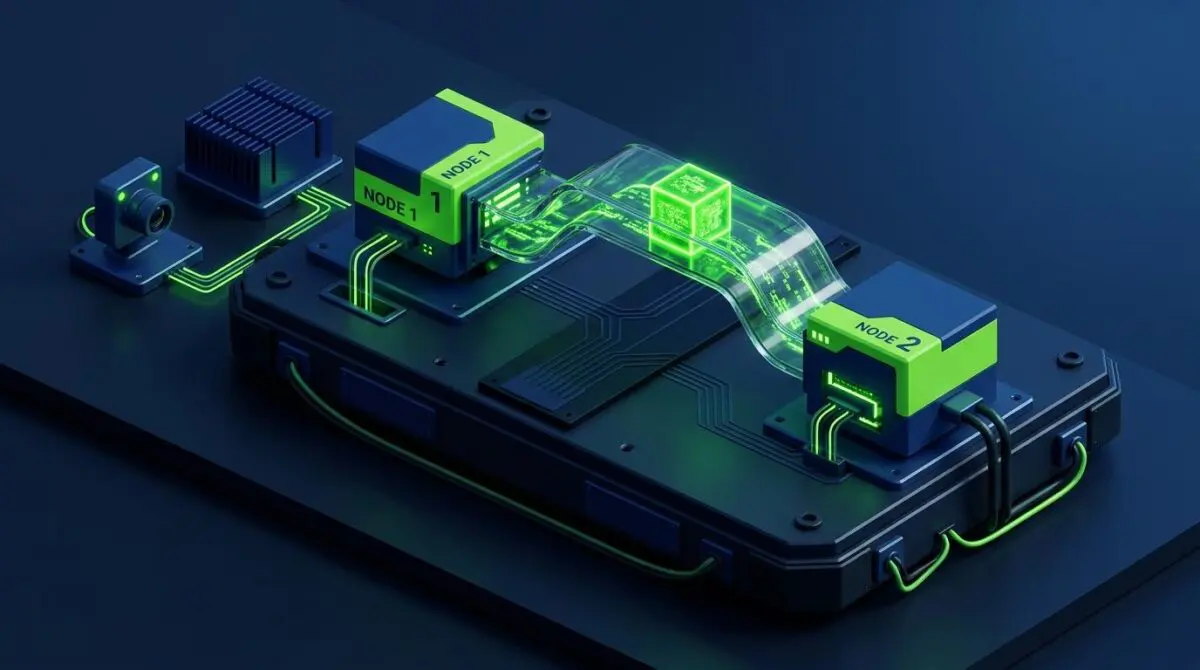
The enabling mechanism is the upstream rosidl::Buffer abstraction and a CUDA buffer backend contributed to ROS 2 Lyrical. When publisher and subscriber meet runtime conditions, the payload can move between nodes with zero copy.
NVIDIA Isaac ROS 5.0 ships with every node updated to consume the CUDA buffer backend. That shift turns GPU-resident message transport from a research concept into a deployable default for edge robotics.
Inside the rosidl::Buffer Migration Workflow
As detailed in the NVIDIA Developer Blog, ROS 2 Lyrical now represents variable-length primitive arrays such as uint8[] through the rosidl::Buffer<uint8_t> type in generated C++ code. The CPU-backed default mirrors the std::vector-style API that existing ROS 2 code already expects, while platform vendors can provide externally managed storage without introducing separate message types.
NVIDIA contributed a CUDA buffer backend that uses CUDA Virtual Memory Management for rosidl::Buffer<uint8_t> storage. When publisher and subscriber run on the same host and CUDA device under the same Linux user with a supported RMW implementation, the transport skips serialization and host copies.
If those conditions are absent, ROS 2 automatically switches back to the conventional CPU path. That fallback keeps compatibility with existing nodes and makes the optimized route optional.
The migrate-node-to-rosidl-buffer skill turns the process into a repeatable workflow. It logs the starting revision, follows each message field across callbacks and helper libraries, performs a read-only copy-boundary audit, and designs the smallest patch that preserves the interface.
For the Depth Anything 3 node, the public ROS contract does not change. The node still publishes sensor_msgs/msg/Image, but the data field now accepts CUDA-backed storage through subscription options.
On the output side, allocate_buffer gives the standard Image.data field CUDA-backed storage. The TensorRT wrapper then writes the final 32FC1 depth result straight into that allocation through a write handle tied to the active CUDA stream.
Local CPU consumers for point clouds and debug visualization are kept as explicit side paths. They do not define the representation sent on the depth topic.
- Subscription options forward acceptable buffer backends to the image transport topology.
- CUDA allocation replaces host allocation for the output image payload.
- Stream-aware handles extract input and output pointers safe for the TensorRT stream.
- CPU fallback remains handled by the backend rather than separate callback branches.
NVIDIA Nsight Systems can verify that no payload-sized host-device transfer appears at the ROS boundary for an eligible CUDA path. A test subscriber can also confirm active backend negotiation by checking that msg->data.get_backend_type() returns ‘cuda’.
Because backends are packaged as ROS 2 plugins, building and sourcing cuda_buffer_backend is sufficient to make the capability available at runtime. There is no need to rebuild ROS 2 core packages.
What CUDA-Backed Message Transport Changes for Robotics AI
The deeper shift here is not the CUDA backend itself. It is the use of an AI coding agent to perform a boundary audit that would otherwise demand deep ROS 2 middleware expertise.
Instead of generating a template or rewriting code broadly, the migrate-node-to-rosidl-buffer skill directs the agent to preserve the node contract, trace memory ownership, and verify fallback behavior independently. That makes the migration repeatable across an entire robotics stack rather than a one-off refactor.
For robotics AI teams, this changes the optimization calculus. A GPU-native perception or inference node can now adopt zero-copy transport with minimal interface changes, while keeping CPU fallback as a default for incompatible peers.
On NVIDIA Jetson AGX Thor, that combination matters most at the edge. Perception, inference, and autonomy workloads frequently share the same host and device, which aligns with the backend’s co-located runtime requirements.
The caveat is that the optimized path is conditional. Separate-process transport, RMW selection, and backend negotiation still need independent validation in production deployments.
Yet the direction is clear: ROS 2 data paths are following the same GPU-resident trend that already transformed computer vision and simulation pipelines. A measurable reduction in host transfers at the ROS boundary removes one of the last architectural excuses for keeping robotics data on the CPU.
Closing the Gap Between GPU Kernels and Robot Data Paths
The Depth Anything 3 migration shows that a ROS 2 node can preserve its public interface while eliminating payload-sized CPU copies. For robotics teams, the immediate win is not a new algorithm but a faster, cleaner path from CUDA inference to the next node. For teams building AI agent workflows that need to scale beyond a single migration, Andres SEO Expert’s programmatic SEO and AI automation service applies the same repeatable-agent discipline to technical content and search infrastructure — start the conversation here.
Frequently Asked Questions
What is zero-copy ROS 2 transport and why does it matter for robotics AI?
Zero-copy ROS 2 transport lets message payloads move between nodes without CPU memory copies or serialization when both endpoints share a CUDA device and compatible runtime conditions. It matters because GPU-native perception and inference nodes, such as depth estimators, can avoid payload-sized host-device transfers at the ROS 2 boundary, reducing latency and CPU overhead.
What is rosidl::Buffer in ROS 2 Lyrical?
rosidl::Buffer is an abstraction in ROS 2 Lyrical that represents variable-length primitive arrays, such as uint8[], in generated C++ code. Its default CPU-backed implementation mirrors the std::vector-style API existing ROS 2 code expects, while platform vendors can supply externally managed storage, like CUDA memory, without creating separate message types.
When does ROS 2 use the CUDA buffer backend instead of the CPU path?
The CUDA buffer backend activates when the publisher and subscriber run on the same host and CUDA device, under the same Linux user, with a supported RMW implementation. If any condition is missing, ROS 2 automatically falls back to the conventional CPU path, preserving compatibility with existing nodes. NVIDIA Isaac ROS 5.0 ships with every node updated to consume this backend, making GPU-resident transport a deployable default for edge robotics.
How does the migrate-node-to-rosidl-buffer skill simplify ROS 2 migration?
The migrate-node-to-rosidl-buffer skill turns migration into a repeatable workflow. It logs the starting revision, follows each message field across callbacks and helper libraries, performs a read-only copy-boundary audit, and designs the smallest patch that preserves the node’s public interface.
Does the Depth Anything 3 TensorRT node change its ROS 2 public interface?
No. The node still publishes sensor_msgs/msg/Image, and its public ROS contract remains unchanged. The data field now accepts CUDA-backed storage through subscription options, and the TensorRT wrapper writes the final 32FC1 depth result directly into that allocation via a stream-aware write handle.
How can you verify that zero-copy CUDA transport is active?
You can use NVIDIA Nsight Systems to confirm that no payload-sized host-device transfer appears at the ROS boundary for an eligible CUDA path. A test subscriber can also check that msg->data.get_backend_type() returns ‘cuda’, which confirms active backend negotiation.
What are the caveats of CUDA-backed ROS 2 message transport?
The optimized path is conditional. Separate-process transport, RMW selection, and backend negotiation still require independent validation in production. CPU fallback remains the default for incompatible peers, and the CUDA route is currently best suited to co-located workloads, such as those on NVIDIA Jetson AGX Thor.