Key Takeaways
- Agent evaluation now scores the final environment state, not just whether the right tool was called.
- Step-level traces guide debugging, but end-to-end task success is what production release gates should measure.
- Public benchmarks expire fast — pass@k versus pass^k gaps show why domain-specific internal suites are replacing leaderboards.
Table of Contents
The End of the Single-Call Safety Net
NVIDIA’s engineering team published a technical guide on September 21, 2026 that resets how AI agents should be judged. The central argument is that scoring a model on isolated tool calls creates a false sense of reliability.
Agents now operate across multistep workflows, call tools, observe results, and recover from failures. A single output string cannot capture whether the underlying work actually finished.
The new evaluation standard therefore tracks state across a live execution environment. Scoring whether an agent chooses and populates the right function is only the entry point, not the outcome.
Stateful Traces and the Two Scoring Layers Running on Top
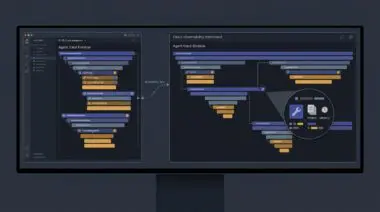
As NVIDIA’s technical guide explains, modern agent evaluation requires a full execution environment that executes each tool call, updates state, and reads the resulting world state. The trace becomes the foundation for every metric that follows.
A trace is the ordered log of a single attempt: the user message, each step, and the final environment state. Process scoring grades the rows of that trace, while end-to-end scoring grades the final state.
Step-Level Versus End-to-End Scoring
Step-level process scoring asks whether a call was valid, relevant, and useful at the moment it occurred. It reveals exactly where a chain of actions breaks.
End-to-end outcome scoring ignores the path and checks only whether the final state matches the goal. Did the refund post, did the database update, did the ticket route correctly?
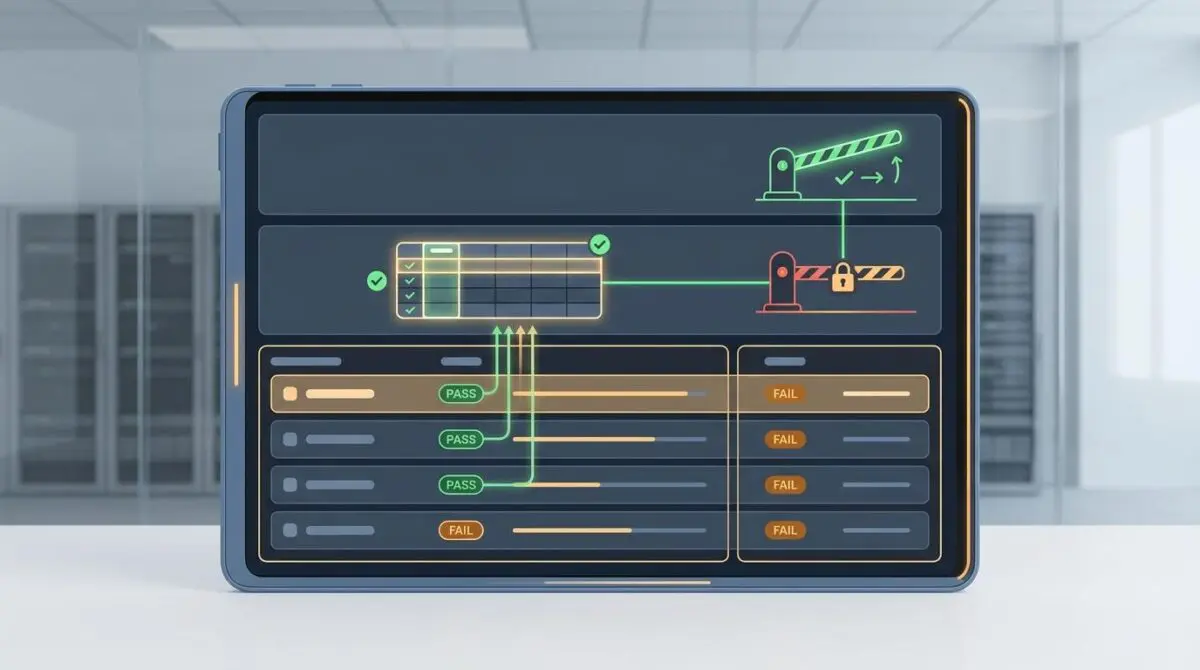
Both readings matter for different reasons. Step-level traces guide debugging and fine-tuning priorities; end-to-end scoring is what users actually experience and what most production releases gate on.
The Benchmark-Trial-Task-Turn-Step Rollup
Every benchmark run rolls through a fixed hierarchy: benchmark, trial, task, turn, and step. Each level defines a different granularity of measurement.
A trial is one independent pass over the full task set. A task is one scorable problem instance identified by a task ID.
A turn is an exchange boundary, while a step is an atomic action inside that turn. A step is usually a tool call, and every score above it rolls up from those calls.
The framework groups the core metrics into three axes: accuracy, verbosity, and cost.
- Task success rate: successful tasks divided by total tasks; the release gate that confirms the environment reached the goal state.
- Consistency range: success rate spread across three to five trials; a 90 percent and 74 percent split is not an 84 percent model.
- Tool-call precision: correct calls divided by calls issued; surfaces hallucinated names and unnecessary calls.
- Argument accuracy: correct arguments divided by calls with the right tool; separates wrong API selection from wrong slot filling.
- Steps per success: steps divided by successful tasks; measures how long a trajectory runs when it works.
- Cost per success: spend divided by successful tasks; turns tokens and GPU-seconds into an economic unit.
Metrics, Rollups, and Why Two Benchmarks Rarely Compare
Pairing metrics is non-negotiable. Success rate without consistency is only a point estimate on a stochastic system.
Tool-call precision without argument accuracy hides slot-filling failures. A model can pick the right API and still fill it with malformed parameters.
Step count is often the axis that varies most across models on the same task. Four steps versus fifteen steps can signal a materially different cost and failure profile.
Three Dimensions That Break Comparability
Two benchmarks can both claim to measure tool calling and still produce numbers that should not be compared. The gap usually comes down to task complexity, environment statefulness, and verification methodology.
Task complexity ranges from single-turn with one tool to multistep planning with error recovery. Statefulness determines whether a benchmark can surface drift, context loss, or corrupted state.
Executable verification, such as checking whether a database row changed or a test passed, is the gold standard. Reference-based evaluation requires maintained answer sets, while LLM-as-judge scores remain provisional until validated against human ratings.
Contamination Has Become a Live Problem
Benchmark contamination is no longer limited to pretraining data leakage. Web-searching agents can retrieve answer keys during evaluation, and public Hugging Face datasets can quickly be re-scraped into training corpora.
Private domain evaluations solve part of this by being impossible to scrape. That is one reason enterprise teams are shifting toward internal test suites built from real tickets and APIs.
Nemotron 3.5 Lightning and the Customer Reality Gap
Nemotron 3.5 Lightning’s published results are most useful when read as task completion and time-to-done rather than isolated accuracy. On PinchBench, the model reaches 86 percent accuracy while finishing 10,000 tasks 30 percent faster than Qwen3.6 35B at comparable accuracy.
That efficiency claim matters because an agent that reaches a goal in fewer steps can beat a higher-scoring model that burns extra tokens and time. But public scores are not release gates.
External research adds another layer of caution around single-run success rates. Splunk’s evaluation research distinguishes pass@k, where at least one of k runs succeeds, from pass^k, where every run must succeed.
In one cited computer-use benchmark, an agent hit about 78 percent pass@10 but only 36 percent pass^10. That gap shows how an agent can look capable while being too inconsistent to ship.
Arize’s evaluation research similarly warns that a confident final answer can hide wrong tool selection, ignored errors, or a database update applied to the wrong order. Path-level checks are what turn those hidden failures into diagnostic evidence.
The Aging Public Benchmark Problem
A published trace from SWE-bench Verified remains useful for illustrating rollup mechanics. But Splunk’s guidance notes that the suite should no longer be treated as a dependable frontier metric.
That judgment follows an OpenAI benchmark audit that examined 27.6 percent of problems and found at least 59.4 percent of audited items had flawed tests that rejected functionally correct submissions. For coding workflows, the stronger current options are SWE-bench Pro or SWE-bench-Live.
GAIA v1 is also aging out, with Gaia2 emerging as the replacement in changing environments. The broader lesson is that static leaderboards carry an expiration date.
Governance pressure is rising in parallel. Splunk points to a Gartner forecast that 40 percent of enterprises will demote or decommission autonomous AI agents by 2027 after governance gaps surface in production.
Release Gates Are Moving Into Your Own Infrastructure
The practical shift is now unambiguous: enterprise deployment should prioritize domain-specific evaluations built from real tickets, traces, and APIs, gated on environment state rather than isolated call accuracy. For teams building AI agent evaluation pipelines that need to scale, programmatic SEO AI automation is how Andres SEO Expert approaches the underlying data and content infrastructure — contact us.
Frequently Asked Questions
What is the new standard for evaluating AI agents instead of single tool calls?
NVIDIA’s September 21, 2026 technical guide argues that scoring isolated tool calls creates false reliability. The new standard tracks state across a live execution environment, executing each tool call, updating state, and reading the resulting world state. The trace becomes the foundation for every metric that follows.
What is a stateful trace in AI agent evaluation?
A stateful trace is the ordered log of a single attempt: the user message, each step, and the final environment state. It allows process scoring to grade each row of the trace and end-to-end scoring to grade the final state, revealing where a chain of actions breaks.
What is the difference between step-level and end-to-end scoring?
Step-level process scoring asks whether a call was valid, relevant, and useful at the moment it occurred. End-to-end outcome scoring ignores the path and checks only whether the final state matches the goal, such as whether a refund posted or a database updated.
What key metrics are used in AI agent evaluation?
Core metrics are grouped into accuracy, verbosity, and cost. They include task success rate, consistency range, tool-call precision, argument accuracy, steps per success, and cost per success. These roll up from the benchmark-trial-task-turn-step hierarchy.
Why are two AI agent benchmarks rarely comparable?
Comparability breaks down across task complexity, environment statefulness, and verification methodology. Executable verification is the gold standard, while reference-based evaluation requires maintained answer sets and LLM-as-judge scores remain provisional until validated against human ratings.
What is the difference between pass@k and pass^k?
Pass@k means at least one of k runs succeeds. Pass^k means every run must succeed. In one cited computer-use benchmark, an agent hit about 78 percent pass@10 but only 36 percent pass^10, showing how an agent can look capable while being too inconsistent to ship.
How should enterprises evaluate AI agents for release?
Enterprise deployment should prioritize domain-specific evaluations built from real tickets, traces, and APIs, gated on environment state rather than isolated call accuracy. Public benchmarks like SWE-bench Verified are aging out, and governance pressure is rising, with Gartner forecasting that 40 percent of enterprises will demote or decommission autonomous AI agents by 2027.