Key Takeaways
- TensorRT multi-device integration in Dynamo-Triton lets one KIND_MODEL instance own eight GPUs behind a single gRPC endpoint, so callers never manage ranks or per-GPU streams.
- Cosmos 3 Nano video generation falls from 156.6 seconds on one GPU to 34.2 seconds on eight, a 4.58x end-to-end speedup and 6.09x on the denoising transformer RPC path.
- Multi-device attention is still Blackwell-only in BF16 and FP16, and every rank must call enqueueV3 concurrently or collectives can hang indefinitely.
Table of Contents
A 4.6x End-to-End Cut Without Rewriting the Serving Interface
A single generation job that required 156.6 seconds on one GPU now finishes in 34.2 seconds on eight, without pushing rank management into the calling application. That is the central result from NVIDIA’s latest developer breakdown of TensorRT multi-device inference paired with Dynamo-Triton 26.07.
The workload was Cosmos 3 Nano video generation at 1280×720, 189 frames, and 35 denoising steps. Every test ran on the same eight-GPU system, with a single-GPU baseline and matching seed and profile across configurations.
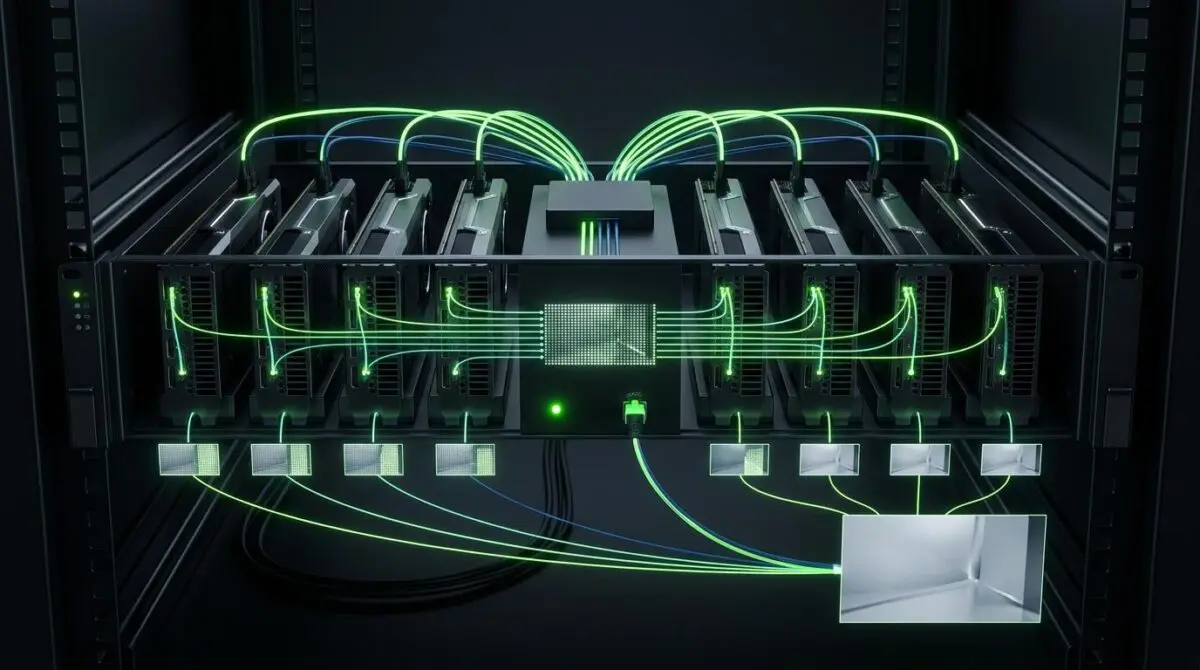
The enabling architecture is a new serving boundary: one KIND_MODEL instance can hold several GPUs and still present a single gRPC endpoint. Callers submit transformer requests without coordinating ranks, communicators, or per-GPU streams.
That keeps the client workflow stable and turns the distributed engine into a versioned Triton model. For latency-sensitive generative media pipelines, the practical effect is faster review-and-refine cycles without a custom serving shim, as NVIDIA’s developer breakdown details.
How One KIND_MODEL Instance Takes Over Eight GPUs
Each TensorRT plan embeds the distributed Ulysses graph at compile time. Dynamo-Triton then loads that versioned engine, creates the multi-rank execution state, and launches the context-parallel ranks together for every request.
The Cosmos 3 Nano workload shows why this matters. The denoising transformer consumes 93.4 percent of single-GPU runtime, making it the strongest target for acceleration.
Classifier-free guidance forces two predictions for every denoising step: one negative or unconditional, and one conditioned on the prompt. Across 35 steps, that becomes 70 transformer RPCs per generation.
At context-parallel size eight, the model divides 44,160 video tokens into 5,520 tokens per rank outside attention. The much shorter 2,992-token text path remains replicated.
Inside every transformer layer, Ulysses rearranges the attention dimension so each rank still processes the complete video sequence while owning only a nonoverlapping subset of heads. The implementation relies on TensorRT distributed-collective layers around standard attention, not a separate multi-device attention operator.
Export-carrier operations lower into three converter targets: reduce-scatter, all-to-all, and all-gather. An accepted CP8 engine therefore contains two initial reduce-scatters, 108 all-to-alls across 36 layers, and one closing all-gather.
Latency improves sharply as ranks scale. Mean end-to-end time drops from 156.6 seconds on one GPU to 88.0 on two, 53.1 on four, and 34.2 on eight.
Transformer RPC speedup reaches 6.09x at CP8, while end-to-end speedup peaks at 4.58x because fixed overhead remains. Time outside the RPC path holds between roughly 10.2 and 10.5 seconds, making prompt work, scheduler updates, VAE decode, and postprocessing a larger share of the total.
Quality validation used matched frames 0, 47, 94, 141, and 188 and required mean absolute error of 25 or less and peak signal-to-noise ratio of 18 dB or more. The outputs are not pixel-identical: CP2 and CP4 measured MAE 12.759 and PSNR 21.111 dB, while CP8 measured MAE 16.316 and PSNR 19.400 dB.
The Operational Reality Behind Multi-Device Inference
The production picture is more constrained than a latency chart alone suggests. Official TensorRT 11.3 documentation splits multi-device inference into distributed collective operations and multi-device attention, each with distinct hardware and precision boundaries.
Distributed collectives cover AllReduce, AllGather, Broadcast, Reduce, ReduceScatter, AllToAll, Gather, and Scatter on Ampere or newer. Multi-device attention is narrower: Blackwell-only, and limited to BF16 and FP16.
That split means attention-level context parallelism is not yet a universal option. Teams on older architectures can still exploit collectives, but they cannot adopt the same attention-splitting path described in this benchmark.
Rank initialization adds stricter operational demands. Every rank must load the same engine, allocate its own input and output buffers, and use its own execution context and CUDA stream.
More critically, all ranks must call enqueueV3 or execute_async_v3 concurrently. If one rank stalls, the collective operation can hang indefinitely.
There is also a platform-specific warm-up concern. On B300 systems, the first NCCL communicator initialization can take roughly 21 to 22 seconds with NCCL 2.29.4, and current guidance points to NCCL 2.30.x or later for multi-device workloads.
Architecture documentation frames the trade-off directly: multi-device execution lowers per-rank memory pressure and shortens single-query latency, but pays with inter-GPU communication. It operates in the opposite direction from Multi-Instance GPU, which carves one GPU into isolated slices.
The benchmark itself is limited to a latency scenario. It excludes model loading and mp4 encoding, and it does not measure concurrent request throughput, cost per generated video, or total cost of ownership.
That makes the speedup a deliberate resource-for-latency trade, not a blanket efficiency improvement. Teams should evaluate it against their own SLOs and deployment economics.
The Latency Trade-Off That Changes Generative Media Workflows
Eight GPUs take a Cosmos 3 generation from roughly 2.6 minutes to about 34 seconds while preserving a standard serving interface. That is a meaningful option when response time outweighs minimizing GPU allocation per request.
For teams tracking how this kind of inference infrastructure reshapes search demand, programmatic SEO and AI automation is how Andres SEO Expert turns technical signals into search advantage — contact Andres SEO Expert.
Frequently Asked Questions
What speedup does TensorRT multi-device inference deliver for Cosmos 3 Nano?
On an eight-GPU system, end-to-end generation time dropped from 156.6 seconds on one GPU to 34.2 seconds on eight, a 4.58x end-to-end speedup. Transformer RPC speedup reached 6.09x at context-parallel size eight.
How does one KIND_MODEL instance use eight GPUs?
Each TensorRT plan embeds the distributed Ulysses graph at compile time. Dynamo-Triton loads that versioned engine, creates multi-rank execution state, and launches context-parallel ranks together for every request. The instance presents a single gRPC endpoint, so callers do not manage ranks or per-GPU streams.
What is the latency scaling for Cosmos 3 Nano across GPUs?
Mean end-to-end time is 156.6 seconds on one GPU, 88.0 seconds on two, 53.1 seconds on four, and 34.2 seconds on eight. Fixed overhead outside the transformer RPC path remains roughly 10.2 to 10.5 seconds.
What are the differences between distributed collectives and multi-device attention in TensorRT?
Distributed collectives include AllReduce, AllGather, Broadcast, Reduce, ReduceScatter, AllToAll, Gather, and Scatter, and run on Ampere or newer. Multi-device attention is Blackwell-only and limited to BF16 and FP16. Teams on older architectures can use collectives but not the same attention-splitting path.
What operational risks come with multi-device TensorRT inference?
Every rank must load the same engine, allocate its own buffers, and use its own execution context and CUDA stream. All ranks must call enqueueV3 or execute_async_v3 concurrently; if one rank stalls, a collective operation can hang indefinitely. On B300 systems, first NCCL communicator initialization can take about 21 to 22 seconds with NCCL 2.29.4.
Does multi-device inference reduce cost per generated video?
The benchmark measures latency only. It excludes model loading and mp4 encoding and does not measure concurrent request throughput, cost per generated video, or total cost of ownership. It is a resource-for-latency trade, not a blanket efficiency improvement.
What quality trade-offs occur with context parallelism in Cosmos 3 Nano?
Outputs are not pixel-identical. Validation used matched frames 0, 47, 94, 141, and 188. CP2 and CP4 measured MAE 12.759 and PSNR 21.111 dB, while CP8 measured MAE 16.316 and PSNR 19.400 dB. The acceptance threshold required MAE of 25 or less and PSNR of 18 dB or more.