




Key Takeaways
- The reason-and-recommend boundary, where the agent investigates and proposes but humans execute state-changing financial actions, is the architecture that makes regulated fintech deployment viable.
- Eight workloads clear the autonomy bar, with fraud investigation, dispute resolution, and regulatory impact analysis offering the most bounded risk profile and clearest analyst time savings.
- Market signals show roughly 90 percent of vendors claim AI capability while only 12 to 14 percent of firms run active agent pilots, and Gartner expects over 40 percent of agentic AI projects to be cancelled by the end of 2027.
Table of Contents
The Reason-and-Recommend Boundary Is the Product
n8n Lab has published a detailed practitioner guide mapping eight autonomous AI agent architectures for fintech operations, from fraud investigation to client advisory escalation.
The guide draws a hard line between bounded automation and genuine agents that reason through variable investigation paths.
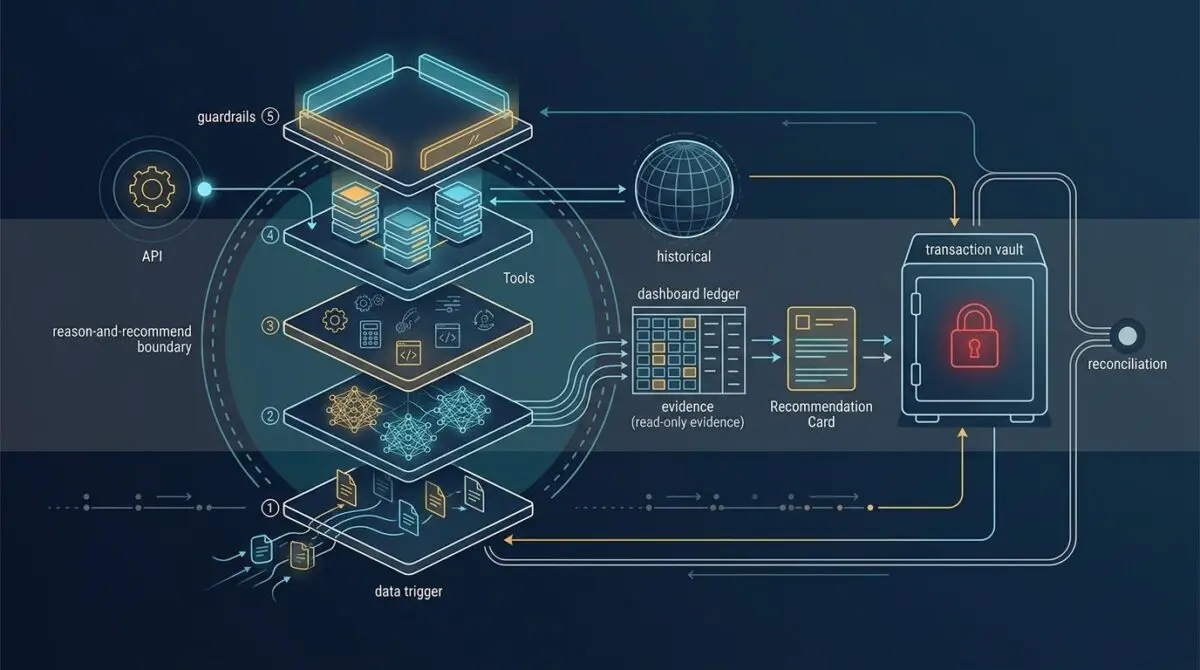
Its central operating pattern is ‘reason-and-recommend’: the agent may investigate, cite evidence, and propose an outcome, but final state-changing actions remain with human operators.
According to the n8n Lab guide, the only autonomous exception is a narrowly scoped auto-resolution category in reconciliation.
The single most important design decision is enforcing a reason-and-recommend boundary, keeping humans in control of final financial actions.
That boundary is not a limitation; it is the product architecture that makes regulated fintech deployment viable.
Eight Fintech Agent Workloads That Clear the Autonomy Bar
The guide organizes eight use cases by what the agent reasons about, the guardrail required, and deployment maturity.
- Fraud Investigation: Reasons through alert-specific data sources and recommends analyst review before any account action.
- Reconciliation Discrepancy Resolution: Hypothesizes timing, fee, duplicate, or conversion mismatches, with only pre-approved patterns eligible for auto-resolution.
- KYC Enhanced Due Diligence: Runs variable corporate registry, watchlist, and adverse media checks with full source citation.
- Vendor and Payment Processor Failover: Evaluates degradation severity, traffic context, and backup processor status under hard cost ceilings.
- Customer Dispute Resolution: Builds structured assessments from account, merchant, and dispute history for human decision-making.
- Regulatory Change Impact Analysis: Maps new rules to internal policies and processes with explicit uncertainty flags and legal review.
- Liquidity and Cash Position Monitoring: Distinguishes seasonal variation from genuine anomalies and alerts treasury without moving funds.
- Client-Facing Financial Advisory: Reasons about regulatory sensitivity in customer prompts and escalates aggressively to licensed advisors.
Fraud investigation, dispute resolution, and regulatory impact analysis offer the most bounded risk profile and the clearest analyst time savings.
Customer-facing financial advisory is explicitly sequenced last, after internal reasoning systems have production experience.
Guardrails, Step Limits, and the Price of a Wrong Decision
Every architecture in the guide rests on a five-layer framework: trigger, reasoning, tools, memory, and guardrails.
The reasoning layer decides which questions to ask; the tool layer is restricted to read-only REST API calls; memory is strictly session-scoped.
Three guardrail pillars sit behind the reason-and-recommend pattern.
- Hallucination prevention: Source citation arrays force the agent to show exactly which database row or document supports a finding.
- Data leak prevention: Read-only credentials and tool isolation keep an agent from querying unrelated systems.
- Cost control: A strict step limit, often set around seven max iterations, caps token spend and forces escalation.
In the n8n build reference, the AI Agent node uses a system prompt that hardcodes authority limits and requires structured JSON output.
Allowed tools are scoped to functions such as get_merchant_history or check_user_fraud_flags, while an escalate_to_human tool captures the reason and investigation summary.
Edge cases are tested deliberately: a transaction timestamp that aligns with a core banking downtime window should force escalation, not a guessed answer.
A 503 response from a KYC provider must pass the exact API timeout message to an analyst rather than hallucinating a clean record.
The production checklist includes read-only credential audits, evaluation against at least 100 historical tickets, JSON schema validation, separate error channels, and PII truncation.
Market Signals: Pilots, Pricing Pressure, and the Production Gap
WealthTech Today‘s latest analysis highlights a widening gap between vendor claims and real operational adoption in adjacent financial services.
The research estimates roughly 90 percent of wealth tech vendors now offer some AI capability, but only 12 to 14 percent of wealth management firms have active AI agent pilots.
Another estimated 75 percent of vendors claiming ‘agent’ status are still deterministic tools with no real autonomy.
That mismatch maps directly onto the n8n Lab guide: autonomous reasoning is difficult to ship, not difficult to label.
The same analysis tracks a five-level autonomy scale, from no autonomy to fully autonomous, and an industry directory that separates production offerings from prototypes.
Pricing is shifting from per-seat, per-firm, and AUM models toward usage- and outcome-based models as token costs squeeze vendor margins.
An EY AI Pulse Survey finding cited in the analysis puts the pressure in perspective: 98 percent of C-suite leaders say token costs are forcing them to reconsider AI plans, yet only two-thirds have a metering methodology.
Adjacent UK regulatory survey data shows 75 percent of financial services firms already use AI, while Gartner predicts more than 40 percent of agentic AI projects will be cancelled by the end of 2027.
Inadequate risk controls are named as one reason for cancellation, reinforcing the reason-and-recommend guardrail as an operational necessity rather than a conservative preference.
Deployment data points toward narrow, high-volume starting points: disputes, fraud investigation, regulatory impact analysis, and document verification.
Human quality assurance belongs at checkpoints and flagged exceptions, not on every reply.
The Deployment Window Is Narrower Than the Hype
For fintech automation teams, the next 12 months will not be won by the most autonomous demo; they will be won by the most auditable reason-and-recommend loop that cuts investigation time without moving decision authority. For teams building agentic automation pipelines that must survive regulatory scrutiny, programmatic SEO and AI automation is how Andres SEO Expert approaches the production path — talk to the team.
Frequently Asked Questions
What is the reason-and-recommend boundary in fintech AI agents?
The reason-and-recommend boundary is an operating pattern where an AI agent may investigate, cite evidence, and recommend an outcome, but humans keep authority over final state-changing financial actions. The only autonomous exception in the guide is a narrowly scoped auto-resolution category in reconciliation.
Which fintech agent workloads are best suited for early production deployment?
The guide identifies eight workloads: fraud investigation, reconciliation discrepancy resolution, KYC enhanced due diligence, vendor and payment processor failover, customer dispute resolution, regulatory change impact analysis, liquidity and cash position monitoring, and client-facing financial advisory. Fraud investigation, dispute resolution, and regulatory impact analysis offer the most bounded risk and clearest analyst time savings. Client-facing advisory is sequenced last.
What guardrails prevent hallucinations and data leaks in fintech AI agents?
They use a five-layer framework: trigger, reasoning, tools, memory, and guardrails. The tool layer is restricted to read-only REST API calls, memory is session-scoped, and source citation arrays force the agent to show supporting database rows or documents. Read-only credentials and tool isolation prevent querying unrelated systems.
Why do fintech AI agents need a strict step limit?
A strict step limit, often around seven max iterations, caps token spend and forces escalation instead of unbounded reasoning. It also helps control cost and prevents the agent from continuing after it should hand off to a human.
How large is the gap between AI agent vendor claims and actual adoption in wealth management?
Research cited by WealthTech Today estimates about 90 percent of wealth tech vendors offer some AI capability, but only 12 to 14 percent of wealth management firms have active AI agent pilots. Another estimated 75 percent of vendors claiming agent status are still deterministic tools with no real autonomy.
What is included in the production checklist for deploying fintech AI agents?
The production checklist includes read-only credential audits, evaluation against at least 100 historical tickets, JSON schema validation, separate error channels, and PII truncation. Edge cases are tested deliberately, such as a transaction timestamp during core banking downtime forcing escalation and a KYC provider 503 passing the exact API timeout message to an analyst.
How is pricing for fintech AI agents changing?
Pricing is shifting from per-seat, per-firm, and AUM models toward usage- and outcome-based models as token costs squeeze vendor margins. An EY AI Pulse Survey finding cited in the analysis says 98 percent of C-suite leaders report token costs are forcing them to reconsider AI plans, yet only two-thirds have a metering methodology.
What do market signals say about the deployment window for fintech AI agents?
Deployment data points toward narrow, high-volume starting points such as disputes, fraud investigation, regulatory impact analysis, and document verification. Gartner predicts more than 40 percent of agentic AI projects will be cancelled by the end of 2027, with inadequate risk controls named as one reason, so the deployment window favors auditable reason-and-recommend loops over maximum autonomy.