Key Takeaways
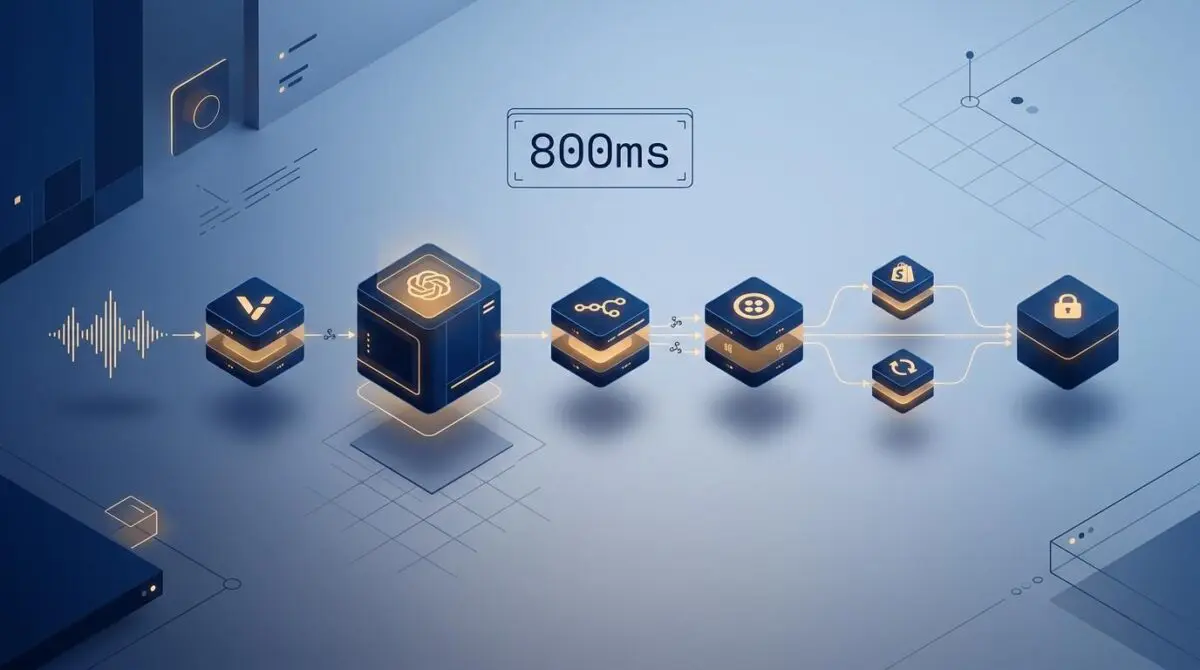
- Vapi, GPT-4o, n8n, and Twilio form a five-layer voice stack that holds retail responses under 800 milliseconds by splitting the voice layer from backend API calls.
- Guardrails are mechanical, not conversational: out-of-policy returns, profanity, or n8n 503 errors trigger a hard transfer to the live Twilio SIP queue.
- Managed platforms such as Aircall’s incoming Shopify Order Management Agent are productizing the exact order loop that custom orchestration treats as an engineering project.
Table of Contents
Voice Agents Are Becoming the Retail Back Office
Retail support queues are shifting from hold music to tool calls. A recent technical breakdown from n8n Lab maps a production-grade voice agent that handles order status lookups, return eligibility checks, and loyalty balance queries without a human agent.
The pattern pairs Vapi for inbound voice orchestration, GPT-4o for conversational reasoning, and n8n as the webhook execution layer. Twilio carries the SIP trunk, Shopify and Loop supply the transactional data, and Deepgram transcribes the caller in real time.
The design separates the low-latency voice layer from the heavier backend API layer. That split keeps spoken responses under 800 milliseconds even when Shopify queries take longer to resolve.
The Architecture That Keeps Latency Under 800 Milliseconds
The technical blueprint from n8n Lab frames the system as a five-layer flow: trigger, reasoning, tools, memory, and guardrails. A call arrives at Twilio, moves into Vapi, and gets transcribed by Deepgram before reaching GPT-4o.
The LLM decides whether the caller wants an order update, a return, or a loyalty balance. When it needs external data, Vapi pauses the conversation and fires a webhook to n8n.
n8n becomes the middleware router. It queries Shopify, Loop, or a loyalty platform API, then returns a cleaned JSON payload back to Vapi.
The LLM converts that payload into natural speech. Short-term memory lives in the Vapi session context, while long-term memory comes from an initial CRM lookup keyed to caller ID.
Three core tools drive the build:
- lookup_order_status: Searches Shopify by phone number and returns tracking URL and delivery estimate.
- initiate_return: Verifies delivery date, then calls Loop or Shopify Returns for an RMA number.
- check_loyalty_balance: Queries Yotpo, Smile.io, or a CRM and converts tier plus points into a conversational dollar value.
The return tool description carries a strict trigger condition. The prompt language is explicit:
Use this tool ONLY when the customer explicitly asks to return an item AND you have verified the item was delivered within the last 30 days.
Guardrails are mechanical, not conversational. If a return falls outside the 30-day window, the LLM hits a hard boundary and triggers ‘transfer_to_agent’ instead of executing ‘initiate_return’.
Escalation paths also fire on profanity, repeated failures, or any request the agent cannot answer after two attempts. The transfer tool dials the live Twilio SIP queue and passes call context to a human.
Write access remains deliberately narrow. The agent can generate return labels, but it must never move funds to a custom payment method or issue a replacement order without a return scan.
Edge cases expose the limits of live voice control. When Deepgram mishears ‘A’ as ‘8’, the Shopify query returns null, and the agent must ask the caller to read characters one by one.
API failures during flash sales create a harder failure mode. If n8n returns a 503 error, the agent should tell the caller the system is updating and immediately transfer to the human queue.
The production checklist pushes teams to verify sub-800-millisecond response times, apply least-privilege Shopify tokens, and run at least 50 recorded calls to prove out-of-policy returns always escalate.
Platform Consolidation Is Colliding With Custom Orchestration
Retail voice AI is no longer a custom integration exercise. Platform vendors are now productizing the exact order management loop that the build-your-own architecture treats as an engineering challenge.
Aircall‘s September 2026 update states that a Shopify-integrated Order Management Agent for e-commerce and retail is coming soon. That is a direct signal: a core retail use case is becoming a managed feature, competing with the Vapi plus n8n orchestration pattern.
Aircall also reports expanded language support to 38 languages and an agent memory pilot that reduced handling time for transferred calls by 69%. Those numbers matter because return and loyalty queries often start with one agent and finish with another.
Market context supports the shift. Retell AI, in a vendor-produced use-case overview, cites a Gartner projection that 75% of customer service interactions would be powered by AI voice agents or chatbots by 2025.
By September 2026, that figure reads less like a forecast and more like an operational benchmark for retail support volume. The remaining challenge is not whether voice agents answer calls; it is whether the integration layer holds up under production load.
Retell AI also flags the boundaries: complex multi-step requests, strong accents, ambiguous intent, sarcasm, and emotional tone still degrade voice agent performance. Those limits align with the edge cases in the custom build, from misheard order IDs to null queries and API failures.
Smallest AI adds another demand signal, citing a Forbes agency council statistic that nearly 125 million U.S. adults now use voice search. That consumer behavior pushes retailers to treat voice as a front-end, not just a support channel.
At scale, telephony, transcription, LLM reasoning, and text-to-speech typically cost between twelve and twenty cents per minute. That unit cost must be weighed against repetitive human lookup work, not against complex escalations that still require human judgment.
The strategic split is now clear. Teams can either assemble Vapi, GPT-4o, n8n, Twilio, and Shopify into a custom orchestration layer, or wait for turnkey platforms to ship a native order management agent.
Custom builds offer more control over guardrails, tool schemas, and latency tuning. Managed platforms offer faster deployment and native CRM integration, but often delay deep backend customization.
The Build Window for Retail Voice AI Is Shrinking
The near-term task is not proving that a retail voice agent can answer an order status call; it is deciding whether to build against the Vapi plus n8n pattern before managed platforms close the custom orchestration gap. For teams building retail voice agents that need to scale beyond the pilot phase, programmatic SEO and AI automation is how Andres SEO Expert approaches production-grade AI workflows — contact Andres SEO Expert.
Frequently Asked Questions
What is a retail voice agent and what tasks can it handle?
A retail voice agent is an AI system that handles inbound customer calls for order status lookups, return eligibility checks, and loyalty balance queries without a human agent. In a production build, it typically pairs Vapi for voice orchestration, GPT-4o for reasoning, n8n for webhook execution, Twilio for SIP, Shopify and Loop for transactional data, and Deepgram for real-time transcription.
How do you keep retail voice agent latency under 800 milliseconds?
The architecture separates the low-latency voice layer from the heavier backend API layer. Vapi handles inbound voice, Deepgram transcribes in real time, GPT-4o reasons, and n8n routes webhooks to Shopify or Loop. This split lets spoken responses stay under 800 milliseconds even when backend queries take longer to resolve.
What tools are used in a Vapi plus n8n retail voice agent build?
The core tools are lookup_order_status, initiate_return, and check_loyalty_balance. lookup_order_status searches Shopify by phone number and returns a tracking URL and delivery estimate. initiate_return verifies delivery date, then calls Loop or Shopify Returns for an RMA number. check_loyalty_balance queries Yotpo, Smile.io, or a CRM and converts tier plus points into a conversational dollar value.
How does the voice agent handle returns and out-of-policy requests?
The return tool carries a strict trigger condition: use it only when the customer explicitly asks to return an item and the item was delivered within the last 30 days. If a return falls outside that window, the LLM hits a hard boundary and triggers transfer_to_agent instead of executing initiate_return.
When should a retail voice agent escalate to a human agent?
Escalation fires on profanity, repeated failures, or any request the agent cannot answer after two attempts. It also fires for out-of-policy returns and API failures, such as an n8n 503 error during a flash sale. The transfer tool dials the live Twilio SIP queue and passes call context to a human.
What are the limitations and costs of AI voice agents in retail?
Voice agents still struggle with complex multi-step requests, strong accents, ambiguous intent, sarcasm, and emotional tone. Edge cases include misheard order IDs, null Shopify queries, and API failures. At scale, telephony, transcription, LLM reasoning, and text-to-speech typically cost between twelve and twenty cents per minute.
Should retailers build a custom Vapi plus n8n voice agent or use a managed platform?
Custom builds offer more control over guardrails, tool schemas, and latency tuning, but require more engineering. Managed platforms like Aircall offer faster deployment and native CRM integration, but may delay deep backend customization. The decision depends on how much orchestration control the retailer needs before managed platforms close the custom orchestration gap.