Key Takeaways
- Fully loaded labor cost, not base salary, sets the manual baseline that decides whether the ROI model survives conservative containment rates.
- Break-even equals one-time build cost divided by monthly net savings, where net savings must subtract AI minutes plus hybrid escalation costs after transfer.
- Gartner estimates AI cost projections miss by 500 to 1,000 percent, so present conservative, base, and upside scenarios instead of a single ROI figure.
Table of Contents
AI Voice Agent ROI in 2026: The Financial Framework That Survives Production
The Financial Case for AI Voice Agents Has a Math Problem
Most AI voice agent ROI models collapse in production because they start from an incomplete manual labor baseline and an unrealistic automation rate. A defensible financial case does not begin with vendor savings claims; it begins with the true fully loaded cost of the staff currently handling the calls.
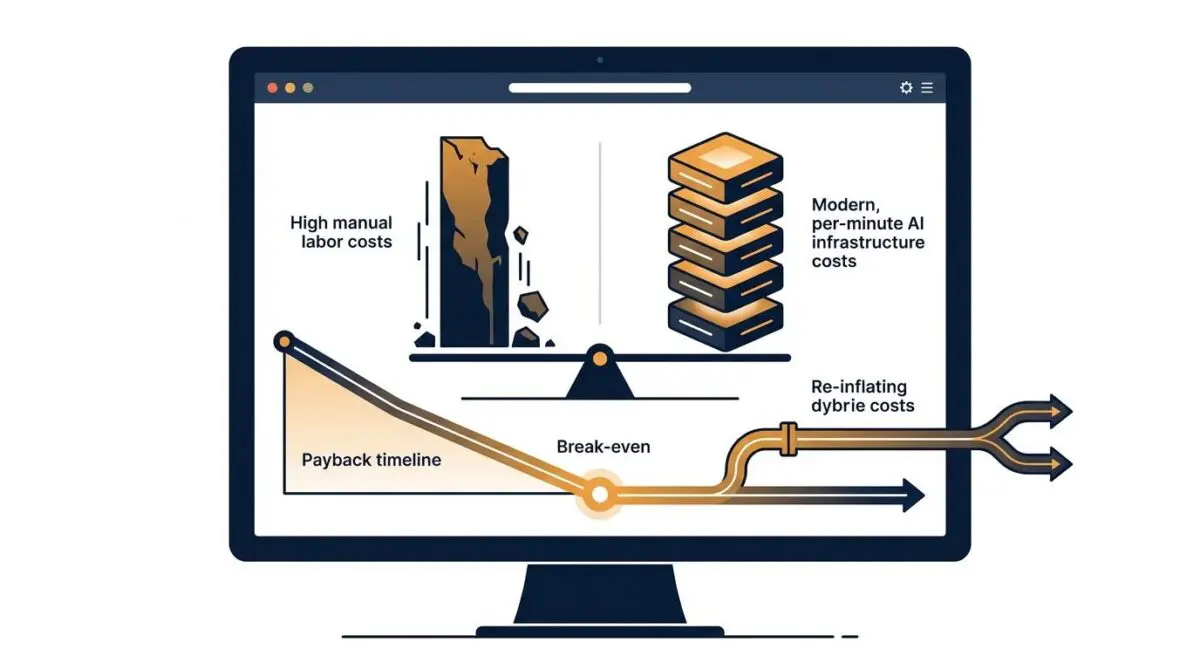
The core calculation is straightforward: subtract platform usage, language model processing, text-to-speech, telephony, and the cost of human escalations from the manual staffing baseline. The resulting net monthly savings then determines the break-even timeline before any development budget is approved.
As of late September 2026, operations leaders and finance teams across the automation sector are under more pressure than ever to verify those numbers before committing to custom AI agent development. The model must survive conservative containment rates, not just optimistic demos.
From Loaded Labor Baseline to Break-Even: The Calculation That Actually Holds
The first step replaces base salary with fully loaded labor cost. According to n8nlab’s ROI calculator, payroll taxes, benefits, management allocation, and software licensing overhead typically push a twenty-dollar hourly wage closer to thirty dollars in real cost.
That baseline is multiplied by average handling time and monthly call volume for the specific call intent being automated. Using generic contact center volume across all call types distorts the model and creates an artificial savings case.
The automation side shifts costs from variable labor to a mix of one-time build expenditure and lower variable software fees. A production voice stack typically spans five layers: telephony and orchestration, reasoning language model tokens, tool and API execution, memory and context retention, and guardrails with human transfer.
Build cost commonly ranges from ten thousand to thirty thousand dollars for a compliant system with custom CRM integration. Internal development uses loaded engineering hours multiplied by project duration.
A modern stack usually lands between twelve and twenty cents per minute. The calculation should use the actual volume-tier pricing for the orchestration platform, speech-to-text provider, and language model, not an uncommitted enterprise discount.
- Manual baseline formula: average handling time × monthly call volume × fully loaded per-minute labor cost.
- Automation running cost formula: AI call duration × monthly volume × blended per-minute AI cost.
- Break-even formula: one-time build cost ÷ monthly net savings.
The Five-Layer Cost Stack
Every automated call triggers a sequence of computational events that each add cost. Telephony and orchestration maintain the audio connection and control latency.
Speech-to-text transcribes the caller, the language model reasons across context and system prompts, and text-to-speech converts the response back into natural audio. Tool calls to CRM or fulfillment APIs may carry their own execution fees, while memory layers store transcripts and run embedding or vector queries.
The guardrail layer is where financial models either hold or break. When the system transfers a caller to a human, the interaction becomes a hybrid cost: AI minutes consumed before transfer plus fully loaded human minutes after transfer.
Escalation Math Changes the Payback
A seventy percent containment rate on one thousand medical intake calls produces seven hundred fully automated calls and three hundred escalated calls. The escalated calls still consume AI minutes before transfer and human minutes afterward.
In a private practice example, that hybrid structure drops monthly cost from two thousand five hundred dollars to eight hundred fifty-five dollars. The result is a payback of about seven and three tenths months on a twelve thousand dollar build.
In a retail order support example, five thousand calls with eighty percent containment reduce monthly cost from five thousand dollars to two thousand one hundred dollars. Break-even arrives in roughly six and two tenths months.
Before plugging in any vendor pricing, finance teams need four variables locked in.
- Fully loaded hourly rate: sourced from finance or HR, establishes the true cost of manual call handling.
- Average handling time: pulled from call center analytics, defines human effort per task.
- Monthly call volume: sourced from telephony logs, sets the scale of the automation opportunity.
- Containment rate: the percentage of calls resolved without human transfer, typically modeled at sixty to eighty percent for Tier 1 workflows.
Production Risks That Inflate Monthly Bills
Even a mathematically sound model can drift once live traffic introduces edge cases. An answering machine that fails to trigger beep detection can loop until the provider’s hard timeout, consuming language model tokens for no business value.
A slow CRM API can extend calls with dead air, while an unbounded memory array can pass an entire growing transcript into every language model turn. Both accelerate per-minute and per-token costs faster than the initial projection.
Hidden concurrency fees and international SIP routing mismatches create another class of unexpected charges. Telephony should be localized to the primary customer base, and vendor contracts should be reviewed for reserved instance fees alongside usage rates.
- Maximum call duration limits: prevent failed calls from consuming excessive tokens.
- Context summarization: keeps language model input tokens from multiplying on long calls.
- Tool call timeouts and caching: reduce dead air and API retry loops.
- Concurrency rate limits: flatten traffic spikes and avoid unplanned infrastructure charges.
Vendor Optimism Meets Gartner’s 500% to 1,000% Cost Overrun Warning
Retell AI’s published conversational AI sales calculator illustrates the appeal of vendor-generated ROI math. With default inputs of one human agent working eight hours per day at twenty dollars per hour, the tool reports one hundred seventy-eight percent ROI and estimated monthly savings of two thousand forty-eight dollars.
Those figures are vendor-supplied and self-reported, so they describe the optimistic end of the possible range rather than an independently verified production result. The more uncomfortable data sits on the finance side of the market.
Alteryx has drawn attention to Gartner estimates showing AI cost projections missing by five hundred to one thousand percent. More than half of AI pilots are expected to be abandoned by 2028 because of unexpected cost overruns.
That is not a marginal error; it is a structural gap between procurement assumptions and operational billing. Gartner also warns that planned labor cost increases of two to three percent are being replaced by cloud and vendor AI cost increases of eight to ten percent.
The measurement problem compounds the cost problem. Alteryx cites a BCG survey of more than two hundred eighty finance executives that places median finance AI ROI at ten percent, with roughly one third reporting limited or no gains.
Deloitte Finance Trends data goes further: sixty-three percent of finance leaders have fully deployed AI, but only twenty-one percent report clear, measurable return. Integreon adds that seventy to eighty-five percent of AI initiatives fail to meet expected outcomes, based on RAND research.
Integreon’s C-suite guidance recommends pairing efficiency savings with a reinvestment story and presenting a range rather than a single ROI percentage. The one-page AI profit and loss should show conservative, base, and upside scenarios on the same line.
For automation buyers, the strategic implication is clear. Vendor calculators can structure a sales conversation, but they cannot replace a finance-owned model built on loaded labor costs, volume-tier infrastructure pricing, and conservative escalation assumptions.
Why the Escalation Rate Decides the Business Case
The final defense of an AI voice agent ROI model is not the platform price per minute; it is the containment rate you are willing to defend in front of a CFO. For teams building voice agent cost models that need to move from spreadsheet assumptions to production-grade automation, programmatic SEO and AI automation is how Andres SEO Expert approaches it — contact the team.
Frequently Asked Questions
What is the correct baseline for calculating AI voice agent ROI?
The correct baseline is fully loaded labor cost, not base salary. It should include payroll taxes, benefits, management allocation, and software licensing overhead, then be multiplied by average handling time and monthly call volume for the specific call intent being automated.
How do you calculate break-even for an AI voice agent?
Break-even equals one-time build cost divided by monthly net savings. Monthly net savings equals the manual staffing baseline minus AI running costs, including platform usage, language model processing, text-to-speech, telephony, and human escalation costs.
What costs make up the five-layer AI voice stack?
A production voice stack typically spans telephony and orchestration, reasoning language model tokens, tool and API execution, memory and context retention, and guardrails with human transfer. A modern stack usually lands between twelve and twenty cents per minute.
Why does the escalation rate decide the AI voice agent business case?
Escalated calls become hybrid costs because they consume AI minutes before transfer and fully loaded human minutes after transfer. A higher containment rate reduces those hybrid costs, while a lower containment rate can quickly erode projected savings and extend payback.
Why do vendor ROI calculators overstate AI voice agent savings?
Vendor calculators are often vendor-supplied and self-reported, using optimistic defaults that ignore loaded labor costs, volume-tier infrastructure pricing, and conservative escalation assumptions. Gartner warns of AI cost projections missing by five hundred to one thousand percent, and many pilots are abandoned due to cost overruns.
What production risks inflate AI voice agent monthly bills?
Common risks include answering machine loops, slow CRM APIs that create dead air, unbounded memory that multiplies token usage, hidden concurrency fees, and international SIP routing mismatches. Mitigations include maximum call duration limits, context summarization, tool call timeouts, caching, and concurrency rate limits.
What variables should finance lock before using vendor pricing?
Finance teams should lock four variables: fully loaded hourly rate, average handling time, monthly call volume, and containment rate. These should come from finance or HR, call center analytics, and telephony logs rather than vendor assumptions.