



Key Takeaways
- GitHub’s usage metrics API adds a pull_request_review_times array that splits review latency into ready-to-first-review, first-to-final-review, and final-review-to-merge stages.
- Each stage reports a median and a 90th percentile, and only human reviews are timed, so Copilot and bot reviews are excluded from the calculation.
- There is no historical backfill and qualifying pull requests must be opened by a person and reviewed by another person, so early data will be sparse.
Table of Contents
GitHub Now Pinpoints the Exact Stage Where Pull Requests Stall
GitHub’s September 25 changelog details a quiet but consequential update to the Copilot usage metrics API.
The new pull_request_review_times array breaks down review latency in enterprise and organization repos-1-day reports into three distinct human-reviewed stages.
Teams can now see exactly how many minutes a merged pull request spent waiting for its first review, moving through review iterations, and sitting approved before merge.
Inside the New pull_request_review_times Metrics Array
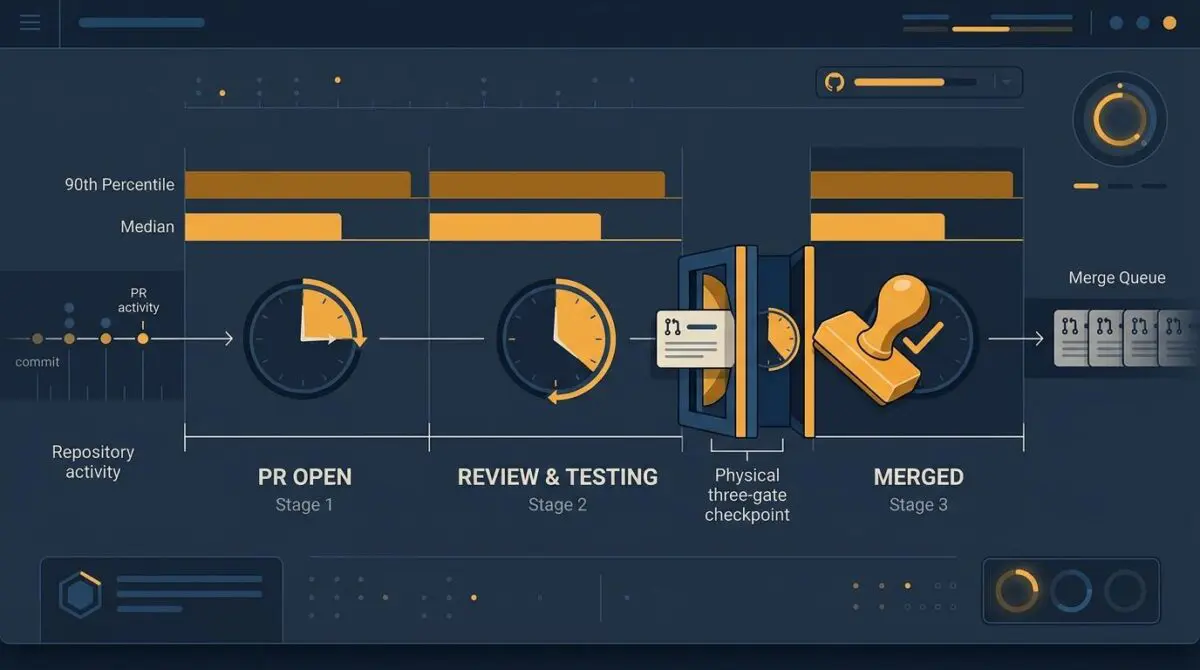
As detailed in GitHub’s changelog, each entry in the new array reports a median and a 90th percentile for three durations.
The stages cover ready-to-first-review, first-to-final-review, and final-review-to-merge.
Both authored_by and reviewed_by are set to human in this release, which means only human reviews are timed.
What the Array Actually Measures
- ready_to_first_review — Time from a pull request becoming ready for review to its first human review.
- first_to_final_review — Time between the first and final human review.
- final_review_to_merge — Time from the final human review to the merge.
The median shows the typical pace, while the 90th percentile highlights the slow edge cases that often distort engineering team perceptions.
Durations are attributed to the day the pull request merged, and the existing pull_requests fields remain unchanged.
Counting Rules and Edge Cases
Qualifying pull requests must have been opened by a person and reviewed by at least one other person.
Copilot code review, other bot reviews, and author self-reviews are excluded from the timing logic.
A pull request that receives both a human review and a Copilot code review still qualifies because the human review is what gets measured.
As a result, total_merged in the new array is usually lower than pull_requests.total_merged, which also counts merges that had no reviews.
There is no historical backfill, so the initial data will be sparse for the first several days.
Pull requests that entered the ready-for-review state before September 21, 2026 do not appear in this section.
If a repository merges no qualifying pull requests on a given day, the array is empty rather than zero-filled.
The first-to-final-review stage reports a value of 0 when a pull request receives only one review.
Access and Permissions
Enterprise owners, billing managers, organization owners, and custom roles with the View Copilot Metrics permission can access these reports.
The Copilot usage metrics policy must be enabled at the organization or enterprise level.
Why Stage-Level Telemetry Rewrites the Performance Playbook
Vendor-published telemetry from a commercial engineering analytics blog claims that AI-assisted teams merge 16 percent more pull requests per developer yet spend 441 percent longer in review.
That data, which has not been independently verified at production scale, points to the same bottleneck this new GitHub metric exposes: the human-speed review stage.
Another self-reported 30-day dataset from the same vendor found 298 of 324 merged pull requests were agent-assisted, with 96.5 percent of changed lines coming from agents and zero human reviews recorded.
That pattern makes the human-review-only attribution in GitHub’s new array especially important for separating machine productivity from human latency.
Engineering metrics guidance in the market often targets a first review within four business hours and a total review cycle under 24 business hours for standard pull requests.
Those are practice benchmarks, not official research, so they function more as baseline references than universal standards.
The New Bottleneck Hunt Starts Before the First Comment
Stage-level review timing shifts the conversation from how fast code is written to how fast it actually clears the queue.
For teams using GitHub’s enterprise metrics, the new array turns anecdotal frustration into a diagnostic target.
For teams building measurement-driven engineering workflows, programmatic SEO and AI automation is how Andres SEO Expert applies the same telemetry-to-action discipline to search performance — contact us.
Frequently Asked Questions
What is the pull_request_review_times array in GitHub Copilot usage metrics?
It is a new array in GitHub Copilot usage metrics API reports that breaks down human pull request review latency into three stages: ready_to_first_review, first_to_final_review, and final_review_to_merge. Each entry reports median and 90th percentile durations for qualifying merged pull requests.
Which pull request review stages does GitHub now measure?
GitHub measures ready-to-first-review, first-to-final-review, and final-review-to-merge. These cover the time before the first human review, between the first and final human review, and from final human review to merge.
Does the new GitHub review stage metric include Copilot or bot reviews?
No. The release sets authored_by and reviewed_by to human, so Copilot code review, other bot reviews, and author self-reviews are excluded. A pull request can still qualify if it has both a human review and a Copilot review, because only the human review is timed.
Why is total_merged in pull_request_review_times lower than pull_requests.total_merged?
Because pull_request_review_times only counts qualifying pull requests opened by a person and reviewed by at least one other person. pull_requests.total_merged also includes merges that had no reviews, so its total is usually higher.
Is there historical data or backfill for GitHub pull_request_review_times?
No. There is no historical backfill. Initial data will be sparse for the first several days, and pull requests that entered the ready-for-review state before September 21, 2026 do not appear in this section.
Who can access the GitHub Copilot usage metrics review stage reports?
Enterprise owners, billing managers, organization owners, and custom roles with the View Copilot Metrics permission can access these reports. The Copilot usage metrics policy must also be enabled at the organization or enterprise level.
How should engineering teams use stage-level pull request review latency?
Teams can use the median to understand typical review pace and the 90th percentile to find slow edge cases. The stages help shift focus from code-writing speed to how fast pull requests clear human review and merge, turning anecdotal review frustration into a diagnostic target.