



Executive Summary
- CRMs function as the single source of truth (SSOT) for structured customer data, enabling stateless automation via RESTful APIs.
- Integration with AI content ops allows for dynamic personalization by injecting CRM-stored variables into LLM prompts.
- Modern CRM architecture prioritizes webhook extensibility and JSON payload compatibility for real-time data synchronization.
What is CRM?
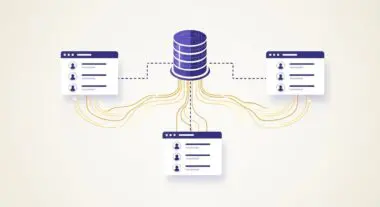
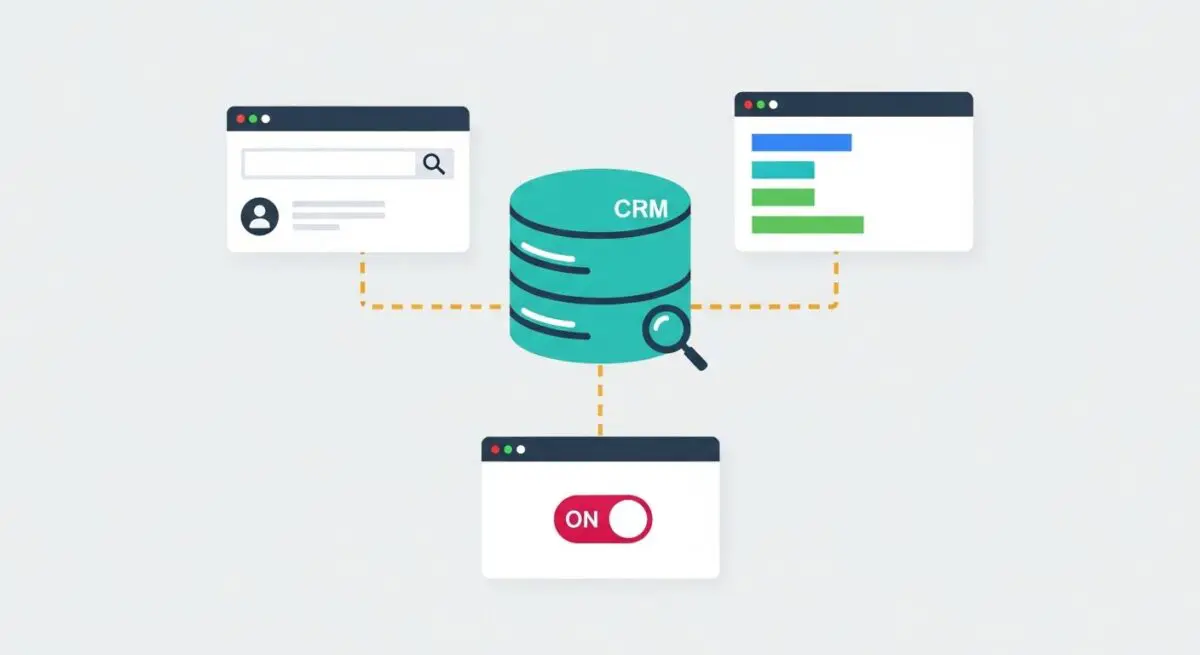
Customer Relationship Management (CRM) is a centralized software architecture designed to manage, analyze, and optimize an organization’s interactions with current and potential customers. In the context of modern automation, a CRM serves as the Single Source of Truth (SSOT), housing structured data that fuels programmatic workflows. It functions as a relational database that stores attributes such as lead status, interaction history, and behavioral metadata, which are accessible via RESTful APIs for external processing.
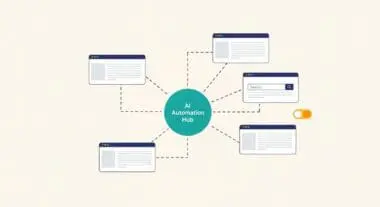
Beyond simple contact storage, a CRM acts as the orchestration hub for data pipelines. By utilizing JSON payloads and webhooks, it enables the seamless transfer of information between disparate systems, such as marketing automation platforms, AI agents, and customer support interfaces. This connectivity is essential for maintaining state across stateless serverless functions, ensuring that every automated touchpoint is informed by historical data.
The Real-World Analogy
Imagine a world-class concierge at a luxury hotel. This concierge maintains a detailed ledger for every guest, noting not just their name, but their preferred room temperature, dietary restrictions, and past complaints. When a guest arrives, the concierge doesn’t just hand over a key; they inform the kitchen to prepare a specific meal and the housekeeping staff to adjust the thermostat. In this scenario, the ledger is the CRM, and the concierge is the Automation Engine. Without the ledger, the concierge’s actions would be generic and inefficient; with it, every service becomes a personalized, high-value interaction.
Why is CRM Critical for Autonomous Workflows and AI Content Ops?
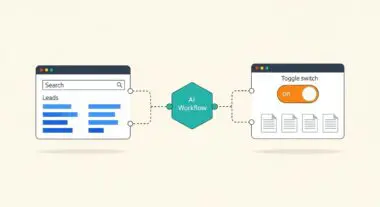
In the era of AI Content Ops, the CRM provides the necessary context for Large Language Models (LLMs) to generate hyper-personalized content. Without a CRM, automated content generation remains generic. By pulling real-time data from a CRM, an automation script can inject specific customer pain points or purchase history into a prompt, resulting in output that resonates with the recipient’s current stage in the buyer’s journey.
Furthermore, CRMs are vital for stateless automation. Since serverless functions (like those in AWS Lambda or Google Cloud Functions) do not retain memory between executions, they rely on the CRM to provide the “state” of a customer. This allows for complex, multi-step workflows—such as lead scoring or automated follow-ups—to execute reliably based on the most recent data updates received via webhooks.
Best Practices & Implementation
- Standardize Data Schemas: Ensure all incoming data from webhooks follows a strict schema to prevent integration failures and data corruption within the CRM.
- Implement Robust API Error Handling: When syncing data, use exponential backoff strategies to handle API rate limits and transient network errors.
- Prioritize Data Hygiene: Use automated deduplication scripts and validation rules to maintain the integrity of the SSOT, preventing AI agents from processing redundant or conflicting information.
- Secure Webhook Endpoints: Use secret tokens or signature verification to ensure that data pushed to your CRM originates from trusted sources.
Common Mistakes to Avoid
One frequent error is data fragmentation, where customer information is scattered across multiple platforms without a primary CRM acting as the master record. This leads to “hallucinations” in automated workflows where AI agents act on outdated information. Another mistake is failing to document API mapping, which results in technical debt and broken pipelines when the CRM schema is updated without corresponding changes in the automation layer.
Conclusion
A CRM is the foundational data layer that transforms generic automation into intelligent, context-aware autonomous workflows. Mastering its API capabilities is essential for any enterprise scaling AI-driven content and search operations.