Executive Summary
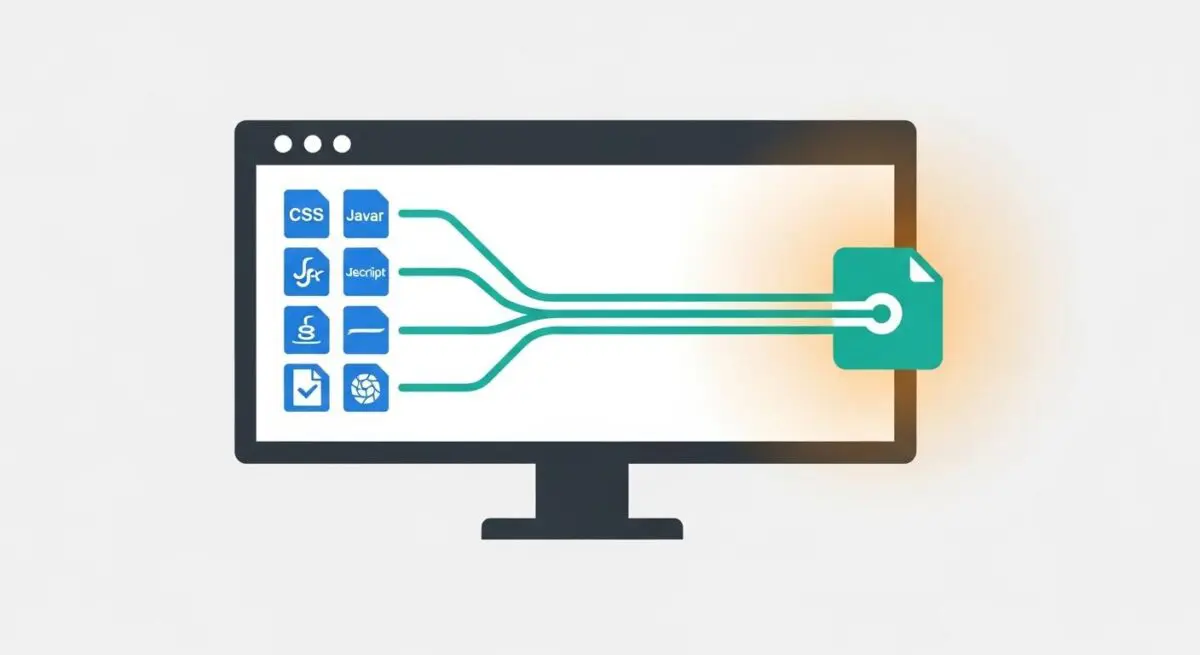
- Reduces the total number of HTTP requests by consolidating multiple discrete files into a single payload.
- Enhances compression efficiency by allowing algorithms like Gzip or Brotli to operate on larger, contiguous data blocks.
- Mitigates the performance penalties associated with TCP slow start and round-trip time (RTT) latency.
What is Resource Bundling?
Resource bundling is a front-end performance optimization technique that combines multiple individual files—typically JavaScript (JS) and Cascading Style Sheets (CSS)—into a single, larger file known as a bundle. In the early stages of web development, browsers were limited in the number of concurrent connections they could establish with a server. Resource bundling emerged as a solution to bypass these limitations by reducing the total number of HTTP requests required to render a page.
Modern bundling processes are usually handled by build tools such as Webpack, Vite, or Rollup. These tools analyze the dependency graph of an application, starting from an entry point, and merge all necessary modules into optimized assets. While the advent of HTTP/2 and HTTP/3 introduced multiplexing—allowing multiple requests over a single connection—bundling remains a critical practice for improving compression ratios and managing execution order in complex web applications.
The Real-World Analogy
Imagine you are ordering ten different items from an online retailer. If the retailer sends each item in a separate envelope, you must deal with ten different deliveries, ten different tracking numbers, and ten different delivery drivers arriving at your door. This creates significant logistical overhead and increases the chance of a delay. Resource bundling is equivalent to the retailer placing all ten items into a single, well-organized box. You receive everything at once, the delivery driver only makes one trip, and the total packaging material is used more efficiently, reducing the overall complexity of the delivery process.
Why is Resource Bundling Critical for Website Performance and Speed Engineering?
Resource bundling directly impacts the critical rendering path by minimizing the overhead associated with HTTP headers and TCP handshakes. Every individual request carries a performance cost; by merging assets, we reduce the time the browser spends in the “request/response” cycle. This is particularly vital for improving First Contentful Paint (FCP) and Largest Contentful Paint (LCP), as the browser can begin parsing and executing the necessary styles and scripts sooner.
Furthermore, bundling facilitates better data compression. Compression algorithms like Brotli are more effective when they can identify patterns across a larger dataset. When files are bundled, the algorithm can find more redundancies, resulting in a smaller total transfer size compared to the sum of many small, individual files. This optimization reduces the Time to Interactive (TTI) by ensuring the main thread is not blocked by a high volume of fragmented network tasks.
Best Practices & Implementation
- Implement Tree Shaking: Use modern bundlers to automatically remove unused code (dead code elimination) from the final bundle to keep file sizes lean.
- Utilize Code Splitting: Avoid creating a single “monolithic” bundle. Split code into vendor bundles (for third-party libraries) and route-based bundles to ensure users only download the code necessary for the current page.
- Minification and Obfuscation: Always pair bundling with minification to remove whitespace, comments, and unnecessary characters, further reducing the payload size.
- Content Hashing for Caching: Append a unique hash to the bundle filename (e.g., main.a1b2c3.js). This allows for long-term cache headers while ensuring users receive the latest version immediately upon an update.
Common Mistakes to Avoid
One frequent error is “Over-Bundling,” where a single, massive JavaScript file is created for the entire website. This forces the browser to download and parse megabytes of code that may not be needed for the initial view, severely damaging Total Blocking Time (TBT). Another mistake is ignoring the benefits of HTTP/2 multiplexing; in some high-latency environments, extremely granular splitting may actually be more beneficial than aggressive bundling. Finally, failing to separate CSS from JS bundles can lead to unstyled content flashes or delayed rendering.
Conclusion
Resource bundling remains a cornerstone of speed engineering by balancing the trade-off between request overhead and file size. When implemented with strategic code splitting and tree shaking, it ensures a streamlined delivery of assets that optimizes both server efficiency and user experience.