



Executive Summary
- Decouples the presentation layer from the WordPress core, utilizing pre-rendered static assets for near-instantaneous Time to First Byte (TTFB).
- Enhances security by eliminating direct client-side access to the MySQL database and PHP execution environment during the request cycle.
- Leverages modern build tools and CDNs to distribute content globally at the edge, significantly reducing server-side processing overhead and hosting costs.
What is Jamstack?
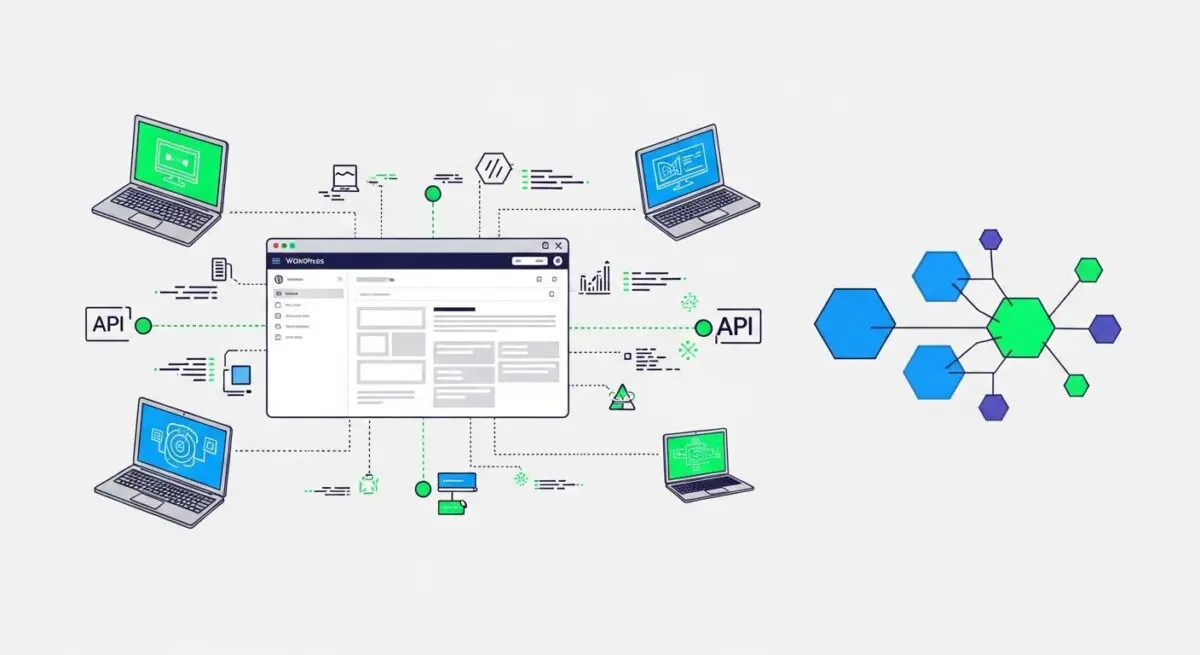
Jamstack is an architectural approach that shifts the burden of page rendering from the server-side at request time to the build-side ahead of time. The term is an acronym for JavaScript, APIs, and Markup. In a traditional WordPress environment, the server processes PHP and queries a MySQL database every time a user requests a page. In contrast, a Jamstack architecture treats WordPress as a Headless CMS, where the backend is used solely for content management and data entry.
The technical workflow involves fetching data via the WordPress REST API or WPGraphQL during a build process. This data is then injected into templates using a static site generator (SSG) like Next.js, Gatsby, or Hugo. The resulting output consists of highly optimized, static HTML, CSS, and JavaScript files that are deployed directly to a Content Delivery Network (CDN). This decoupling ensures that the frontend is entirely independent of the backend server’s uptime or processing speed.
The Real-World Analogy
Imagine a high-end coffee shop. In a traditional WordPress setup, every customer orders a custom drink, and the barista must grind beans, steam milk, and brew the shot for every single person while they wait at the counter. This is server-side processing. In a Jamstack architecture, the shop prepares “Ready-to-Drink” bottled versions of their most popular beverages every morning. When a customer arrives, they simply grab a bottle and go. The quality is identical, but the delivery is instantaneous because the intensive labor was completed before the customer even arrived.
How Jamstack Impacts Server Performance & Speed Engineering?
Jamstack fundamentally alters the performance profile of a WordPress site by removing the dependency on the LAMP/LEMP stack during the critical rendering path. By serving pre-rendered Markup from the edge, the Time to First Byte (TTFB) is minimized to the physical limits of the network, often dropping below 50ms. This architecture eliminates the need for complex server-side caching layers like Varnish or Redis for the frontend, as the assets are already static and immutable.
From a security perspective, Jamstack provides a massive advantage. Since the public-facing site is composed of static files, there is no active connection to the WordPress database or the PHP engine. This effectively neutralizes common attack vectors such as SQL injection, PHP execution vulnerabilities, and DDoS attacks targeting the application layer. Furthermore, the reduction in server-side compute requirements allows for massive scalability without the need for expensive load balancers or high-resource cloud instances.
Best Practices & Implementation
- Implement Incremental Static Regeneration (ISR): Use frameworks like Next.js to update specific pages in the background as traffic comes in, ensuring content remains fresh without requiring a full site rebuild.
- Optimize API Payloads: Use WPGraphQL instead of the standard REST API to fetch only the specific data fields required for a component, reducing the data transfer overhead during the build phase.
- Automate CI/CD Pipelines: Configure webhooks within WordPress to trigger automated builds on platforms like Vercel or Netlify whenever a post is published or modified.
- Offload Dynamic Functionality: Use serverless functions or third-party microservices for dynamic features such as site search (Algolia), comments (Disqus), or contact forms (Formspree).
Common Mistakes to Avoid
A frequent error is over-engineering simple websites where the complexity of a decoupled stack outweighs the performance benefits. Another critical mistake is failing to account for dynamic content requirements; developers often forget that traditional WordPress plugins for forms or memberships will not work out-of-the-box and require API-based alternatives. Finally, neglecting to optimize the build pipeline can lead to long deployment times, which frustrates content editors who expect immediate updates.
Conclusion
Jamstack represents a paradigm shift in WordPress architecture, prioritizing security and edge-level performance through decoupling. It is the gold standard for enterprise-grade scalability and high-availability web deployments in the modern era.