



Executive Summary
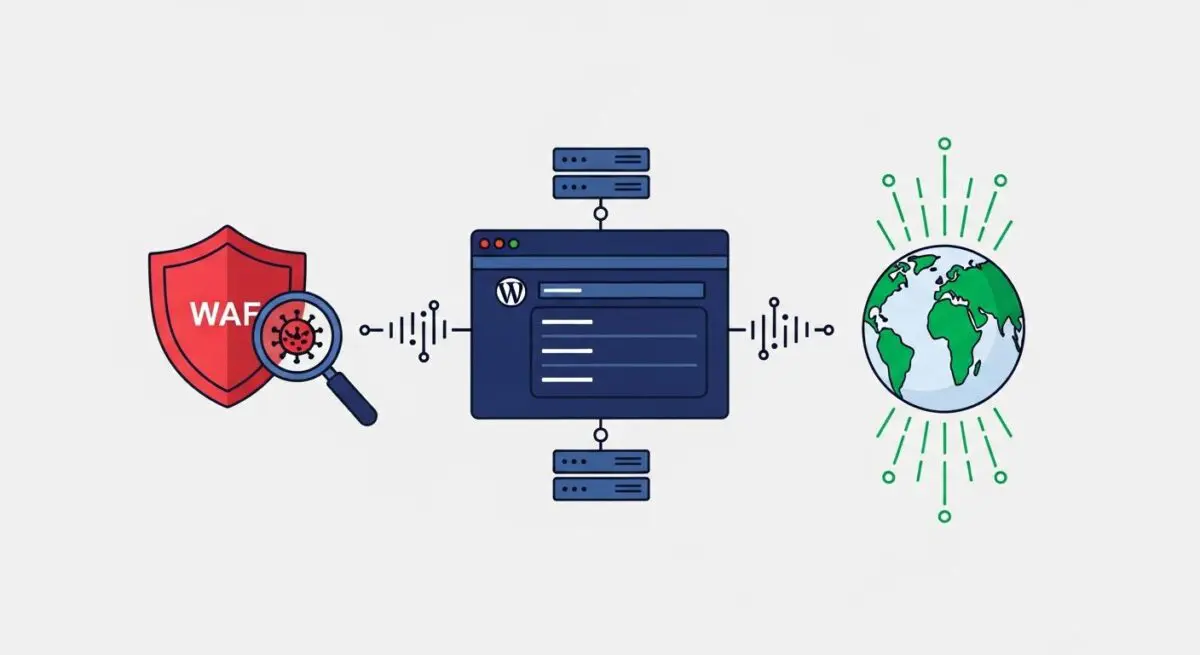
- Cloud-based Layer 7 Web Application Firewall (WAF) that filters malicious traffic at the Anycast edge before it reaches the origin server.
- Comprehensive integrity monitoring including server-side scanning, DNS monitoring, and SSL certificate validation to detect unauthorized changes.
- Integrated Content Delivery Network (CDN) that optimizes global delivery and provides robust DDoS mitigation through massive network capacity.
What is Sucuri Security?
Sucuri Security is an enterprise-grade security suite designed to provide a comprehensive defense-in-depth architecture for WordPress and other CMS platforms. It operates primarily as a cloud-based reverse proxy, positioned between the public internet and the origin hosting server. This architectural placement allows Sucuri to intercept all incoming HTTP/HTTPS requests, performing deep packet inspection (DPI) to identify and neutralize threats such as SQL injection (SQLi), Cross-Site Scripting (XSS), and Remote File Inclusion (RFI) before they ever reach the application layer of the WordPress site. By utilizing a globally distributed Anycast network, Sucuri ensures that security processing is decentralized, providing high availability and low-latency filtering for legitimate traffic.
The platform is comprised of several critical components: the Web Application Firewall (WAF), a continuous monitoring engine, and a professional incident response service. The WAF utilizes a combination of signature-based detection and heuristic analysis to identify known and emerging threats. Furthermore, Sucuri provides ‘virtual patching’ capabilities, which allow the firewall to block exploits targeting vulnerabilities in WordPress core, plugins, or themes even before an official security patch has been released or applied by the site administrator. This proactive approach is essential for maintaining the security posture of complex WordPress environments where immediate updates may not always be feasible due to compatibility testing requirements.
The Real-World Analogy
Imagine an international airport’s security infrastructure. Before a passenger even reaches the boarding gate (the WordPress server), they must pass through multiple layers of screening: passport control (IP reputation), baggage scanning (signature-based filtering), and behavioral analysis (heuristic detection). Sucuri Security acts as this entire perimeter, ensuring that only verified, ‘clean’ traffic ever reaches the terminal. Just as an airport security checkpoint prevents unauthorized individuals from overwhelming the terminal’s resources or causing harm, Sucuri ensures that malicious bots and hackers are stopped at the edge, allowing the internal operations of the airport—or in this case, the WordPress server—to function smoothly and without interruption.
How Sucuri Security Impacts Server Performance & Speed Engineering?
The implementation of Sucuri Security has a transformative impact on server performance and speed engineering. Traditionally, security measures such as login rate-limiting, IP blacklisting, and brute-force protection are handled at the origin server level via WordPress plugins or local firewall configurations (e.g., iptables or mod_security). These methods are resource-intensive, consuming significant CPU cycles and RAM, particularly during a sustained attack. By offloading these security tasks to Sucuri’s edge nodes, the origin server is relieved of the computational burden associated with filtering malicious traffic. This preservation of resources directly translates to improved server response times and greater stability for legitimate users.
Furthermore, Sucuri integrates a high-performance Content Delivery Network (CDN) into its security stack. By caching static assets (such as CSS, JavaScript, and images) and even dynamic HTML across its global Anycast network, Sucuri minimizes the physical distance between the user and the content. This reduction in geographical latency significantly improves Core Web Vitals, specifically the Largest Contentful Paint (LCP) and Time to First Byte (TTFB). The Anycast routing ensures that every request is automatically directed to the nearest Point of Presence (PoP), which not only speeds up delivery but also provides a massive buffer against Distributed Denial of Service (DDoS) attacks by distributing the load across the entire network capacity.
Best Practices & Implementation
- Implement Origin IP Masking: Configure the origin server’s firewall to only accept traffic from Sucuri’s specific IP ranges. This prevents attackers from bypassing the WAF by targeting the server’s IP address directly, a common vulnerability in misconfigured setups.
- Enable Strict SSL/TLS Modes: Utilize the ‘Full SSL’ configuration to ensure that all data transmitted between the Sucuri WAF and the origin server is encrypted. This maintains end-to-end integrity and prevents man-in-the-middle attacks within the transit network.
- Leverage Virtual Patching: Keep the WAF’s security rules updated to take advantage of virtual patching. This is particularly critical for enterprise sites that require extensive staging and testing before applying core or plugin updates.
- Optimize Caching Headers: Fine-tune the caching levels within the Sucuri dashboard to match the site’s update frequency. Use ‘Site Caching’ for static sites and ‘Minimal Caching’ or custom rules for highly dynamic e-commerce environments to ensure content freshness without sacrificing performance.
- Integrate Security Headers: Use Sucuri to inject essential security headers such as HSTS (HTTP Strict Transport Security), X-Frame-Options, and X-XSS-Protection, which further harden the browser-side security of the WordPress site.
Common Mistakes to Avoid
One of the most frequent errors is relying solely on the Sucuri WordPress plugin without activating the Web Application Firewall (WAF). While the plugin provides excellent monitoring and hardening features, it does not offer the perimeter protection that the WAF provides. Another critical mistake is failing to update DNS records correctly; if the A records are not pointed to the Sucuri Anycast IP, the traffic continues to hit the origin server directly, leaving the site exposed. Finally, many administrators neglect to whitelist their own office or developer IP addresses, which can lead to accidental lockouts during intensive administrative tasks or automated API calls.
Conclusion
Sucuri Security is a cornerstone of enterprise WordPress architecture, providing a robust shield that optimizes both security and performance. By offloading threat mitigation to the edge and leveraging a global CDN, it ensures that WordPress environments remain resilient, fast, and scalable in an increasingly hostile digital landscape.