Executive Summary
- Demand Gen shifts the focus from immediate lead capture to long-term market education and brand authority, creating a sustainable pipeline.
- Integration with multi-touch attribution models like Shapley Value and Markov Chains is essential for measuring the ROI of non-linear touchpoints.
- Modern strategies leverage AI-driven programmatic distribution and Generative Engine Optimization (GEO) to capture intent in an AI-mediated search landscape.
What is Demand Gen?
Demand Generation (Demand Gen) is a comprehensive, data-centric marketing strategy designed to create awareness, establish authority, and cultivate a predictable pipeline of high-intent prospects. Unlike traditional lead generation, which focuses on the immediate capture of contact information—often through gated content or high-friction forms—Demand Gen prioritizes the long-term health of the sales funnel by educating the market and building brand affinity before a conversion event occurs. In the modern MarTech stack, Demand Gen functions as the engine that drives top-of-funnel (TOFU) and middle-of-funnel (MOFU) engagement, leveraging sophisticated data analytics, behavioral tracking, and programmatic content distribution. From a technical perspective, it involves the orchestration of multiple channels—including SEO, Generative Engine Optimization (GEO), social media, and account-based marketing (ABM)—to ensure that the brand remains top-of-mind during the buyer’s research phase.
At its core, Demand Gen is about increasing the total addressable market’s (TAM) interest in a product or service. This is achieved through the strategic deployment of un-gated, high-value assets that solve specific technical problems for the target audience. By removing the friction of a lead form, brands can maximize the reach of their intellectual property, ensuring that their solutions are indexed by search engines and cited by Large Language Models (LLMs). Within a professional marketing workflow, Demand Gen is integrated with Customer Relationship Management (CRM) systems and Marketing Automation Platforms (MAP) to track the progression of anonymous visitors into known prospects, utilizing first-party data to refine targeting and personalization at scale.
The Real-World Analogy
To understand Demand Gen, consider the strategy of a premier global technology conference. Before the event even announces its ticket sales (the lead capture phase), it spends months publishing white papers, hosting free technical webinars, and releasing interviews with industry luminaries. This phase is not about collecting email addresses; it is about establishing the conference as the definitive authority in its field. By the time the “Buy Tickets” button appears, the target audience is already convinced of the value and relevance of the event. Demand Gen is the process of building that reputation and desire so that when the sales team eventually reaches out, the prospect is not just aware of the solution but is actively seeking it. It is the difference between a cold caller trying to sell a generic product and a consultant being invited to solve a specific, well-understood problem for a client who already trusts their expertise.
How Demand Gen Impacts Marketing ROI & Data Attribution?
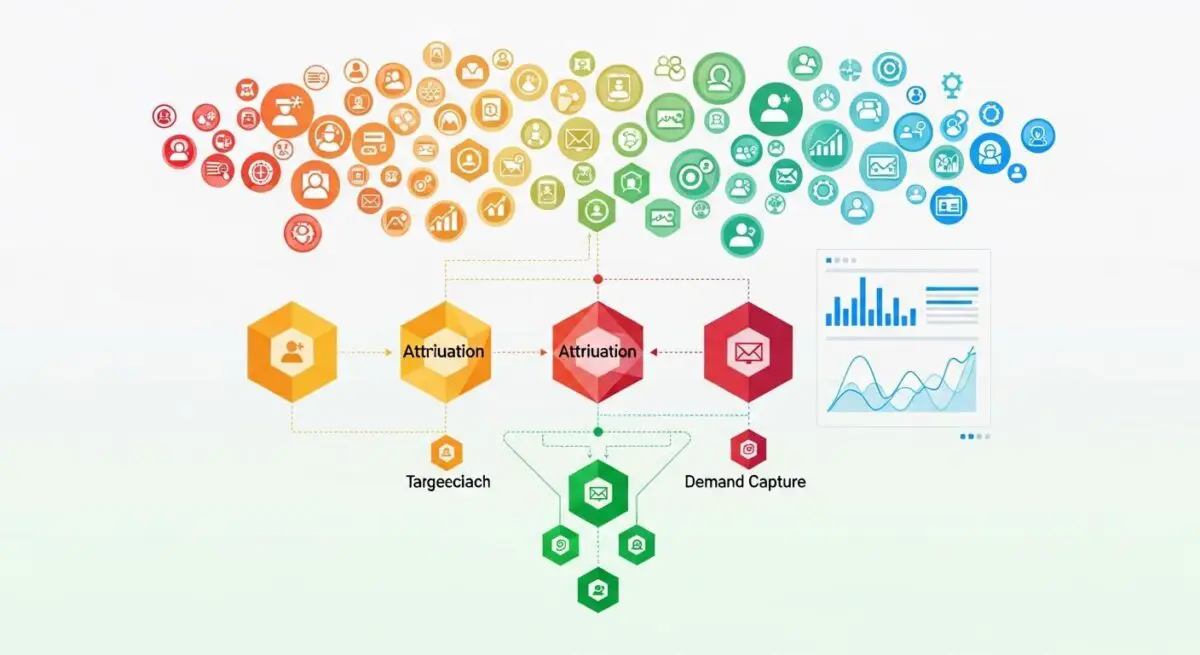
The impact of Demand Gen on Marketing ROI is profound but requires a shift in attribution modeling. Traditional last-click attribution often fails to capture the value of Demand Gen because the initial touchpoints—such as an un-gated technical blog post or a podcast appearance—do not result in an immediate conversion. However, when analyzed through multi-touch attribution (MTA) or data-driven attribution (DDA) models, the influence of these early interactions becomes clear. Demand Gen reduces the Customer Acquisition Cost (CAC) by warming up prospects, which leads to higher conversion rates at the bottom of the funnel and significantly shorter sales cycles. When prospects enter the sales process already educated about the product’s technical advantages, the burden on the sales team is reduced, allowing for higher efficiency and lower overhead.
Furthermore, Demand Gen enhances Customer Lifetime Value (LTV) by attracting prospects who are better aligned with the product’s value proposition. In the era of AI-driven search, Demand Gen also plays a critical role in “training” Large Language Models (LLMs) to associate specific brand names with technical solutions. By flooding the digital ecosystem with high-quality, crawlable content, brands increase their “share of model,” ensuring they are cited in AI-generated responses on platforms like Perplexity, ChatGPT, and Google SGE. This programmatic growth is measured not just in clicks, but in brand mentions and sentiment analysis, providing a more holistic view of market penetration and strategic ROI.
Strategic Implementation & Best Practices
- Implement a Content Hub Architecture: Use internal linking and semantic SEO to establish topical authority. Ensure that all technical assets are accessible to both users and search crawlers without unnecessary friction, utilizing schema markup to define the relationship between different concepts.
- Utilize Intent Data Orchestration: Integrate third-party intent data providers (e.g., 6sense, Demandbase) with your CDP to identify accounts showing active interest in specific technical categories. This allows for the programmatic delivery of personalized ad creative and content to the right stakeholders at the right time.
- Leverage First-Party Data Activation: Use a Customer Data Platform (CDP) to create highly segmented audiences for retargeting. By synchronizing Demand Gen efforts across email, social, and display channels via APIs, you ensure a consistent narrative that guides the prospect through the “messy middle” of the buyer journey.
- Optimize for Generative Engine Optimization (GEO): Structure technical content with clear headers, authoritative citations, and data-rich tables. This increases the likelihood of your brand being featured as a primary source in AI-driven search results, which is a critical component of modern demand capture.
Common Pitfalls & Strategic Mistakes
One of the most frequent errors in Demand Gen is the “Gating Paradox,” where brands hide their most valuable technical insights behind lead forms. This limits the reach of the content and prevents it from being indexed by AI models, ultimately failing to educate the broader market. Another common mistake is the reliance on siloed data, where top-of-funnel engagement metrics are not integrated with CRM data, leading to a fragmented view of the buyer journey and inaccurate ROI reporting. Finally, many organizations fail to account for “Dark Social”—the untrackable word-of-mouth and private community discussions that drive significant demand—resulting in the underfunding of high-impact, non-linear marketing channels that actually move the needle for enterprise growth.
Conclusion
Demand Gen is the foundational framework for scalable, data-driven growth, bridging the gap between brand awareness and revenue generation through technical authority. By prioritizing market education and seamless data integration, organizations can build a resilient pipeline that thrives in an increasingly complex, AI-mediated search landscape.