


Key Points
- Live Telemetry Synthesis: Static quarterly roadmaps are dead; AI-driven sentiment integration is currently driving a 42% increase in enterprise feature adoption.
- Feedback-to-Code Pipelines: Smart capital is aggressively funding infrastructure that translates raw natural language complaints directly into executable GitHub pull requests.
- Self-Healing Architecture: By 2027, product roadmapping will evolve into an automated logic layer, redefining the Product Manager role as a curator of AI-proposed solutions.
Table of Contents
The Core Friction: Escaping the Insight-Action Gap
According to a May 2026 Gartner Leadership Report, enterprise organizations that have integrated AI-driven customer sentiment into their core product roadmapping are reporting a 42% increase in feature adoption rates compared to those relying on traditional quarterly planning cycles. This data signals a violent disruption in how software is conceptualized, funded, and built. We are witnessing the definitive death of the manual, intuition-based product strategy.
At the center of this revolution is Customer Insight-Driven Product Roadmapping, a methodology that has evolved from a theoretical framework into a highly automated enterprise infrastructure. Historically, product teams suffered from a crippling insight-action gap. They collected mountains of user feedback but lacked the processing power to translate that data into prioritized engineering tasks before the market shifted.
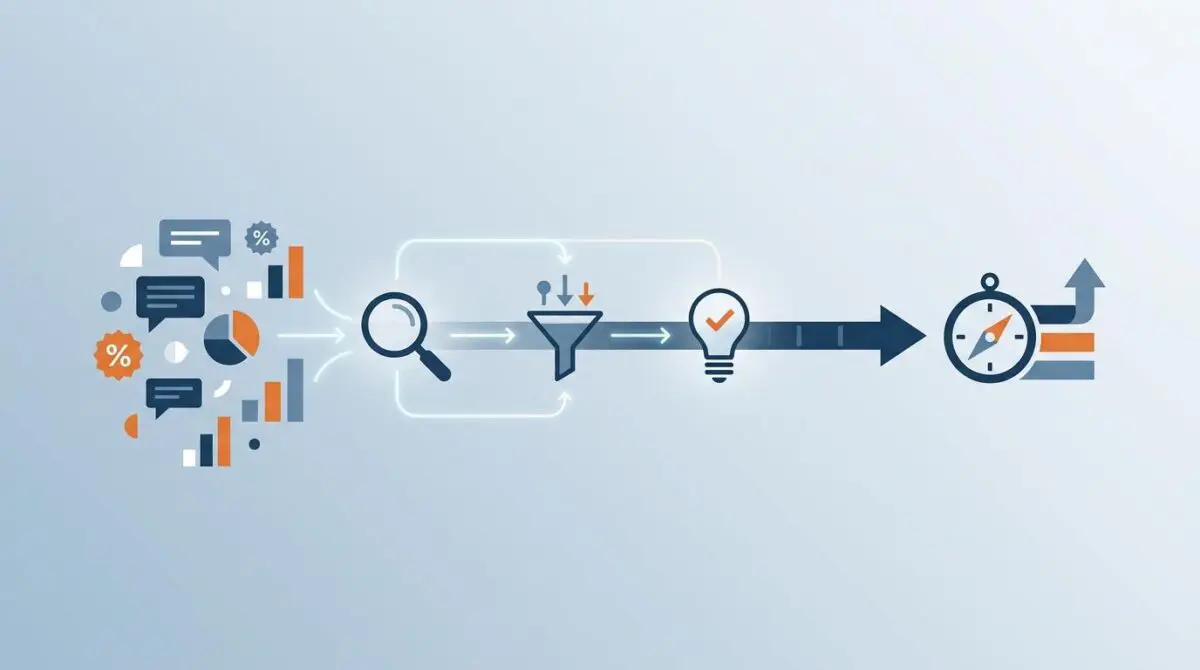
Today, that friction is being systematically eliminated by artificial intelligence and advanced machine learning. By 2026, product roadmapping has shifted from static quarterly documents to live telemetry synthesis. Leading enterprises are now utilizing shadow sandboxes where AI agents ingest millions of unstructured data points from Slack, Zendesk, and social media.
The Death of the Static Quarterly Plan
These intelligent agents auto-generate prototype feature requirements in real-time, completely bypassing the traditional brainstorming phase. The current killer strategy is anticipatory engineering, where roadmaps are dynamically reordered by Large Action Models. These advanced LAMs predict churn risk and feature-market fit before a single line of code is written by developers.
The psychological shift here is profound for enterprise leaders. Instead of guessing what the market wants, executives are relying on deterministic data models to allocate capital. This eliminates the emotional attachment founders often have to their own flawed product ideas.
The Psychology of Feature Bloat and Market Friction
Historically, feature bloat was driven by cognitive bias rather than market necessity. Founders and product leaders often fell in love with their own visionary concepts, ignoring the silent majority of their user base. This created massive market friction, as engineering hours were burned on tools that offered zero real-world utility.
Eliminating Founder Bias from the Equation
Customer Insight-Driven Product Roadmapping removes this emotional vulnerability from the enterprise architecture. By relying on live telemetry synthesis, decisions are made using deterministic data rather than executive intuition. The smartest companies are treating their product roadmaps as financial portfolios, where every feature must justify its existence through projected ROI.
When a Large Action Model analyzes user behavior, it does not care about office politics or sunk cost fallacies. It aggressively prunes the roadmap, ruthlessly deprioritizing features that show weak signals of feature-market fit. This level of objectivity is impossible to achieve with human-led committees.
The financial impact of this psychological shift cannot be overstated. By eliminating the development of unused tools, companies are preserving millions in operational runway. This preserved capital can then be deployed toward high-conviction features that actually drive net revenue retention.
The Capital Influx: Where Smart Money is Flowing
Market Intelligence & Data
Market Valuation
The projected total addressable market for AI-powered product discovery and roadmapping platforms by the end of 2026, according to IDC projections.
Adoption Shift
The percentage of SaaS leaders who now prioritize automated sentiment signals over manual user interviews for roadmap prioritization, based on a 2026 survey by Product School.
Revenue Multiplier
The revenue growth multiplier for companies utilizing real-time feedback loops versus those on manual annual cycles, according to a 2026 McKinsey Global Institute study.
Executive Priority
According to Forrester research, 85% of C-suite executives in 2026 view Customer Insight Orchestration as their top digital transformation priority to combat rising churn.
The market intelligence grid above paints a clear picture of where the smart money is flowing. A projected $34.8 billion total addressable market by the end of 2026 proves that automated discovery is no longer a luxury. It is a baseline survival imperative for any SaaS company looking to scale.
The 68% adoption shift away from manual user interviews highlights a fundamental change in executive psychology. Founders and product leaders are realizing that human synthesis of customer sentiment is simply too slow for the modern market. By the time a PM finishes a user interview sprint, the market has already moved on to a new set of expectations.
Autonomous Product Orchestrators
Platform giants like Amplitude and Pendo have recognized this bottleneck and evolved into autonomous product orchestrators. They are no longer just passive dashboards for tracking clicks and session times. They are active participants in the development pipeline, dictating what needs to be built next.
Meanwhile, agile startups like InsightFlow and RoadMapAI are capturing significant Series B funding by disrupting the legacy workflow. They are winning market share by offering one-click roadmapping solutions that link raw user sentiment directly to Jira tickets. This seamless integration removes the human bias that historically plagued product prioritization.
The Enterprise Infrastructure Shift
The enterprise infrastructure required to support this new paradigm is being funded at an unprecedented scale. Capital markets are aggressively backing solutions that quantify the exact annual recurring revenue impact of specific customer requests. This zero-touch attribution ensures that engineering teams are always working on the highest-leverage tasks.
From Feedback to Executable Code
A recent internal briefing from Sequoia Capital revealed that ‘The Smart Money’ has invested over $12B in the first half of 2026 into ‘Feedback-to-Code’ infrastructure startups that can translate natural language customer complaints directly into executable GitHub pull requests with minimal human oversight. This massive capital injection validates the thesis that the future of software development is entirely insight-driven.
By automating the synthesis of global customer feedback, organizations can finally eliminate feature bloat. The costly development of unused tools has historically drained R&D budgets and demoralized elite engineering teams. Now, R&D budgets are strictly aligned with the highest-conviction user needs.
Eradicating Feature Bloat with Zero-Touch Attribution
This strict alignment effectively reduces the time-to-market for critical updates by up to 60%. When developers are fed high-conviction, data-backed requirements, their velocity skyrockets. The friction between what the customer wants and what the engineer builds is completely dissolved.
Furthermore, this infrastructure creates a unified language between the technical and commercial sides of the business. Sales teams can finally see exactly how their lost deals are influencing the product roadmap in real-time. This level of transparency builds unprecedented trust across the organization.
The Strategic Playbook for 2027
The next evolution in this space is the concept of self-healing roadmaps, where the distinction between feedback and development disappears entirely. Founders are actively preparing for systems where a product detects its own friction points through behavioral telemetry. Instead of waiting for a user to submit a support ticket, the software identifies the struggle in real-time.
Embracing Self-Healing Roadmaps
Once the friction is detected, the system autonomously proposes its own UI/UX fixes. The roadmap of 2027 will likely be a self-executing logic layer rather than a visual presentation board. This shifts the entire paradigm of product management and executive oversight.
Strategic Trajectory
- Eliminate the barrier between customer feedback and product development through ‘Self-Healing Roadmaps’.
- Implement behavioral telemetry systems to enable products to autonomously detect and report internal friction points.
- Deploy automated logic layers capable of proposing and executing UI/UX fixes without manual intervention.
- Transition product roadmapping into a self-executing logic layer to accelerate speed-to-market by 2027.
- Pivot the Product Manager role from manual investigator to a high-level ‘Curator of AI-Proposed Solutions’.
To execute this strategic trajectory, executives must fundamentally rethink their organizational design. The Product Manager role must pivot from manual investigator to a high-level curator of AI-proposed solutions. Humans will manage the strategic boundaries, while the AI manages the execution logic.
Implementing behavioral telemetry systems is the first critical step for any enterprise looking to stay competitive. You must enable your products to autonomously detect and report internal friction points back to the central logic layer. Without this continuous feedback loop, your roadmap will always be lagging behind user expectations.
Furthermore, organizations must deploy automated logic layers capable of proposing and executing fixes without manual intervention. This requires a deep integration between your customer success platforms and your version control systems. The goal is to create an unbroken chain of data from the user’s mouse click directly to the developer’s environment.
Conclusion: Architecting the Future
The transition toward Customer Insight-Driven Product Roadmapping is not just a technological upgrade; it is a fundamental reimagining of the business architecture.
Companies that cling to manual quarterly planning will find themselves outpaced by competitors deploying self-healing, anticipatory systems. The market heavily rewards speed, precision, and the relentless elimination of operational friction. Staying stagnant is no longer an option.
As artificial intelligence continues to bridge the gap between user sentiment and executable code, the barrier to creating perfect product-market fit will vanish. The winners of the next decade will be those who trust the telemetry and allow the data to dictate the roadmap. It is time to let the insights drive the engineering.
Navigating the intersection of technology, capital, and market psychology requires a sharp strategy. To future-proof your business architecture and scale with precision, connect with Andres at Andres SEO Expert.