Key Points
- Autonomous Execution: The transition from passive APIs to Agentic Infrastructure enables autonomous workflows, eliminating the historical 48-hour settlement window through Just-in-Time (JIT) liquidity.
- Institutional Liquidity: Smart capital is aggressively backing Vertical AI and self-healing ledgers, shifting institutional reliance toward tokenized cross-border pipelines and sovereign financial networks.
- Invisible Finance: The future of financial architecture is Intent-Based Finance, where natural language interfaces execute complex multi-step workflows invisibly within enterprise software.
Table of Contents
The Financial Tech Friction: Moving Beyond Passive APIs
According to a May 2026 report by Gartner, global spending on AI agent software in the financial sector is projected to reach $206.5 billion this year as institutions pivot toward fully autonomous business operations.
This massive influx of capital highlights a fundamental shift in how we build financial technology. For years, founders and financial architects have duct-taped passive API integrations together to build their platforms.
This legacy approach created a fragile ecosystem prone to bottlenecks, manual reconciliation, and catastrophic latency. If you were to design the ultimate Fin-tech stack for a friend today, you would completely bypass these archaic rails.
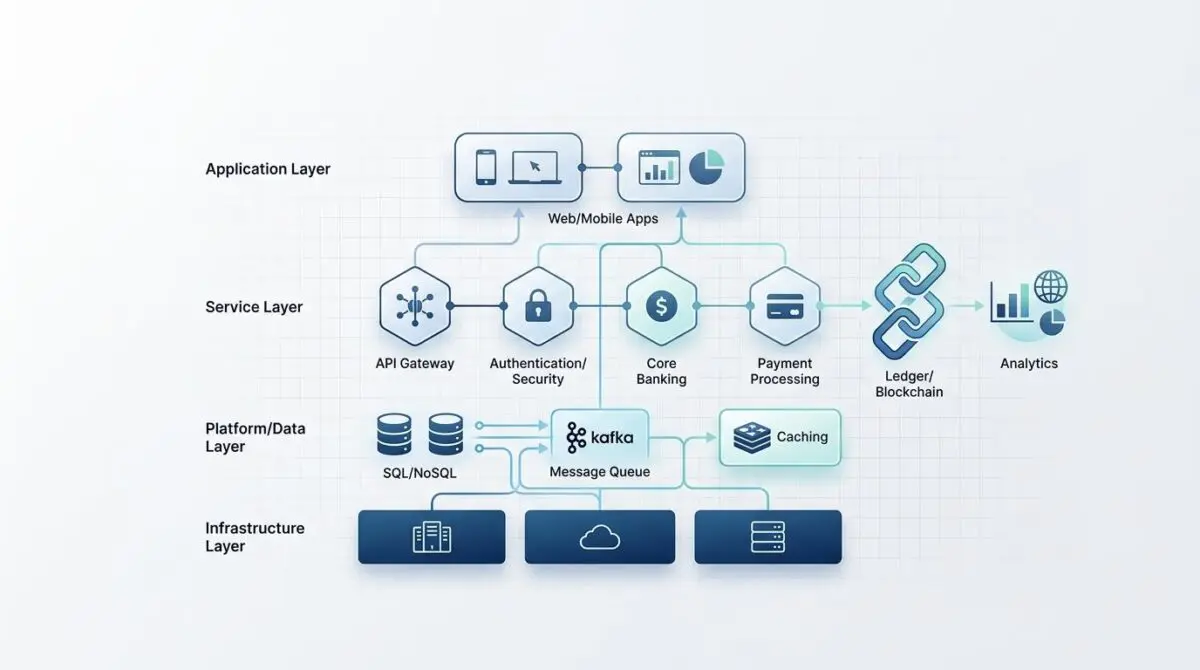
You would build an Agentic FinTech Infrastructure Stack. This is not just an incremental software upgrade; it is a fundamental rewrite of how digital money moves, settles, and grows.
The Rise of Autonomous Business Operations
The modern tech stack flips the passive paradigm entirely on its head. We are entering an era where the infrastructure itself possesses a sophisticated reasoning layer.
This reasoning layer is powered by autonomous AI agents that handle complex multi-step workflows without any human intervention. Imagine real-time liquidity matching and automated tax optimization executing flawlessly in the background.
These systems are supported by cloud-native microservices and event-driven ledgers. They enable sub-second settlement across global rails like FedNow and tokenized cross-border pipelines.
This is the definitive architecture for the modern enterprise. It transforms finance from a reactive department into a proactive, autonomous growth engine.
Market Intelligence & Capital Flow
To understand the magnitude of this technological shift, we must follow the institutional capital. The numbers dictate the narrative, and smart money is no longer interested in legacy wrappers.
Market Intelligence & Data
Embedded Finance Market
The global embedded finance market is valued at $155.96 billion in 2026 as non-financial platforms become primary distribution hubs, according to Mordor Intelligence.
AI Concentration
AI-centric startups accounted for 58% of all fintech venture capital investments in the most recent fiscal cycle, as reported by Silicon Valley Bank.
Embedded Transactions
Annual transaction value through embedded finance rails in the US is expected to exceed $7 trillion by the end of 2026, per data from Bain & Company.
CFO AI Momentum
A 2026 survey from Citizens Bank indicates that 82% of midsize company CFOs have prioritized increasing their AI infrastructure budgets to enhance decision velocity.
This data reveals a profound transformation in the financial ecosystem. The massive valuation of the embedded finance market proves that non-financial platforms are the new distribution hubs for capital.
Decoding the Smart Money Pivot
The heavy concentration of AI in venture capital is not a speculative fad. It is a calculated move by institutional investors to monopolize the next generation of financial rails.
CFOs are actively weaponizing their balance sheets by prioritizing AI infrastructure budgets. They understand that decision velocity and automated execution are the ultimate competitive advantages in a volatile market.
This capital flow signals the death of traditional banking interfaces. The future belongs to platforms that can embed financial utility directly into the user’s daily operational workflow.
The FinTech Deep Dive: Architecting the Agentic Stack
Building the Agentic FinTech Infrastructure Stack requires a deep understanding of both distributed systems and artificial intelligence. The goal is to create a self-sustaining financial organism.
Eradicating Integration Debt and Settlement Latency
The modern stack solves the massive Integration Debt that previously hindered business velocity. Legacy systems forced companies to rely on expensive short-term bridge financing just to cover operational gaps.
By utilizing unified API layers and AI-driven reconciliation, the historical 48-hour settlement window is officially eliminated. Sub-second settlement is now the baseline expectation for any serious financial platform.
This technological leap enables Just-in-Time liquidity. Businesses can now deploy capital the absolute instant it is earned, effectively ending the reliance on manual back-office auditing and bloated treasury teams.
Tokenized Pipelines and Sovereign Financial Networks
Institutional flows from powerhouse firms like Sequoia and Citi Ventures are heavily concentrated in stablecoin infrastructure. They are building sovereign financial pipelines to completely bypass traditional banking gatekeepers.
Data from QED Investors reveals that stablecoin payment processing volume surged to $9 trillion in 2025, an 87% year-over-year increase, signaling a massive shift toward tokenized assets for institutional cross-currency exchange.
This liquidity migration is fundamentally altering the global macroeconomic landscape. Tokenized cross-border pipelines offer a frictionless, mathematically verifiable alternative to the archaic and expensive SWIFT network.
As these sovereign networks mature, they will absorb trillions in corporate treasury flows. The Agentic FinTech Infrastructure Stack is the only architecture capable of routing these tokenized assets efficiently.
The Disruption of Core Banking Ledgers
Smart capital is aggressively pivoting toward Vertical AI and Agentic-as-a-Service providers. Dominant players like Stripe and Adyen have already evolved into comprehensive ecosystem orchestrators.
Meanwhile, aggressive startups like LedgerWorks and FlowState are disrupting core banking from the inside out. They provide real-time, self-healing ledgers that automatically correct data discrepancies without human oversight.
These event-driven ledgers ensure that every single transaction is instantly verifiable and immutable. This architecture entirely eliminates the need for nightly batch processing and weekend reconciliation blackouts.
Naturally, as these autonomous systems scale globally, navigating cross-jurisdictional compliance becomes a real-time computational challenge. However, modern agentic stacks embed regulatory guardrails directly into the smart contract layer, ensuring continuous compliance without sacrificing execution speed.
The Strategic Action Plan: Embracing Intent-Based Finance
The technological trajectory for the next 12 to 24 months is crystal clear. The landscape will aggressively move toward Intent-Based Finance.
Strategic Trajectory
- Pivot toward Intent-Based Finance by transitioning from monitoring dashboards to objective-driven execution models.
- Replace manual interfaces with natural language processing to handle complex financial intents autonomously.
- Deploy agents capable of optimizing cash yield and liquidity across regional subsidiaries and diverse financial rails.
- Orchestrate financial operations across both decentralized and centralized environments through intelligent automation.
- Integrate Invisible Finance capabilities as a background utility within existing non-financial enterprise software.
Founders and financial architects must internalize this roadmap immediately. The days of building complex visual dashboards for treasury teams are over.
From Dashboards to Invisible Finance
Executives must prepare their organizations for the era of Invisible Finance. Traditional graphical user interfaces will be entirely replaced by sophisticated natural language processing models.
Users will simply input financial intents, such as optimizing cash yield across all regional subsidiaries. The agentic stack will interpret this intent and execute it autonomously across both decentralized and centralized rails.
The infrastructure will operate entirely as a background utility within non-financial enterprise software. To survive this transition, institutions must stop building standalone software and start deploying intelligent financial agents.
Conclusion
The Agentic FinTech Infrastructure Stack is not just the ultimate toolkit to recommend to a founder friend. It is the definitive blueprint for the next decade of global autonomous commerce.
Those who cling to passive APIs, batch processing, and manual reconciliation will be rapidly outpaced by competitors wielding autonomous capital. The transition to intent-based, invisible finance is already underway, and the smart money has already placed its bets.
Navigating the intersection of financial technology, institutional capital, and market psychology requires a sharp strategy. To future-proof your FinTech architecture and scale with precision, connect with Andres at Andres SEO Expert.