




Key Points
- Entity-Based Authority: Transition from keyword targeting to defining your brand as a unique, disambiguated node within AI knowledge graphs.
- RAG-Friendly Chunking: Structure content into semantically dense, modular blocks that fit within the context windows of large language models.
- Citation Velocity: Secure placement in generative engine overviews by maximizing factual groundedness and verifiable multi-source consensus.
Table of Contents
The AI Search Context
According to a 2026 BrightEdge report, AI Overviews now appear for 84% of all commercial search queries, leading to a 25% decrease in traditional organic traffic but a 40% increase in lead quality for cited brands.
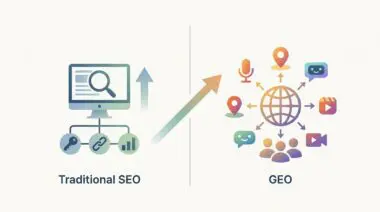
The paradigm has officially shifted away from traditional search engine optimization.
Historically, optimization focused on satisfying keyword algorithms and accumulating raw backlink authority.
Today, the primary user interacting with your website is no longer a human eye scanning for blue links.
Instead, the user is a Large Language Model or a specialized retrieval agent.
These autonomous agents synthesize your raw data into conversational, zero-click answers.
Brands failing to adapt their technical architecture for this machine readability are experiencing catastrophic visibility drops.
Conversely, organizations optimizing for entity-based authority are securing dominant placements within generative engine interfaces.
Success is now measured by citation velocity.
This metric tracks the frequency and accuracy with which an LLM references your proprietary data to fulfill a complex user intent.
Traditional organic traffic is aggressively bifurcating into two distinct streams.
The first stream consists of zero-click AI answers that satisfy informational queries instantly.
The second stream comprises high-intent citation traffic driven by users clicking through the AI’s source links for deeper validation.
To capture this high-intent traffic, your digital presence must be re-engineered from the ground up.
This requires a profound understanding of how vector databases index content and how language models generate responses.
Core Architecture & Pillars
Core Architecture & Pillars
Entity-Based Authority Mapping
AI engines prioritize “entities” over “keywords.” This involves defining your brand as a unique node within a knowledge graph, ensuring that LLMs can disambiguate your products or services from competitors using persistent identifiers.
RAG-Friendly Content Chunking
Retrieval-Augmented Generation functions best when content is structured in semantically dense “chunks” that fit within an LLM’s context window. Long-form content must be modularized to be easily indexed by vector databases.
Semantic Connectivity & Citations
Generative engines verify facts across multiple sources. To be cited in an AI Overview, your content must align with the “consensus” of high-authority nodes while providing unique, verifiable data points that the engine cannot find elsewhere.
Multi-Modal Indexing Readiness
By 2026, AI Search is multi-modal. Overviews often synthesize text, video snippets, and data tables. Technical optimization requires structured representations of non-textual assets to be included in the LLM’s “reasoning” process.
Entity-Based Authority Mapping
Artificial intelligence engines do not understand keywords in the traditional sense.
They process entities, relationships, and concepts mapped across vast, multi-dimensional knowledge graphs.
To dominate in Generative Engine Optimization (GEO), you must define your brand as a unique, unambiguous node.
This requires moving far beyond standard metadata or basic keyword density.
You must implement highly granular Schema.org definitions that link directly to persistent identifiers.
Connecting your digital properties to Wikidata or DBpedia entries establishes an undeniable factual grounding.
When an engine can mathematically verify your entity against established global databases, your citation probability skyrockets.
This disambiguation process ensures that an LLM never confuses your proprietary products with a competitor’s offerings.
It transforms your brand from a mere string of text into a recognized, authoritative entity within the machine’s neural network.
RAG-Friendly Content Chunking
Modern AI search relies heavily on Retrieval-Augmented Generation to pull real-time facts into conversational outputs.
This architecture functions optimally when source content is structured in semantically dense chunks.
These chunks must fit neatly within the restrictive context windows of parsing language models.
Long-form, rambling content is notoriously difficult for vector databases to index and retrieve accurately.
OpenAI’s latest ‘SearchGPT 4.0’ whitepaper reveals that their retrieval algorithm prioritizes ‘Semantic Density’—the ratio of factual nodes to word count—over traditional backlink profiles.
You must modularize your site architecture using strict heading hierarchies.
Every section should begin with a summary block to feed the pre-fetch logic of AI search agents.
By delivering high-signal, low-noise content blocks, you reduce the computational load required to process your pages.
This computational efficiency directly correlates with higher inclusion rates in generative overviews.
Semantic Connectivity & Citations
Generative engines are programmed to verify facts across multiple authoritative sources before presenting them to a user.
To be cited in an AI Overview, your content must align with the broader consensus of high-authority nodes.
However, simply echoing consensus is not enough to secure the primary citation link.
You must provide unique, verifiable data points that the engine cannot easily source elsewhere.
Internal linking must evolve from a tactic for distributing page rank into a strategy for semantic mapping.
Automated related-entity links help AI crawlers build a comprehensive conceptual map of your topical expertise.
External citations to rigorous, peer-reviewed data further validate your semantic cluster.
This web of connectivity proves to the retrieval agent that your domain is a central hub of accurate information.
Multi-Modal Indexing Readiness
By 2026, the AI search experience is inherently multi-modal.
Overviews synthesize text, video snippets, audio transcripts, and complex data tables into a single cohesive answer.
Technical optimization now demands structured representations of all non-textual assets.
If your proprietary data is locked inside a flat image file, the language model cannot parse or reason with it.
You must deploy clean HTML tables, comprehensive VideoObject schema, and explicit segment markers.
This ensures your multimedia assets are fully integrated into the LLM reasoning process.
Providing structured data pipelines for visual and auditory content grants you a massive competitive advantage.
It allows the generative engine to extract specific frames or data points to enrich its user-facing output.
The Execution Roadmap
Implementation Roadmap
Entity Disambiguation Audit
Verify that your Organization Schema is valid and linked to your social profiles and official Knowledge Graph IDs. Use a tool like the Schema Markup Validator to ensure there are no “orphan” nodes.
Implement Semantic Block Headers
Restructure WordPress post templates to include a “Key Takeaways” block at the top. This block should contain 3-5 bullet points optimized for the “Answer Box” logic used by SearchGPT and Google AIO.
Vectorize Site Navigation
Ensure your sitemap.xml includes “lastmod” tags for every URL and implement a “Search Action” schema. This allows AI engines to understand how to deep-link into your site for specific conversational follow-ups.
Factual Grounding Reinforcement
Update high-traffic pages to include citations to external high-authority sources (e.g., .gov, .edu, or industry leaders). LLMs are more likely to trust and cite content that demonstrates “groundedness” in established facts.
AI Citation Monitoring
Monitor Google Search Console for “AI Overview” impressions. Use third-party LLM rank trackers to see if your brand is being mentioned in conversational queries for your target topics.
Entity Disambiguation Audit
The first step in any strategic GEO campaign is auditing your foundational entity architecture.
You must verify that your Organization Schema is structurally flawless and fully validated.
This schema must explicitly link to your verified social profiles, corporate Wikipedia pages, and official Knowledge Graph IDs.
Use advanced markup validators to ensure there are no orphan nodes within your data structure.
An orphan node is an entity that lacks clear semantic relationships to recognized authorities.
Resolving these disconnects signals trust and structural integrity to crawling AI agents.
Furthermore, ensure that your author entities are equally disambiguated to establish topical authority.
Every piece of content must be mathematically tied to a recognized expert within your niche.
Implement Semantic Block Headers
Content templates must be radically restructured to accommodate machine reading patterns.
Inject a dedicated key takeaways block at the very top of every major article or landing page.
This block should contain three to five highly factual, dense bullet points.
These bullets are specifically optimized for the extraction logic utilized by SearchGPT and Google AI Overviews.
When an LLM scans a document, it heavily weights the initial tokens for context and summarization.
Providing a pre-summarized, semantically rich header dramatically increases your inclusion rate in zero-click answers.
It acts as a high-speed injection vector directly into the model’s short-term memory.
This tactic bypasses the need for the engine to parse thousands of words of surrounding context.
Vectorize Site Navigation
Traditional XML sitemaps are no longer sufficient for complex AI crawling.
You must ensure your sitemap includes accurate modification tags for every single URL.
Furthermore, implementing a Search Action schema allows engines to understand your site’s internal query structure.
This technical enhancement enables AI agents to deep-link directly into your architecture.
When users ask conversational follow-up questions, the LLM can seamlessly route them to your specific granular pages.
Vectorizing your navigation transforms your site from a static brochure into an interactive knowledge base.
It allows retrieval agents to traverse your domain using semantic proximity rather than rigid hyperlink structures.
This fluid navigation model is essential for capturing multi-turn conversational search traffic.
Factual Grounding Reinforcement
Language models are inherently prone to hallucination, which is their greatest vulnerability.
To combat this, their retrieval algorithms heavily favor source material that demonstrates rigorous factual grounding.
You must update all high-traffic pages to include explicit citations to external, high-authority sources.
Linking to government databases, educational institutions, and recognized industry leaders transfers trust to your domain.
An LLM is exponentially more likely to cite your brand if your content is demonstrably anchored in established facts.
This practice creates a verifiable chain of custody for the information you publish.
It effectively offloads the burden of fact-checking from the generative engine back to your architecture.
Engines reward this reduction in computational risk with higher citation visibility.
AI Citation Monitoring
Tracking traditional keyword rankings is rapidly becoming a vanity metric.
You must pivot your analytics focus to monitoring AI Overview impressions within Google Search Console.
Additionally, deploy third-party LLM rank trackers to measure brand mentions across various conversational queries.
You need to know exactly when and how your brand is being surfaced by different model architectures.
If your citation velocity drops, it signals a disconnect in your semantic density or entity mapping.
Continuous monitoring allows for agile adjustments to your GEO strategy before traffic completely evaporates.
Understanding the specific prompts that trigger your brand mentions enables you to reverse-engineer user intent.
This data loop is critical for refining your RAG-friendly content chunking over time.
Technical Implementation
Executing a flawless GEO strategy requires precise code-level interventions.
The foundation of your entity authority rests on a perfectly structured JSON-LD payload.
This payload must be injected into the header of your primary domain architecture.
It explicitly defines your organization, connects it to external knowledge graphs, and declares your specific areas of expertise.
Below is the exact schema configuration required to disambiguate your brand for generative engines.
{
  "@context": "https://schema.org",
  "@type": "Organization",
  "name": "YourBrand",
  "url": "https://example.com",
  "sameAs": [
    "https://www.wikidata.org/wiki/Q12345"
  ],
  "knowsAbout": [
    "Generative Engine Optimization",
    "AI Search Strategy"
  ],
  "description": "Leading authority on AI Search shifts in 2026."
}
Ensure that the Wikidata identifier precisely matches your verified corporate entity.
The expertise array must align perfectly with the topical clusters you target in your content architecture.
Any discrepancy between this schema and your on-page semantic signals will result in algorithmic demotion.
Furthermore, this schema must be dynamically updated as your organizational footprint expands.
Validation & Future-Proofing
Validation & Monitoring
- Perform manual validation by querying the “AI Overview” for primary keywords and verifying the presence of your URL in the “Sources” carousel.
- Deploy automated “Brand Mention” audits using Perplexity’s API to track citations across model versions like GPT-5 and Claude 4.
- Adjust the semantic density and structural modularity of content chunks if the brand fails to appear in the synthesized engine responses.
The landscape of artificial intelligence is evolving at an unprecedented velocity.
Validation cannot be a one-time event; it must be a continuous, automated process.
As models deploy new retrieval mechanisms, your architecture must adapt instantly.
If automated audits reveal a drop in brand mentions, immediately review the structural modularity of your content.
Often, a failure to appear in synthesized responses indicates that your content chunks are too diffuse.
Tightening semantic density and reinforcing factual grounding will typically restore your citation velocity.
You must also monitor the evolving context window limits of primary language models.
As these windows expand, your chunking strategy may need to be recalibrated to provide deeper contextual signals.
Remaining agile in your technical SEO implementation is the only way to survive the generative shift.
Navigating the intersection of traditional SEO and Generative Engine Optimization requires a precise architecture. To future-proof your enterprise stack for AI Overviews and LLM discovery, connect with Andres at Andres SEO Expert.
Frequently Asked Questions
What is Generative Engine Optimization (GEO)?
GEO is the strategic process of re-engineering digital content to be machine-readable for Large Language Models and AI retrieval agents. It prioritizes entity-based authority and semantic density over traditional keyword optimization to secure citations in AI-generated search results.
How does AI search influence commercial query traffic?
AI search causes traffic to bifurcate into zero-click conversational answers and high-intent citation traffic. While traditional organic volume may decrease by roughly 25%, the quality of leads for cited brands often increases by up to 40% as users seek deeper validation from source links.
What defines RAG-friendly content for AI indexing?
Content is RAG-friendly when it is structured in semantically dense, modularized chunks that fit within an LLM’s context window. Using summary blocks and strict heading hierarchies allows vector databases to accurately index and retrieve specific factual nodes from your site.
Why is entity-based authority mapping essential for brands?
Entity-based authority mapping establishes a brand as a unique, unambiguous node within a knowledge graph using identifiers like Wikidata. This allows AI engines to mathematically verify your brand’s identity, distinguishing your proprietary information from competitors and increasing citation probability.
What is the significance of “citation velocity” in AI search?
Citation velocity is a metric tracking the frequency and accuracy with which an LLM references your data to fulfill user intent. It has replaced traditional keyword rankings as the primary measure of success for visibility within generative search interfaces.
How does multi-modal indexing readiness impact AI Overviews?
By 2026, AI search is multi-modal, synthesizing text, video snippets, and data tables. Brands that implement structured representations of all non-textual assets allow AI engines to integrate their multimedia content directly into the model’s reasoning and output process.
How should organizations monitor their GEO performance?
Organizations should track AI Overview impressions via Google Search Console and deploy third-party LLM rank trackers to monitor brand mentions. This feedback loop allows for agile adjustments to content modularity and semantic density if citation velocity drops.