Key Points
- Agentic AI Integration: The transition from generative to Agentic AI empowers autonomous workflows to execute complex liquidity management without manual intervention.
- Eradicating the Complexity Tax: Deploying an autonomous finance stack reduces operational overhead by up to 60 percent, reallocating legacy IT budgets toward pure innovation.
- Intent-Based Banking: User interfaces are shifting from static dashboards to natural language commands, capturing a projected $1.5 trillion Agentic Commerce market.
Table of Contents
The Financial Tech Friction
According to PitchBook data from May 2026, the AI sector reached a historic milestone in Q1 2026 with total venture funding hitting $255.5 billion, eclipsing the entire full-year 2025 total in just three months. This unprecedented capital influx signals a permanent paradigm shift in financial technology. The era of static dashboards and fragmented banking applications is officially dead. In its place rises the Hyper-Personalized Autonomous Finance Stack.
This is not merely a superficial software upgrade for retail consumers. It is a fundamental rewiring of how global liquidity operates at scale. By leveraging advanced artificial intelligence, this ultimate FinTech stack moves beyond passive advice into active, autonomous execution. It transforms stagnant capital into an intelligent, self-optimizing asset class.
Historically, legacy financial institutions have forced users to navigate a labyrinth of disconnected services. Consumers and founders alike suffer from financial fragmentation fatigue. They are forced to manually bridge the gap between checking accounts, credit facilities, and investment portfolios.
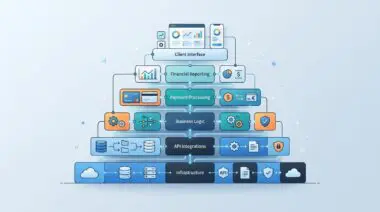
The Hyper-Personalized Autonomous Finance Stack solves this by acting as a singular, intelligent orchestration hub. It aggregates financial intent and executes complex workflows in milliseconds. This disruptive technology fundamentally alters the relationship between humans and their capital.
Market Intelligence & Capital Flow
Market Intelligence & Data
Embedded Finance Surge
Bain & Company projections indicate total US embedded finance transaction value will exceed this milestone by the end of 2026.
Global Wallet Adoption
Data from Juniper Research shows digital wallet users will reach over half the global population by mid-2026.
Autonomous Resolution Rate
Top-tier fintechs like Klarna and Revolut now resolve this percentage of all customer interactions via AI agents as of May 2026 per Twig.
Fintech Valuation Premium
PitchBook reports that median fintech VC valuations are now significantly higher than general AI startups due to proven revenue from agentic workflows.
The data reveals a relentless march toward embedded, invisible financial infrastructure. As consumer behavior shifts, the underlying rails must adapt to handle unprecedented transaction volume. It is no surprise that Bain & Company projections indicate total US embedded finance transaction value will exceed $7 trillion by 2026.
This massive liquidity pool demands a new breed of orchestration that legacy banks simply cannot provide. Furthermore, data from Juniper Research shows digital wallet users will reach over half the global population by 2026. This ubiquitous adoption transforms the digital wallet from a simple payment gateway into a globally systemic orchestration hub.
Smart money is aggressively front-running this transition across the global market. Institutional capital is abandoning traditional banking models in favor of platforms that aggregate financial intent. The valuation premium placed on these autonomous stacks reflects a deep market consensus regarding their future dominance.
Investors recognize that the future belongs to ecosystems that can seamlessly integrate multi-agent architectures. The capital flow dictates that any platform failing to automate complex liquidity management will be rapidly priced out of the market. We are witnessing the largest wealth transfer in tech history, driven entirely by algorithmic execution.
The FinTech Deep Dive: Building the Autonomous Infrastructure
In mid-2026, the fintech landscape is defined by the critical transition from generative AI to Agentic AI. Autonomous financial agents now execute complex workflows rather than just providing generic advisory text. Infrastructure has definitively shifted from cloud-first to agent-ready.
This evolution requires a complete teardown of traditional backend systems. Modern orchestration layers now manage sophisticated multi-agent architectures with zero human latency. These systems handle real-time liquidity, tax optimization, and aggressive yield farming across Layer-2 protocols.
The disruption to legacy wealth management is both immediate and severe. A report from McKinsey in April 2026 revealed that the launch of a single AI-enabled tax-planning workflow by Altruist triggered a $100 billion market drawdown for traditional wealth managers as investors reassessed the durability of human-only advisory fees.
When an algorithm can optimize a portfolio faster and more accurately than a human team, the traditional advisory fee model collapses. The Hyper-Personalized Autonomous Finance Stack capitalizes on this by offering institutional-grade wealth management to the retail consumer. It democratizes access to complex financial engineering.
Programmable Settlement Rails
The foundation of this new stack is built entirely on programmable settlement rails. These rails utilize tokenized deposits and MiCA-compliant stablecoins to bypass outdated SWIFT networks. This enables near-instant finality for cross-border trade and global capital allocation.
By tokenizing fiat currency, institutions can program specific logic directly into the money itself. Funds can be instructed to automatically route to high-yield environments or execute smart contracts upon delivery. This eliminates counterparty risk and drastically accelerates the velocity of money.
The integration of these rails allows the autonomous stack to operate globally without friction. Capital moves programmatically across borders, seeking optimal returns within seconds. This is the true definition of smart money in the modern era.
Eradicating the Complexity Tax
The primary problem solved by this ultimate stack is the crushing Complexity Tax inherent in legacy systems. Historically, institutions have squandered vast resources maintaining outdated, siloed infrastructure. Today, sixty to eighty percent of traditional IT budgets are spent on mere maintenance rather than actual innovation.
Autonomous stacks eliminate this financial fragmentation fatigue completely. They consolidate disparate credit, investment, and checking accounts into a single, AI-governed liquidity pool. This consolidation reduces operational costs for fintechs by staggering margins, often between forty and sixty percent.
The efficiency gains of this consolidation are already verifiable at scale. For instance, Klarna now resolves 67% of all customer interactions via AI agents. This operational leverage is precisely why forward-thinking platforms are dominating the current market cycle.
Revolut experienced a massive fifty-seven percent profit surge in the 2025 fiscal year due to similar autonomous integrations. They have successfully evolved into a globally systemic institution by leveraging agentic workflows. The math is simple: lower overhead and higher automated yield equals market supremacy.
Market Disruptors and Orchestration Hubs
The space is currently dominated by horizontal platforms and specialist enablers like Twig and Stripe. Traditional neobanks are being rapidly disrupted by Orchestration Hubs that focus purely on aggregating financial intent. These hubs do not just hold money; they actively deploy it based on algorithmic commands.
OpenAI closed a record $122 billion funding round in Q1 2026, cementing its foundational role in this ecosystem. Their models serve as the cognitive engine for countless autonomous financial agents. The race to build the most efficient financial brain is accelerating at breakneck speed.
Meanwhile, massive infrastructure plays are reshaping the global payment landscape. SpaceX acquired xAI for $250 billion in early 2026 to integrate autonomous payments directly into satellite-based global infrastructure. This ensures that the autonomous finance stack can operate seamlessly from any point on the globe.
The Strategic Action Plan
Strategic Trajectory
- Capitalize on the $1.5 trillion Agentic Commerce market where AI agents negotiate, procure, and pay for services on behalf of humans.
- Transition toward Intent-Based Banking by migrating user interfaces from static dashboards to natural language commands.
- Deploy autonomous financial workflows that automatically reconfigure global debt-to-income ratios.
- Pivot institutional strategy to align with the shift toward private stablecoin-led digital dollars.
- Adapt to the 2027 regulatory path defined by the move away from Federal rCBDCs as signaled by the May 2026 Executive Order.
Over the next twelve to twenty-four months, the stack will evolve rapidly toward Agentic Commerce. This represents a massive $1.5 trillion market where AI agents negotiate, procure, and pay for services autonomously. Humans will simply set the parameters, and the agents will execute the commerce.
We will witness the rapid rise of Intent-Based Banking across all major platforms. The user interface will move entirely from complex dashboards to simple natural language commands. A user will simply tell their app to optimize their tax burden, and the multi-agent architecture will handle the rest.
These commands will automatically reconfigure global debt-to-income ratios in milliseconds. Capital will be programmatically moved to high-interest environments without any manual user intervention. This creates a frictionless financial existence for the end consumer.
Furthermore, the regulatory landscape is finally crystallizing for institutional players. A May 2026 US Executive Order has signaled a definitive shift toward private stablecoin-led digital dollars over a Federal retail CBDC. This defines the exact regulatory path for 2027.
Institutions must pivot their strategy immediately to align with this stablecoin-led future. Deploying programmable settlement rails that are fully MiCA-compliant is no longer optional; it is a baseline requirement for survival. Those who adapt to this regulatory clarity will capture the lion’s share of the autonomous market.
Conclusion
The Hyper-Personalized Autonomous Finance Stack is the apex of modern financial engineering. It transforms fragmented capital into intelligent, self-optimizing liquidity that operates at the speed of thought. The transition from passive dashboards to agentic workflows is the most significant financial evolution of our decade.
Institutions and founders who fail to adapt will be crushed under the weight of their own legacy complexity. The market has already spoken, and the capital is flowing exclusively toward autonomous orchestration hubs. The future of finance is invisible, intent-based, and entirely algorithmic.
Navigating the intersection of financial technology, institutional capital, and market psychology requires a sharp strategy. To future-proof your FinTech architecture and scale with precision, connect with Andres at Andres SEO Expert.
Frequently Asked Questions
What is a Hyper-Personalized Autonomous Finance Stack?
A Hyper-Personalized Autonomous Finance Stack is an intelligent orchestration hub that leverages advanced artificial intelligence to move beyond passive dashboards into active, autonomous execution. It aggregates financial intent and executes complex workflows, such as liquidity management and yield farming, in real-time without human latency.
How does Agentic AI differ from Generative AI in the fintech industry?
In the 2026 fintech landscape, the shift from Generative to Agentic AI marks the transition from providing generic advisory text to executing complex financial workflows. Agentic AI can autonomously manage tax optimization, reconfigure debt-to-income ratios, and interact with Layer-2 protocols to maximize yield.
What is the projected growth of embedded finance by 2026?
According to projections from Bain & Company, the total transaction value for embedded finance in the US is expected to exceed $7 trillion by the end of 2026. This surge is supported by the rapid adoption of digital wallets, which Juniper Research estimates will reach over 5 billion users globally by mid-2026.
What is Agentic Commerce and its market potential?
Agentic Commerce is a burgeoning $1.5 trillion market where AI agents negotiate, procure, and pay for services autonomously on behalf of humans. Users provide high-level parameters via natural language commands, and the autonomous finance stack handles the execution and settlement of commerce transactions.
How do programmable settlement rails improve global finance?
Programmable settlement rails utilize tokenized deposits and MiCA-compliant stablecoins to bypass traditional, slower networks like SWIFT. By programming logic directly into the currency, these rails enable near-instant finality for cross-border trades and allow capital to move automatically to high-yield environments.
What did the May 2026 US Executive Order signal regarding CBDCs?
The May 2026 Executive Order signaled a definitive regulatory shift away from Federal retail CBDCs in favor of private stablecoin-led digital dollars. This move provides a clear regulatory path for financial institutions to integrate stablecoin-based programmable rails into their autonomous finance stacks for 2027.