Executive Summary
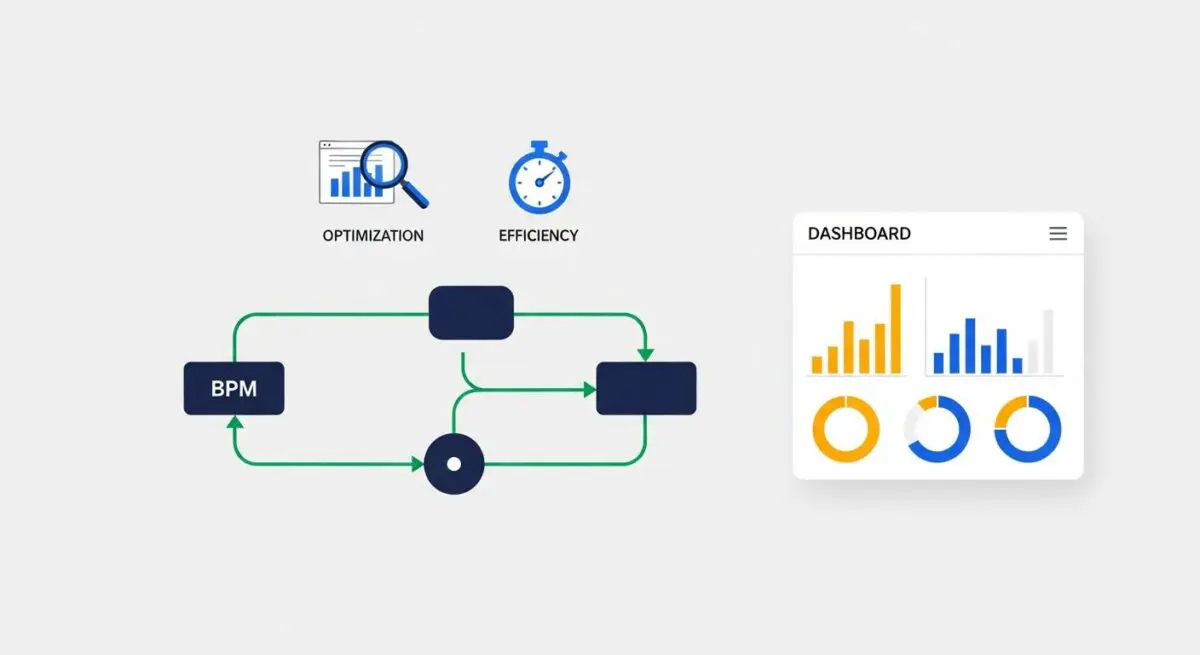
- Lifecycle Optimization: BPM employs a structured lifecycle consisting of design, modeling, execution, monitoring, and optimization to ensure continuous operational refinement.
- Technological Integration: Modern BPM utilizes Business Process Management Suites (BPMS) and BPMN 2.0 standards to bridge the gap between high-level business logic and technical IT implementation.
- Data-Driven Agility: By leveraging process mining and real-time analytics, BPM enables organizations to identify bottlenecks and pivot strategies based on empirical performance data rather than intuition.
What is Business Process Management (BPM)?
Business Process Management (BPM) is a disciplined, systematic approach to making an organization’s workflow more effective, more efficient, and more capable of adapting to an ever-changing environment. It is not a one-time task but a continuous process of improvement that aligns business functions with customer needs.
At its core, BPM involves the discovery, modeling, analysis, measurement, improvement, and automation of business processes. In a modern tech stack, BPM acts as the orchestration layer that sits above individual applications like CRM, ERP, and CMS, ensuring that data and tasks flow seamlessly between disparate systems.
Technically, BPM is often supported by Business Process Management Suites (BPMS), which provide the software environment to map out processes using standardized notations such as BPMN 2.0. This standardization allows both business analysts and software developers to share a common language, reducing the risk of technical debt and misaligned requirements during digital transformation initiatives.
The Real-World Analogy
Think of Business Process Management as the air traffic control system of a major international airport. Without a centralized system, individual pilots might try to land or take off based only on their local visibility, leading to catastrophic bottlenecks and safety risks.
BPM acts as the tower, providing a high-level view of every moving part, from the ground crew and fueling stations to the runways and terminal gates. It ensures that every “process”—in this case, a flight—follows a strict, optimized sequence that maximizes the airport’s throughput while maintaining total operational integrity.
How Business Process Management (BPM) Drives Strategic Growth & Market Competitiveness?
BPM is a primary driver of strategic growth because it directly addresses operational friction, which is often the silent killer of scaling enterprises. By formalizing and optimizing workflows, organizations can significantly reduce the time-to-market for new products and services, providing a distinct competitive advantage.
From a financial perspective, BPM has a profound impact on Customer Acquisition Cost (CAC) and Lifetime Value (LTV). When lead management and onboarding processes are optimized through BPM, the efficiency of the sales funnel increases, leading to higher conversion rates and lower overhead per acquired customer.
Furthermore, BPM enhances data integrity across the organization. By enforcing standardized data entry and validation steps within a process, companies ensure that the business intelligence (BI) tools and AI models they rely on are fed high-quality, consistent data. This leads to more accurate forecasting and better-informed strategic decision-making.
In the realm of digital marketing and SEO, BPM allows for the rapid deployment of content and technical updates. When the process for identifying keyword opportunities, creating content, and performing technical audits is managed as a formal BPM workflow, the agency or internal team can execute at a much higher velocity without sacrificing quality.
Ultimately, BPM fosters organizational agility. In a market where consumer behavior or regulatory requirements can shift overnight, companies with well-documented and managed processes can reconfigure their operations much faster than those relying on ad-hoc or tribal knowledge.
Strategic Implementation & Best Practices
- Implement Process Mining: Utilize process mining tools to analyze event logs from your existing systems (ERP, CRM) to discover how processes are actually functioning in reality versus how they are perceived on paper.
- Adopt BPMN 2.0 Standards: Ensure all process modeling uses the Business Process Model and Notation (BPMN) 2.0 standard to maintain technical consistency and facilitate easier integration with automated execution engines.
- Establish a Center of Excellence (CoE): Create a cross-functional team dedicated to BPM governance, ensuring that process improvements are aligned with broader corporate strategy and that best practices are shared across departments.
- Focus on Incremental Automation: Avoid the temptation to automate every step at once; instead, identify high-volume, low-complexity tasks that offer the highest ROI when automated through Robotic Process Automation (RPA) within the BPM framework.
- Define Clear KPIs and Baselines: Before modifying any process, establish clear key performance indicators such as cycle time, error rate, and resource cost to measure the actual impact of your optimization efforts.
Common Pitfalls & Strategic Mistakes
One of the most frequent errors is “paving the cow path,” which refers to automating an existing process that is fundamentally flawed or inefficient. Automation should only occur after a process has been analyzed and optimized, otherwise, you are simply accelerating the production of errors and waste.
Another significant mistake is the failure to account for the human element within the BPM lifecycle. Processes do not exist in a vacuum; they are executed by people, and ignoring change management or failing to secure stakeholder buy-in often leads to shadow processes that bypass the formal BPM system entirely.
Finally, many enterprise brands fall into the trap of data silos where BPM initiatives are confined to a single department. This localized optimization often creates bottlenecks elsewhere in the value chain, negating the overall benefits of the improvement and leading to fragmented customer experiences.
Conclusion
Business Process Management is the foundational discipline for any organization seeking to achieve operational excellence and scalable growth in a data-driven economy. By treating processes as strategic assets, firms can ensure their technical architecture remains resilient, efficient, and aligned with long-term business objectives.