Key Takeaways
- Unvalidated AI code assistants risk source code leaks, hallucinated dependencies, and no audit trail — a regulatory nightmare.
- NVIDIA’s architecture uses NeMo Guardrails as a pre-model policy gate to block restricted code paths before generation.
- A CI verification gate catches hallucinated packages (slopsquatting) and a metrics loop tracks defect escape rates from AI-assisted changes.
Three Specific Failures That Make Unvalidated AI Code Assistants a Regulatory Nightmare
A technical tutorial published on NVIDIA’s developer blog details a concrete architecture for teams that cannot afford the three most common failure modes of AI coding assistants: source code exfiltration beyond the network perimeter, hallucinated software packages that introduce supply-chain attack surfaces, and the complete absence of an audit trail when generated code ships a production defect.
The solution, authored by NVIDIA senior infrastructure engineer Lovina Dmello and published July 29, 2026, chains together StarCoder2-7B served through NVIDIA NIM, a NeMo Guardrails policy proxy that blocks requests to restricted code paths before the model ever sees them, a CI verification gate tuned specifically for AI failure patterns like slopsquatting, and a Prometheus metrics loop that compares defect escape rates between AI-assisted and human-authored changes.
All validation, enforcement, and measurement components sit external to the model itself. That design choice means teams can adopt layers incrementally, swap in domain-adapted models later through NeMo Framework, and never find themselves locked into a single model vendor’s safety claims.
Table of Contents
- Three Specific Failures That Make Unvalidated AI Code Assistants a Regulatory Nightmare
- Deconstructing the Seven-Layer Validation Architecture for Self-Hosted AI Code Generation
- The Architecture at a Glance
- Deploying StarCoder2 as a Pinned NIM Container
- NeMo Guardrails as the Pre-Model Policy Gate
- The CI Verification Gate Targets AI-Specific Failure Modes
- Commit Trailers and the Measurement Mindset
- Outcome Metrics That Close the Feedback Loop
- Domain Adaptation Without Rewriting the Pipeline
- Why Slopsquatting Represents the Most Underestimated Threat in AI-Assisted Development
- Regulatory Pressure Will Accelerate External Validation Adoption
- The Pipeline-Over-Model Doctrine and What It Signals for Enterprise AI Strategy
Deconstructing the Seven-Layer Validation Architecture for Self-Hosted AI Code Generation
What separates this reference architecture from a typical ‘deploy a model and connect an IDE’ tutorial is its insistence that the model should never function as the control plane. Every safety property, from refusing requests on sensitive file paths to catching invented dependencies, operates in systems that engineering teams already trust and can inspect independently.
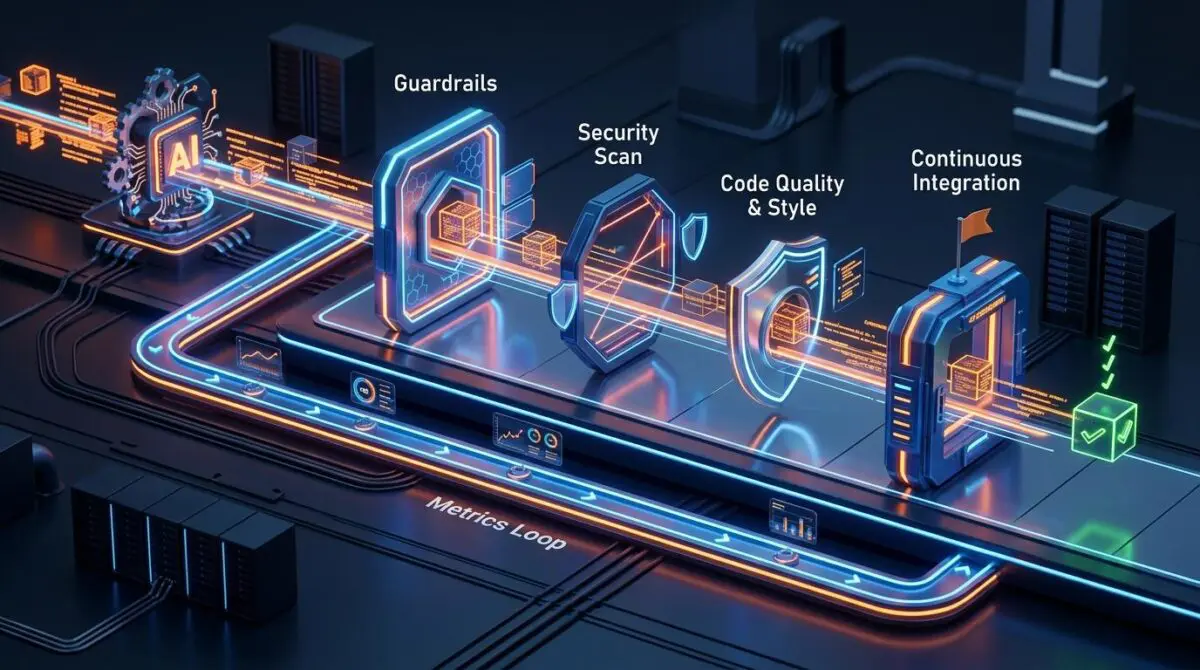
The architecture spans three operational layers. At the top, a developer’s IDE routes completion requests through a NeMo Guardrails proxy. That proxy either forwards permitted requests to the StarCoder2 NIM endpoint or blocks them with a policy message before the model consumes compute. Beneath that, a CI verification stage layered on top of standard unit tests runs model-specific checks against every pull request tagged as AI-assisted. Finally, a metrics loop feeds production defect data back into policy tuning.
The Architecture at a Glance
NVIDIA’s tutorial emphasizes that each component is independently useful. A team can deploy just the self-hosted NIM endpoint for data sovereignty, add NeMo Guardrails when they need policy enforcement, layer on the CI gate when they start relying on AI for production code, and wire metrics when they need to justify the investment quantitatively.
‘The important design choice is that the model is not the control plane.’
That single sentence from the tutorial captures the philosophical core of the entire approach. When a completion gets blocked, the developer inspects the NeMo Guardrails policy, not model internals. When a dependency scan fails, the output comes from a deterministic scanner, not from asking the model to self-audit. When defect rates rise, the signal originates from production incident data, not from model confidence scores.
Deploying StarCoder2 as a Pinned NIM Container
The first step provisions StarCoder2-7B through NVIDIA’s NIM containerized inference platform. The tutorial explicitly instructs teams to pin a specific container version from the NGC catalog rather than using an unversioned tag, a practice that prevents silent model changes from drifting into production pipelines.
The container exposes an OpenAI-compatible completion endpoint on port 8000, which means virtually any modern IDE assistant that accepts a custom base URL can consume it without adapter code. The tutorial demonstrates the pattern with Continue, Cursor, and Cline, but the principle extends to any tool in the ecosystem.
Critically, the NIM container ships with a signed SBOM and VEX record for the model image itself. This means security teams can scan and promote the container through internal platform catalogs using the same processes they apply to any other production artifact, rather than treating AI infrastructure as a special exception.
For pilot deployments, the tutorial recommends running on a single shared GPU host with at least 24 GB of memory, specifically listing NVIDIA A10, L4, L40S, or A100 as suitable options. Broader rollouts would place the NIM behind an internal service mesh or load balancer with the NGC API key managed through a secrets manager.
NeMo Guardrails as the Pre-Model Policy Gate
NeMo Guardrails operates as an OpenAI-compatible proxy that intercepts completion requests before they reach the model. The tutorial configures it with a task policy that inspects each request and determines whether it touches any human-only code path, including authentication, payment processing, cryptography, or files residing under directories like src/security/ or src/auth/.
The mechanism uses a built-in action called self_check_input, which renders a classification prompt, calls the model, and returns a boolean. When the response indicates the request falls into a restricted category, the guardrails flow refuses the request on the spot and returns a policy message to the developer. The NIM endpoint never receives the query and never consumes GPU resources on a forbidden completion.
The tutorial recommends starting with an intentionally conservative policy. Authentication, authorization, payment handling, cryptographic operations, deployment manifests, and incident-response automation are all flagged as human-only paths. Teams can relax restrictions later after accumulating sufficient review data to demonstrate safety in narrower domains.
The CI Verification Gate Targets AI-Specific Failure Modes
The third operational layer addresses what the tutorial identifies as the highest-leverage safety intervention: catching model-specific failures that a human reviewer would struggle to detect by eye. The CI gate activates only on pull requests carrying an ai-assisted label and runs a superset of the normal test suite.
Standard checks include unit tests, SAST via Semgrep, and secret scanning through Gitleaks. The model-specific layer adds a hallucinated-dependency scanner, which the tutorial identifies as the single most valuable check because it targets slopsquatting, a failure mode where a code model invents a plausible-sounding package name, an attacker registers that name in a public registry, and the resulting dependency delivers real malware into the build pipeline.
The tutorial names three maintained scanning tools. Dep-hallucinator covers PyPI, npm, Maven, crates.io, and Go ecosystems, applying naming heuristics and generating SBOM output with CI exit codes. Slopgate performs PR-diff-aware scanning and uploads SARIF results to GitHub’s Security tab. XBOM combines CVE detection, slopsquatting identification, and SBOM generation in a single pass.
A license drift check using pip-licenses fails the build when any newly introduced dependency carries a copyleft license that legal teams have blocked. For air-gapped CI environments where third-party tools cannot be installed, the tutorial provides a roughly 40-line fallback that diffs manifest files between base and head refs, queries registries for each new package name, and flags 404 responses, recently published packages, and prohibited licenses.
Commit Trailers and the Measurement Mindset
Traceability enters the architecture through a prepare-commit-msg Git hook that appends structured trailers to commits authored with AI assistance. Setting the AI_ASSISTANT environment variable to starcoder2-nim causes every commit to carry an AI-Assistant trailer and an AI-Scope field, which CI can then grep to auto-label pull requests.
The tutorial is explicit about the purpose of these trailers: they exist for measurement, not for blame. The relevant question is not whether a specific developer leaned on AI for a particular commit, but whether AI-assisted changes exhibit systematically different review latency, rollback frequency, or defect escape rates compared to the baseline.
Outcome Metrics That Close the Feedback Loop
The final operational layer rejects the industry’s default fixation on acceptance rates. A high percentage of accepted completions says nothing about whether those completions improved or degraded production quality. The tutorial instead instruments two Prometheus counters: one tracking defects that escaped to production from AI-assisted PRs, segmented by severity, and another counting rollbacks of AI-assisted changes.
A minimal exporter polls merged AI-assisted pull requests, correlates them against linked incident issues and revert PRs, and exposes the counters on port 9101. Prometheus scrapes the endpoint, Grafana visualizes AI-assisted series alongside baseline metrics, and a sustained elevation in defect escape rate across two consecutive weeks triggers a policy tightening, an additional CI gate, or a rollout pause.
The tutorial frames this feedback loop as a serpentine process where production signals flow back into the guardrails configuration. If AI-assisted patches keep introducing defects in a specific domain, the task policy expands to cover that domain. If a particular type of hallucinated dependency keeps slipping through, the scanner rules tighten.
Domain Adaptation Without Rewriting the Pipeline
An optional section of the tutorial addresses a predictable limitation of off-the-shelf StarCoder2: it has never seen a team’s internal APIs and will hallucinate function signatures that do not exist. NVIDIA’s ChipNeMo research demonstrated that continued pretraining on domain-specific corpora, combined with supervised fine-tuning and retrieval customization, substantially improves assistant quality for specialized engineering domains.
The architecture absorbs this upgrade path without modification. A team can begin with base StarCoder2, later swap in a stronger code-tuned model, and eventually deploy a fully domain-adapted NIM containerized through NeMo Framework, all without changing a single line of the guardrails configuration, CI verification scripts, commit hook, or metrics exporter.
Why Slopsquatting Represents the Most Underestimated Threat in AI-Assisted Development
The tutorial’s extended treatment of hallucinated dependency scanning deserves particular attention because it surfaces a threat vector that most organizations have not yet incorporated into their threat models. When a code model generates a line like ‘import fastplotlib’ and that package does not exist on PyPI, the immediate consequence is a build failure. But if an attacker monitors model outputs, notices the hallucinated name, registers it, and populates it with malicious code, the consequence escalates to a supply-chain compromise that bypasses every traditional security review.
This attack pattern does not require the adversary to compromise the model, intercept network traffic, or exploit any software vulnerability. It exploits the gap between the model’s syntactic fluency and its complete lack of semantic grounding in the real state of package registries. The model generates a plausible name. The attacker does the rest.
The NVIDIA’s emphasis on running dependency scans that check every newly added package against live registries and flag names that do not exist, were registered very recently, or closely resemble popular packages represents a pragmatic defense-in-depth measure that costs almost nothing to implement but closes an entire category of attack.
Regulatory Pressure Will Accelerate External Validation Adoption
For teams operating in regulated environments, the architecture’s separation of model from control plane carries compliance implications that extend beyond immediate security concerns. When auditors ask how the organization ensures that AI-generated code does not introduce vulnerabilities into production systems, the answer cannot be ‘the model told us it was safe.’ It must point to deterministic, inspectable, auditable controls.
The tutorial’s design pattern provides exactly that answer. Policy enforcement is a YAML file. Dependency verification is a scanner with a pass/fail exit code. Commit traceability is a Git hook that appends structured metadata. Defect metrics are counters scraped by Prometheus. Every control is external, inspectable, and operates independently of the model’s internal representations.
This architecture aligns with emerging regulatory expectations around AI system governance, where the burden of proof rests on deployers to demonstrate that safety mechanisms function correctly, not on model providers to guarantee that their models will never produce harmful outputs.
The Pipeline-Over-Model Doctrine and What It Signals for Enterprise AI Strategy
What NVIDIA’s tutorial articulates, perhaps without using the term explicitly, is a doctrine that will likely define the next phase of enterprise AI adoption: the pipeline matters more than the model. A moderately capable model wrapped in rigorous validation infrastructure will outperform a state-of-the-art model deployed without guardrails, traceability, or outcome measurement in any environment where the cost of failure is nonzero.
The tutorial’s seven-step sequence deploys a 7-billion-parameter model, not a frontier-scale system, and achieves safety properties that frontier models deployed naively cannot match. The lesson is not that smaller models are inherently safer. It is that safety emerges from architecture, not from model scale, and that organizations investing in validation pipelines today will be positioned to adopt more capable models tomorrow without resetting their safety posture to zero.
For engineering leaders evaluating AI coding assistant strategies, the tutorial provides a concrete reference implementation that addresses the three problems it set out to solve, source sovereignty, package hallucinations, and audit trails, without requiring trust in any single vendor’s safety claims. That makes it unusually valuable as both a practical guide and a strategic signal.
Building robust technical infrastructure for AI-powered workflows demands the same discipline that this validation architecture embodies. Organizations looking to integrate AI automation into their content and development pipelines need systems that are auditable, measurable, and resilient to the specific failure modes that language models introduce.
For teams exploring AI automation and programmatic workflow engineering, the principles of external validation and outcome-based measurement translate directly from code generation to content operations. The same architectural patterns that catch hallucinated dependencies can catch hallucinated claims, and the same commitment to measurement over blind acceptance applies whether the output is a function signature or a published article.
For organizations seeking guidance on building validated, scalable technical infrastructure, managed cloud hosting and infrastructure engineering provide the foundation that any AI pipeline ultimately depends on. To explore how these architectural principles apply to your specific technical context, connect with Andres for a detailed consultation, and learn more about the methodology behind Andres SEO Expert.
Frequently Asked Questions
What are the three specific failure modes that unvalidated AI code assistants introduce?
The three failure modes are: source code exfiltration beyond the network perimeter, hallucinated software packages (slopsquatting) that introduce supply-chain attack surfaces, and the complete absence of an audit trail when generated code ships a production defect.
How does the NVIDIA architecture prevent source code exfiltration?
Source code exfiltration is prevented by deploying the model (StarCoder2) as a self-hosted NIM container that never sends data to external endpoints, and by using a NeMo Guardrails policy proxy that blocks requests to restricted code paths (e.g., authentication, payment, cryptography) before the model even sees them.
What is slopsquatting and how does the CI gate defend against it?
Slopsquatting occurs when a code model invents a plausible package name that doesn’t exist; an attacker then registers that name in a public registry with malicious code. The CI gate defends against it by running a hallucinated-dependency scanner (e.g., Dep-hallucinator, Slopgate, XBOM) that checks every new package against live registries and flags nonexistent, recently registered, or suspiciously named packages.
How does the system ensure audit trail and traceability for AI-assisted code changes?
Traceability is achieved through a Git hook that appends structured commit trailers (e.g., AI-Assistant, AI-Scope) to commits authored with AI assistance. CI then auto-labels pull requests as ai-assisted, allowing the system to measure review latency, rollback frequency, and defect escape rates for AI-generated code.
What is the ‘pipeline-over-model’ doctrine described in the article?
The pipeline-over-model doctrine states that safety emerges from the validation architecture (guardrails, CI gates, metrics) rather than from model scale. A moderately capable model wrapped in rigorous external validation outperforms a frontier model deployed without controls, especially where failure costs are nonzero.
How does this architecture support regulatory compliance for AI-generated code?
The architecture supports regulatory compliance by making every control external, inspectable, and auditable: policy enforcement is a YAML file, dependency verification produces pass/fail exit codes, commit trailers add structured metadata, and defect metrics are raw Prometheus counters. This allows teams to point to deterministic controls rather than model confidence, aligning with emerging AI governance requirements.