Key Points
- Decoupled Architecture: Transitioning from hard-coded strings to dynamic, JSON-based template registries eliminates the massive maintenance tax associated with scaling LLM integrations.
- Semantic Prompt Routing: Utilizing dynamic templates to route simple tasks to edge models acts as a financial firewall, drastically reducing enterprise API credit consumption.
- Autonomous Evolution: Organizations must prepare for the ‘Zero-Prompt’ era, where AI agents autonomously monitor performance telemetry to iteratively rewrite their own orchestration templates.
Table of Contents
The Core Friction: The End of Static Strings
According to the 2026 Gartner AI Infrastructure Report, 82% of Global 2000 enterprises have now implemented centralized dynamic prompt management layers. This shift reduces token-related overhead by an average of 38% compared to 2024 levels.
This data highlights a brutal truth in modern enterprise architecture. Relying on hard-coded strings to communicate with advanced artificial intelligence is a massive operational liability.
When businesses first rushed to integrate large language models, they fell victim to the “Consistency Paradox.” Minor API updates or subtle model drifts would silently break production workflows, causing unpredictable outputs.
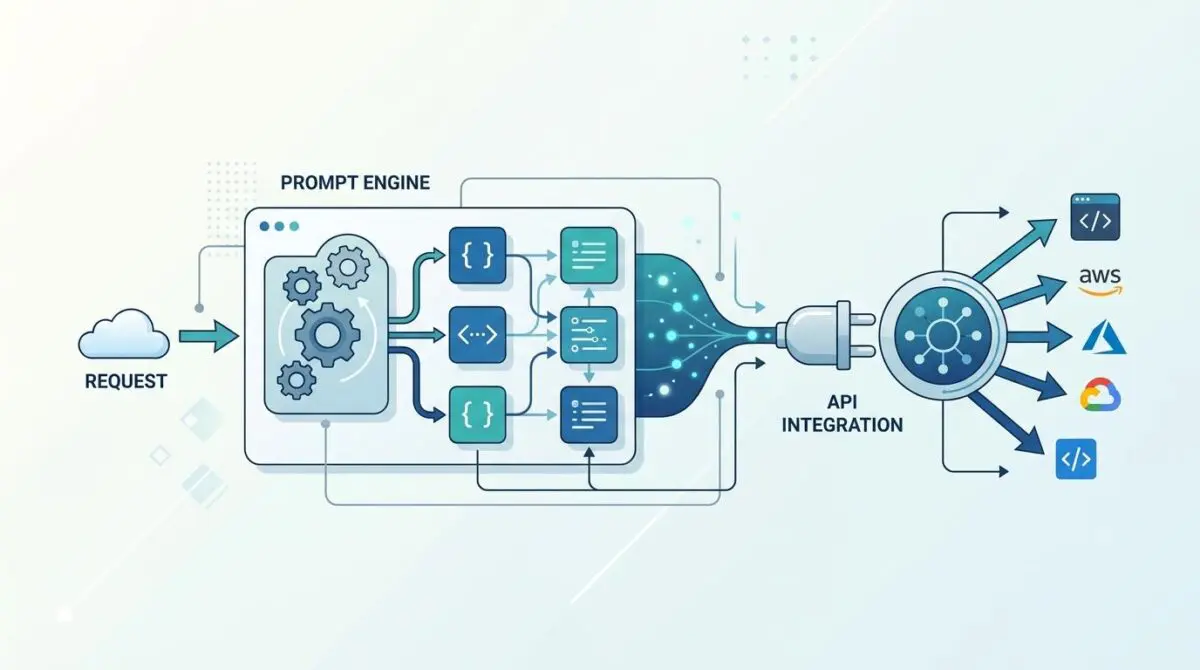
Dynamic Prompt Orchestration (DPO) emerged as the definitive antidote to this market friction. By treating prompts as managed code assets rather than static text, DPO fundamentally restructures how applications interact with intelligence layers.
This architectural shift effectively eliminates the crippling maintenance tax previously associated with scaling LLM integrations. It allows engineering teams to update AI behavior across thousands of endpoints instantly.
There is no need for redeploying software or scheduling downtime. Applications simply adapt with fluid precision to the specific intent of the end-user.
Market Intelligence & Smart Capital
Market Intelligence & Data
Enterprise Migration Rate
Data from the GitHub 2026 ‘Octoverse’ Report shows that nearly three-quarters of enterprise AI repositories have moved from hard-coded prompts to dynamic, JSON-based template registries.
Prompt-Ops Market Size
According to a 2025 Q4 analysis by IDC, the market for prompt management and orchestration tools is projected to reach $6.8 billion by the end of 2026.
Injection Risk Reduction
The 2026 OWASP AI Security Project reports that template-level sanitization in dynamic prompt APIs reduces the success rate of prompt injection attacks by 90%.
Latency Improvement
Benchmarking data from Cloudflare’s 2026 ‘State of the Edge’ report indicates that edge-cached dynamic templates reduce API response latency by an average of 420ms.
The shift toward orchestration is not just a technical upgrade. It represents a massive, calculated reallocation of institutional capital.
Analyzing the current data reveals a profound structural shift in how engineering teams deploy artificial intelligence. We are witnessing a mass migration where development teams have moved from hard-coded prompts to dynamic, JSON-based template registries.
This pivotal transition is attracting serious attention from top-tier venture capital firms. Smart money from heavyweights like Andreessen Horowitz is flowing heavily into Prompt-Ops platforms.
The Rise of Prompt-Ops Middleware
Startups like Portkey, LangSmith, and 2025-founded disruptors like FluxLogic are capturing massive market share. They provide the critical middleware necessary to treat prompts with the exact same rigor as traditional microservices.
Furthermore, enterprise security requirements are rapidly driving mainstream adoption. By centralizing template-level sanitization, organizations are drastically reducing the success rate of prompt injection attacks across their entire digital surface area.
Even technology giants like Microsoft and Amazon have recognized the inevitability of this architecture. They have integrated native dynamic template registries directly into their 2026 cloud-AI stacks, signaling the absolute end of the static string era.
The Strategic Deep Dive: Liquid Templates
In the current landscape, static prompting is entirely obsolete. Enterprises are now deploying “Liquid Templates” to manage the inherent chaos of multi-model environments.
These advanced templates leverage real-time RAG operations and sophisticated semantic caching. They possess the capability to modify their own internal structures based on live API telemetry.
This innovation creates a truly model-agnostic integration layer. Templates auto-adjust their syntax and few-shot examples depending entirely on the specific model handling the request.
Decoupling Logic from Application Code
If a request is routed to a high-reasoning model like GPT-5, the dynamic template expands to provide incredibly deep context. It ensures the model has the exact parameters required for complex logical deduction.
Conversely, if the request is routed to a lightning-fast edge model, the template compresses itself. It transforms into a lean, latency-optimized instruction set designed for pure speed.
By decoupling the prompt logic from the core application codebase, businesses achieve unparalleled agility. They can run sophisticated A/B tests on prompt structures in real-time without ever touching a single line of backend code.
This separation of concerns is the hallmark of mature software engineering. It allows data scientists to optimize AI behavior while software engineers focus purely on infrastructure stability.
Semantic Routing and the Consistency Paradox
The financial impact of this decoupled architecture is absolutely staggering. Dynamic Prompt Orchestration fundamentally changes the unit economics of generative AI at scale.
A 2026 internal briefing from NVIDIA’s AI Enterprise division reveals the power of Semantic Prompt Routing. This technique uses dynamic templates to bypass high-cost models for simple tasks, saving top-tier partners an estimated $1.2 billion in cumulative API credits over the last 12 months.
This intelligent routing mechanism acts as an automated financial firewall. It guarantees that expensive compute resources are reserved exclusively for tasks that actually require complex reasoning.
Routine queries are instantly intercepted and handled by cheaper, faster models. The dynamic template adjusts the payload seamlessly, remaining entirely invisible to the end-user.
This solves the Consistency Paradox once and for all. Applications maintain perfect reliability and output structure, regardless of which underlying model is actually generating the response.
The Executive Action Plan
The trajectory of artificial intelligence integration is moving rapidly toward total automation. Business leaders must adapt their infrastructure today to survive the next wave of disruptive innovation.
Strategic Trajectory
- Transition toward Autonomous Prompt Evolution (APE) by enabling AI agents to monitor performance metrics.
- Implement iterative rewrite mechanisms to optimize dynamic templates for cost-efficiency and output accuracy.
- Prepare for the ‘Zero-Prompt’ era by engineering systems that generate and destroy templates in milliseconds.
- Align orchestration workflows with high-velocity, intent-based query fulfillment.
Executives must mandate the adoption of orchestration middleware immediately. Relying on legacy integration methods is a guaranteed path to bloated API bills and fragile applications.
The operational risk of ignoring this shift is immense. Systems built on static strings will inevitably shatter under the weight of continuous model updates and shifting API endpoints.
Preparing for the Zero-Prompt Era
The next major evolution of this technology is Autonomous Prompt Evolution (APE). In this advanced paradigm, AI agents constantly monitor their own performance metrics and iteratively rewrite their own templates.
These agents optimize relentlessly for both computational cost and output accuracy. Human engineers will no longer manually write prompts; they will simply govern the overarching parameters of the orchestration engine.
We are rapidly approaching the true “Zero-Prompt” era. In this future state, templates will be generated and destroyed in milliseconds, perfectly tailored to the specific, immediate intent of the end-user’s query.
To prepare, organizations must begin treating prompts as dynamic software components today. Building a centralized registry is the foundational step toward achieving autonomous orchestration.
Conclusion
Dynamic Prompt Orchestration is far more than just an engineering best practice. It is a critical strategic imperative for any enterprise operating AI systems at scale.
By treating prompts as fluid, highly manageable assets, organizations can unlock unprecedented operational efficiency. They build resilient systems capable of adapting to market shifts in real-time.
The future of enterprise AI belongs to those who master the architecture of intent. Those who fail to adapt will be left managing legacy code while their competitors scale autonomously.
Navigating the intersection of technology, capital, and market psychology requires a sharp strategy. To future-proof your business architecture and scale with precision, connect with Andres at Andres SEO Expert.
Frequently Asked Questions
What is Dynamic Prompt Orchestration (DPO)?
Dynamic Prompt Orchestration (DPO) is an architectural framework that treats AI prompts as managed code assets rather than static strings. This shift allows engineering teams to update AI behavior across thousands of endpoints instantly without redeploying software or scheduling downtime.
How does dynamic prompt management reduce enterprise AI costs?
Dynamic prompt management utilizes techniques like ‘Semantic Prompt Routing’ to bypass high-cost models for simple tasks, routing them instead to cheaper edge models. This approach has been shown to reduce token-related overhead by an average of 38% and can save billions in cumulative API credits.
What are the security benefits of transitioning to JSON-based template registries?
Transitioning to dynamic, JSON-based templates enables centralized template-level sanitization. According to the 2026 OWASP AI Security Project, this architecture reduces the success rate of prompt injection attacks by 90% across an organization’s digital surface area.
What are Liquid Templates in AI infrastructure?
Liquid Templates are advanced, model-agnostic integration layers that leverage real-time RAG and semantic caching. They possess the capability to auto-adjust their syntax and instructions based on live API telemetry, ensuring optimal context for high-reasoning models or latency-optimized instructions for edge models.
How does decoupling prompt logic from application code improve agility?
By decoupling prompt logic, businesses can run real-time A/B tests on AI behaviors without touching the backend codebase. This separation of concerns allows data scientists to optimize AI performance while software engineers focus on infrastructure stability and scaling.
What is Autonomous Prompt Evolution (APE) and the Zero-Prompt era?
Autonomous Prompt Evolution (APE) involves AI agents that monitor performance metrics and iteratively rewrite their own templates for efficiency. This leads to the ‘Zero-Prompt’ era, where orchestration systems generate and destroy templates in milliseconds, perfectly tailored to the immediate intent of the user.