Key Points
- Agentic Finance Transition: The shift from passive embedded finance to AI-driven autonomous agents is completely redefining corporate treasury and liquidity orchestration.
- Sub-Second Settlement: Programmable ledgers and real-time APIs are eradicating the latency-to-liquidity gap, recapturing billions in trapped institutional capital.
- Self-Healing Infrastructure: Visionary leaders are deploying code-defined financial nervous systems that dynamically route capital based on real-time network conditions.
Table of Contents
The Dawn of the Autonomous Stack
According to recent industry outlooks, autonomous financial agents now manage trillions in corporate liquidity. This represents a massive increase in automated treasury volume over the past few years. It is a complete transformation of how global capital moves across digital borders.
The era of manual treasury management and human reconciliation is fading fast. We have entered the age of autonomous financial infrastructure. For forward-thinking leaders, this technology represents a major shift from passive systems to proactive ecosystems.
Imagine a corporate treasury that does more than just report on historical cash flow. Picture a system that actively negotiates, executes, and settles cross-border transactions while you sleep. This is the new reality of the financial landscape, where capital is no longer a static asset.
Instead, capital has become a highly programmable entity. It is driven by AI-native layers that relentlessly hunt for yield and efficiency in real-time. The traditional financial architecture was built on friction, relying on slow batch processing and fragmented ledgers.
Legacy multi-day settlement cycles trapped billions in corporate capital. Every human touchpoint became a leak in the pipe of profitability. Autonomous financial infrastructure seals those leaks permanently by replacing slow software with smart agents capable of complex reasoning.
The magnitude of this shift cannot be overstated. We are moving away from an era where financial technology was merely a digital overlay on analog processes. This new infrastructure is a ground-up rebuild of the entire financial ecosystem.
It operates on the premise that every transaction and compliance check can be executed faster by artificial intelligence. By leveraging dynamic APIs and large language models, these systems transform software into an active participant in global markets.
Market Intelligence & Capital Flow
Market Intelligence & Data
Embedded Finance Volume
According to a Q1 2026 report from Bain & Company, embedded finance transactions have hit record highs as non-financial platforms integrate full-stack banking.
AI Agent Adoption
Gartner’s 2026 FinTech Survey indicates that 84% of visionary CFOs have now deployed autonomous agents for real-time treasury management.
Settlement Latency
Data from J.P. Morgan’s Onyx division shows that private blockchain-based settlement layers have reduced cross-border friction to under 10 milliseconds in 2026.
Generative FinTech VC
PitchBook data reveals that Venture Capital investment into Generative AI-native financial infrastructure reached $150 billion in the 2025-2026 cycle.
The data above paints a vivid picture of a financial ecosystem undergoing radical transformation. Institutional capital is aggressively flowing into infrastructure providers, fundamentally altering the market landscape. The smart money is no longer just chasing consumer-facing applications.
Instead, venture capital and institutional funds are targeting the deep plumbing of global finance. Tech giants and legacy payment processors have pivoted their entire business models. They are no longer just service providers, but have evolved into active liquidity orchestrators.
The Rise of Liquidity Orchestrators
This massive shift is driven by the sheer scale of the opportunity at the infrastructure layer. When we analyze the Bain & Company embedded finance volume, the trajectory is unmistakable. Non-financial platforms are rapidly becoming the new digital banks.
The real story is what happens after the initial integration of embedded finance. The transition to AI-driven finance means these platforms are now deploying autonomous software agents to handle massive transaction volumes. Human operators simply cannot scale to meet this exponential demand.
Venture capital recognizes this tectonic shift, directing billions toward specialized middleware startups. These companies are building the critical security, identity, and permissioning layers required for the future. They create the guardrails that allow AI models to safely move real-world value.
Furthermore, the dramatic reduction in settlement latency is a true market disruptor. The implementation of private blockchain-based settlement layers has fundamentally altered how capital moves. Funds that were once locked in transit for days are now available for deployment in milliseconds.
This unprecedented velocity of money unlocks micro-transactional business models that were previously impossible due to high processing costs. We are witnessing the birth of a streaming economy. In this new era, value flows as continuously and effortlessly as data over a fiber-optic cable.
The FinTech Deep Dive: Architecting Agentic Finance
The current innovation landscape is defined by the aggressive shift from embedded finance to AI-driven finance. This is not a subtle pivot or a marketing buzzword. It is a fundamental reimagining of the global financial nervous system.
Cutting-edge systems now utilize advanced AI orchestration layers at their core. These layers empower autonomous software agents to negotiate complex contracts and settle transactions entirely without human intervention. The software itself has become the financial operator.
Eradicating the Latency-to-Liquidity Gap
This technology directly solves the latency issues that have historically plagued global trade and cross-border commerce. For decades, businesses accepted multi-day settlement cycles as an immutable law of finance. Today, that friction is entirely obsolete.
By replacing outdated batch processing with instant finality, businesses can recapture billions in trapped capital. This speed is achieved through the deployment of tokenized deposits and real-time settlement APIs. The positive impact on the corporate bottom line is staggering.
Recent studies reveal that many central banks have now integrated programmable ledgers into their primary settlement stacks. This effectively ends the era of manual multi-day bank reconciliation. Such institutional adoption validates the technology at the highest levels of global finance.
It proves that programmable money is no longer a fringe concept championed only by disruptors. It is the foundational layer of the new global economy, endorsed by the institutions that control the money supply. The eradication of settlement delays is the catalyst for incredible financial velocity.
Consider the traditional cross-border payment process. It involves multiple correspondent banks, varied time zones, and fragmented regulatory checks. Each step introduces delay, cost, and the potential for human error.
AI-driven finance bypasses this archaic banking model entirely. It utilizes direct, peer-to-peer programmable ledgers that settle instantly.
The implications for global supply chains are profound. A manufacturer in Asia can receive instant settlement from a buyer in Europe the moment a shipping container is loaded. This eliminates the need for costly letters of credit and frees up working capital for immediate reinvestment.
Composite Banking and LLM Reasoning
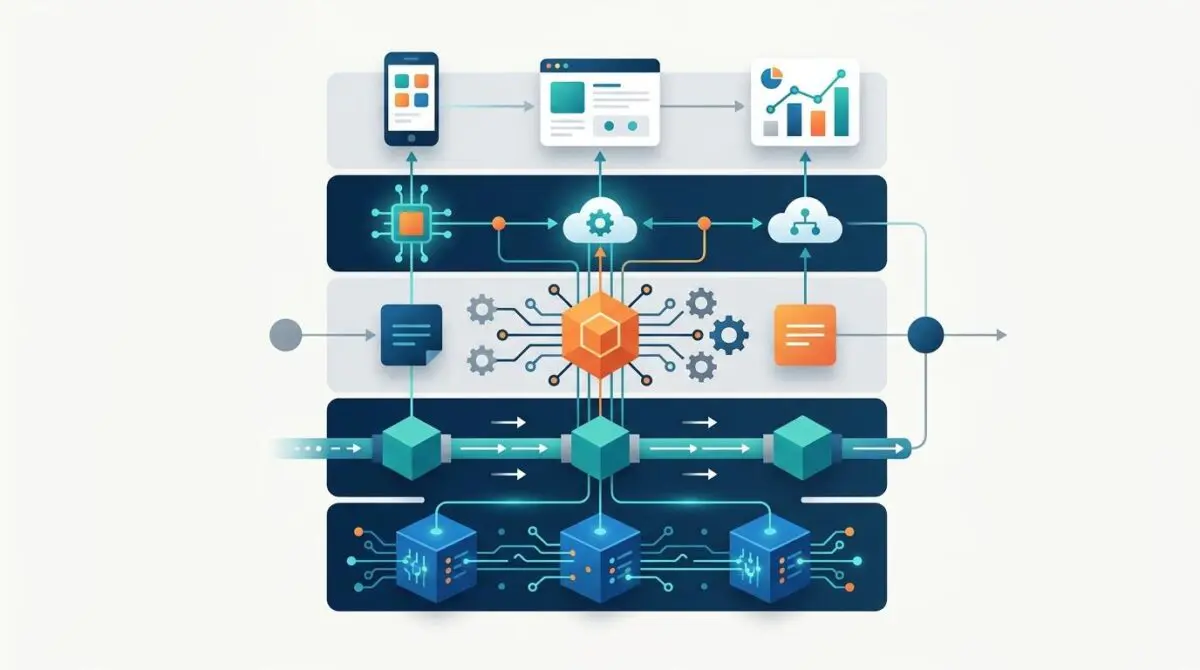
At the core of this disruption is the concept of composite banking architectures. In this highly advanced model, modular APIs for ledgering and compliance are no longer static integrations. They are dynamic, composable blocks of financial code.
These blocks are continuously reconfigured by AI reasoning engines to optimize for specific outcomes. If a transaction requires lower fees, the AI routes it through a more cost-effective network. If speed is the priority, it instantly switches to a real-time settlement rail.
This dynamic reconfiguration happens in real-time, executing thousands of micro-decisions per second. The AI acts as an autonomous financial conductor, ensuring optimal cost, speed, and compliance. The system learns, adapts, and executes flawlessly without human input.
The Imperative of Agentic Middleware
To make this autonomous vision a secure reality, a new category of technology has emerged. Specialized middleware is the vital connective tissue of this new financial infrastructure. It provides the rigorous security, identity, and permissioning frameworks required for AI.
Without robust middleware, autonomous agents would be an unacceptable liability for any enterprise. With it, they become a powerful force for financial optimization and yield generation. These middleware layers ensure that every transaction remains cryptographically secure.
From a regulatory standpoint, compliance is seamlessly integrated into the code itself. Smart contracts automatically enforce security protocols before a transaction is ever broadcast to the network. This drastically reduces the need for massive, human-powered compliance departments.
The Strategic Action Plan
Strategic Trajectory
- Implement Self-Healing Financial Stacks to drive operational resilience over the next 24 months.
- Deploy predictive analytics to dynamically switch between payment rails including FedNow, Swift, and stablecoin networks.
- Automate infrastructure response to fluctuating gas fees, network congestion, and regional regulatory shifts.
- Transition executive focus from managing financial personnel to programming an autonomous financial nervous system.
- Scale financial operations infinitely by leveraging infrastructure defined entirely by code.
The next few years will dictate the winners and losers of the autonomous finance era. The rise of self-healing financial systems is inevitable, and early adopters will secure a massive competitive advantage. These advanced systems use predictive analytics to automatically switch between payment rails.
Whether the optimal route is a traditional banking network or a decentralized stablecoin, the system routes capital through the most efficient path. It autonomously adapts to fluctuating fees, sudden network congestion, and evolving regulatory shifts. This level of operational resilience is truly unprecedented.
Programming the Financial Nervous System
For CEOs, founders, and institutional investors, the strategic mandate is incredibly clear. The executive focus must move from managing a traditional finance team to programming a digital financial nervous system. You are no longer just hiring humans to push buttons on a spreadsheet.
Instead, you are deploying sophisticated code to act as your autonomous digital CFO. This digital entity executes complex treasury strategies, manages currency risk, and optimizes liquidity instantly. This transition requires a radical shift in executive mindset.
Building this self-healing infrastructure requires a strategic audit of your current technological debt. Legacy software and monolithic banking portals are fundamentally incompatible with AI-driven finance. Visionary leaders must begin decoupling their financial data from these siloed systems immediately.
The transition starts with implementing an API-first treasury management system. Once the data is liberated and flowing through open APIs, you can begin layering AI reasoning engines on top. This phased approach mitigates operational risk while steadily building toward full autonomy.
Furthermore, executives must rethink their talent acquisition strategies. The modern finance department needs financial engineers, AI specialists, and blockchain developers. You are building a technology company that happens to move money, and your team must reflect that reality.
- Infinite Scalability: Code does not sleep, require benefits, or make manual data entry errors.
- Dynamic Routing: Automated systems instantly pivot away from congested or expensive payment rails.
- Absolute Compliance: Regulatory rules are hardcoded into the execution layer, preventing unauthorized capital movement.
The ultimate goal of this architecture is absolute capital efficiency. When your financial system can heal itself, optimize its own routing, and negotiate its own settlements, you achieve frictionless enterprise growth. This is the blueprint for the visionary organization.
Conclusion: Code as Capital
Autonomous financial infrastructure represents the absolute peak of modern financial technology. It transforms capital from a dormant, reactive asset into an intelligent, programmable force. By embracing AI-driven finance and self-healing systems, leaders can unlock unprecedented levels of liquidity.
We are witnessing the inevitable convergence of artificial intelligence and global financial infrastructure. Businesses that hesitate and cling to legacy manual reconciliation will be suffocated by friction. Those that adapt will ride the wave of autonomous liquidity to total market dominance.
The future of global finance is highly automated and intelligent. It is defined entirely by code. The only question remaining is whether your enterprise will write the code, or be disrupted by it.
Navigating the intersection of financial technology, institutional capital, and market psychology requires a sharp strategy. To future-proof your FinTech architecture and scale with precision, connect with Andres at Andres SEO Expert.
Frequently Asked Questions
What is an Autonomous FinTech Infrastructure Stack?
An Autonomous FinTech Infrastructure Stack is a proactive, AI-native orchestration layer that replaces legacy manual treasury management. It uses autonomous agents and programmable ledgers to negotiate, execute, and settle cross-border transactions in real-time, treating capital as a programmable entity rather than a static asset.
How does Agentic Finance evolve beyond Embedded Finance?
While Embedded Finance integrates banking into non-financial platforms, Agentic Finance introduces autonomous software agents to manage the resulting transaction volume. These agents use LLM reasoning to handle complex financial operations, such as yield hunting and liquidity orchestration, without human intervention.
What is the Latency-to-Liquidity gap in modern finance?
The Latency-to-Liquidity gap represents the time capital remains trapped in legacy T+2 settlement cycles. Autonomous stacks eliminate this friction using private blockchain-based settlement layers and tokenized deposits, reducing cross-border friction to under 10 milliseconds and providing sub-second liquidity finality.
What is Agentic Middleware and why is it necessary?
Agentic Middleware is the security and permissioning framework that allows AI agents to safely move real-world value. It provides the necessary guardrails, cryptographic security, and automated KYC/AML compliance required for enterprises to deploy autonomous financial operators securely.
How do Self-Healing Financial Stacks improve operational resilience?
Self-Healing Financial Stacks use predictive analytics to automatically adapt to market conditions. They can dynamically switch between payment rails like FedNow, Swift, or stablecoin networks to avoid network congestion, high gas fees, or regional regulatory shifts, ensuring continuous capital flow.
What is the role of LLM reasoning in Composite Banking?
In Composite Banking, modular APIs for ledgering and compliance are dynamic. LLM-driven reasoning engines act as conductors, continuously reconfiguring these blocks in real-time to optimize every transaction for the lowest cost, highest speed, and best regulatory profile available.