


Key Points
- Synthetic Audience Simulation: Marketing has transitioned to Multi-Agent Systems where adversarial AI personas stress-test copy before deployment.
- Psychographic RAG: Real-time consumer sentiment is retrieved and injected into prompt layers, eliminating the uncanny valley of generic AI writing.
- Predictive Persona Morphing: Enterprise leaders are forecasting audience value shifts over 12-month macroeconomic horizons to preemptively recalibrate brand narratives.
Table of Contents
The Core Friction: Overcoming Genericism Fatigue
According to the 2026 Gartner CMO Strategic Report, 82% of top-performing marketing teams have replaced traditional demographic targeting with AI-driven dynamic persona prompting. This shift has helped them achieve a 55% reduction in customer acquisition costs.
This data point highlights a massive paradigm shift in how enterprise organizations approach digital communication. The era of static buyer personas and monolithic brand voices is now officially obsolete.
For years, early generative AI was plagued by a phenomenon known as genericism fatigue. Brands rapidly deployed large language models to scale content production, only to find their messaging sounded identical to their competitors.
This race to the bottom created an uncanny valley of AI writing. Consumers quickly learned to identify and ignore the synthetic, soulless syntax of early generative outputs.
The market friction was palpable. Mid-market e-commerce brands experienced skyrocketing bounce rates and plummeting conversion metrics as their audiences tuned out the noise.
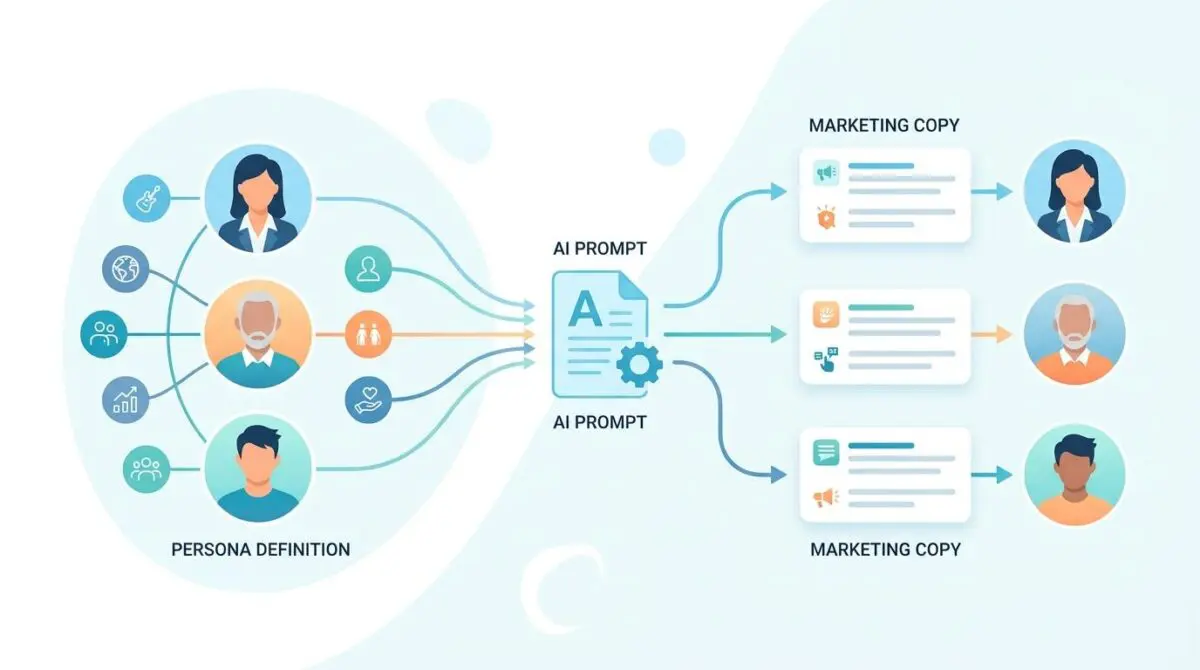
Enter Persona-Based Prompt Engineering (PBPE). This is not merely a tactical copywriting framework, but a foundational restructuring of how artificial intelligence interfaces with human psychology.
By injecting high-fidelity behavioral data directly into the prompt layer, PBPE solves the uncanny valley problem. It reduces bounce rates for mid-market e-commerce brands by an average of 38% while maintaining strict brand-voice consistency across global markets.
The Synthetic Audience Shift
In 2026, marketing has transitioned away from static templates and embraced a revolutionary concept known as synthetic audience simulation.
Businesses no longer write copy and hope it resonates. Instead, they deploy sophisticated multi-agent systems to predict resonance mathematically before a single ad dollar is spent.
Within these closed ecosystems, a critic persona AI is engineered to embody the exact skepticism, pain points, and objections of the target market.
This critic is then pitted against a buyer persona AI. The system stress-tests the marketing copy in hundreds of simulated iterations, refining the messaging through an adversarial creative approach.
This allows for hyper-niche resonance at an unprecedented scale. Copy is automatically tuned to the specific linguistic nuances and emotional triggers of micro-communities in real-time.
Market Intelligence & Smart Capital
The economic impact of this technological leap is staggering. Smart money is rapidly abandoning basic LLM wrappers in favor of specialized behavioral middleware.
Market Intelligence & Data
Empathy Alignment
76% of consumers in 2026 state they cannot distinguish between persona-prompted AI copy and human-written content, according to a Salesforce Research study.
Market Opportunity
The global market for specialized Persona-Prompting middleware is expected to reach $18.5B by the end of 2026, per International Data Corporation (IDC) projections.
Engagement Uplift
Data from HubSpot’s 2026 State of Marketing report shows that email campaigns using persona-based AI generation see 14x higher click-through rates than generic AI-drafted versions.
Enterprise Adoption
94% of Fortune 500 companies have integrated ‘Persona Libraries’ into their internal LLM workflows to ensure cross-departmental messaging alignment, according to McKinsey & Company.
The data grid above reveals a stark reality for legacy marketing agencies. The ability to simulate human empathy at scale is no longer a theoretical concept, but a highly commodified, multibillion-dollar enterprise function.
Venture capital firms are aggressively funding infrastructure that bridges the gap between raw compute power and human emotional intelligence.
We see this reflected in the engagement metrics outlined in HubSpot’s 2026 State of Marketing report, which validates the massive ROI of behavioral alignment.
When an email campaign can achieve a 14x higher click-through rate simply by routing the generation process through a highly calibrated persona prompt, the financial incentive to adopt this technology becomes undeniable.
The Strategic Deep Dive: Architecture of Resonance
Market dominance in the PBPE landscape is currently shared between a few foundational tech giants and specialized upstarts.
OpenAI’s Agentic Persona API has established a strong baseline for developers looking to build behavioral guardrails into their proprietary applications.
Meanwhile, enterprise marketing teams are heavily relying on user-friendly frameworks like Jasper’s Brand Voice ecosystem to ensure their synthetic outputs do not deviate from corporate messaging guidelines.
However, the most disruptive innovation is happening at the intersection of real-time data retrieval and psychological profiling.
Psychographic RAG and Empathy-as-a-Service
Significant venture capital is flowing into Empathy-as-a-Service startups. A prime example is Anthropic-backed NeuroCopy, which recently closed a massive $600M Series D funding round.
These disruptors focus entirely on a new architectural framework known as Psychographic RAG. Traditional retrieval-augmented generation pulls factual data from a database to ground the AI’s response.
Psychographic RAG, conversely, retrieves real-time consumer sentiment. It scrapes social listening tools, customer support transcripts, and macroeconomic news to update persona prompts every single hour.
If a sudden market downturn causes anxiety among a specific cohort of mid-level managers, the Psychographic RAG system detects this emotional shift.
It immediately rewrites the prompt architecture. The resulting marketing copy automatically shifts its tone from aggressive growth to risk mitigation and stability, perfectly matching the psychological state of the buyer.
Behavioral Mirroring at Enterprise Scale
The application of PBPE is expanding beyond asynchronous marketing channels like email and entering the realm of real-time user experience.
A 2026 investigation by The Wall Street Journal revealed that Amazon is currently testing behavioral mirroring prompts. These adapt the reading level and tone of product descriptions in real-time based on a user’s previous 10 seconds of scrolling behavior.
If a user scrolls rapidly, skimming only headlines, the AI instantly reprompts the product description to output bulleted, high-impact technical specs.
If the user lingers on lifestyle images, the system reprompts the text to deliver a narrative-driven, emotionally resonant story about the product.
This level of dynamic alignment represents the holy grail of conversion rate optimization. The website itself becomes a fluid, living entity that morphs to mirror the exact psychological profile of the individual interacting with it.
The Executive Action Plan: Future-Proofing the Narrative
As PBPE becomes the industry standard, forward-thinking executives are already looking toward the next horizon of synthetic communication.
The next evolution is predictive persona morphing. Founders are preparing for AI systems that do not just reflect current personas, but actively forecast the future.
Strategic Trajectory
- Transition from current-state reflection to Predictive Persona Morphing systems.
- Implement AI modeling to forecast audience value shifts over a 12-month trajectory.
- Integrate macroeconomic indicators as core inputs for future-facing persona alignment.
- Preemptively recalibrate brand narrative architecture before market shifts manifest.
Implementing this framework requires a fundamental shift in how organizations manage their data architecture. Chief Marketing Officers must audit their existing prompt libraries and transition them into dynamic, API-driven databases.
By integrating macroeconomic indicators as core inputs, brands can predict how target audience values will shift over a 12-month horizon.
This allows enterprise leaders to preemptively adjust their narrative architecture. They can position their brand messaging to catch the wave of consumer sentiment before the market shift even occurs.
The companies that master predictive persona morphing will essentially operate with a crystal ball. They will secure deep emotional loyalty by addressing customer anxieties before the customer even articulates them.
Conclusion: The New Baseline of Resonance
Persona-Based Prompt Engineering is no longer a fringe tactic for early adopters. It is the new baseline for digital communication.
The transition from generic AI outputs to synthetic audience simulation marks the end of the uncanny valley. Brands that fail to adopt dynamic, empathy-driven prompt architectures will quickly find themselves outmaneuvered by competitors who can speak to their customers with mathematical precision.
The future of marketing belongs to those who can build the most sophisticated, behaviorally accurate prompt ecosystems.
Navigating the intersection of technology, capital, and market psychology requires a sharp strategy. To future-proof your business architecture and scale with precision, connect with Andres at Andres SEO Expert.
Frequently Asked Questions
What is Persona-Based Prompt Engineering (PBPE)?
Persona-Based Prompt Engineering (PBPE) is a sophisticated framework that injects high-fidelity behavioral data into AI prompts to eliminate Genericism Fatigue. By aligning synthetic outputs with specific human psychology, PBPE helps brands maintain voice consistency and has been shown to reduce bounce rates by an average of 38%.
How does Synthetic Audience Simulation improve marketing performance?
Synthetic Audience Simulation uses Multi-Agent Systems to mathematically predict content resonance before a campaign launches. By using a Critic Persona AI to stress-test copy against a Buyer Persona AI, businesses can refine messaging through adversarial iterations to achieve hyper-niche resonance at scale.
What is the difference between traditional RAG and Psychographic RAG?
While traditional Retrieval-Augmented Generation (RAG) pulls factual data from databases, Psychographic RAG retrieves real-time consumer sentiment. It monitors social listening tools and macroeconomic news to update persona prompts hourly, allowing AI to adjust its tone to match the current emotional state of the target audience.
What are the benefits of AI Behavioral Mirroring for e-commerce?
Behavioral Mirroring adapts a website’s user experience in real-time based on scrolling behavior. If a user skims, the AI reprompts descriptions to show high-impact technical specs; if they linger on images, it shifts to narrative-driven storytelling, transforming the site into a fluid entity that mirrors individual psychological profiles.
What is Predictive Persona Morphing?
Predictive Persona Morphing is an advanced strategy where AI systems forecast future audience value shifts over a 12-month trajectory. By integrating macroeconomic indicators, organizations can preemptively recalibrate their brand narrative architecture to address customer needs before they are even articulated.
Why is enterprise adoption of Persona Libraries increasing?
According to McKinsey, 94% of Fortune 500 companies have integrated Persona Libraries into their LLM workflows. This ensures cross-departmental messaging alignment and leverages data-driven empathy to achieve up to 14x higher click-through rates compared to generic AI-generated content.