

Key Points
- The 2026 enterprise strategy has pivoted to Edge-Native, leveraging Small Language Models (SLMs) and ‘Privacy-Silos’ to eliminate cloud dependencies and data residency liabilities.
- ‘Quantized Personalization’ and neuromorphic silicon enable zero-latency, sub-$100 offline inference, driving autonomous operations in heavy industry and hyper-personalized retail.
- Future architectures rely on the ‘Edge-Mesh Collective’ and ‘Evergreen Models’ for continuous on-device learning, sharing compute resources without centralized retraining.
Table of Contents
The Core Friction: Escaping the Connectivity Tax
The enterprise technology landscape has undergone a violent tectonic shift over the past twenty-four months. According to the 2026 Gartner Infrastructure Report, 75% of enterprise data is now generated and processed at the edge. This massive surge from 50% in 2024 is driven by the mandate for sub-10ms response times in autonomous systems.
This is no longer a fringe engineering concept but a fundamental baseline for corporate survival. Leaders who continue to rely exclusively on centralized cloud computing are bleeding capital through invisible inefficiencies. The overarching strategy has officially shifted from a Cloud-First mentality to an Edge-Native reality.
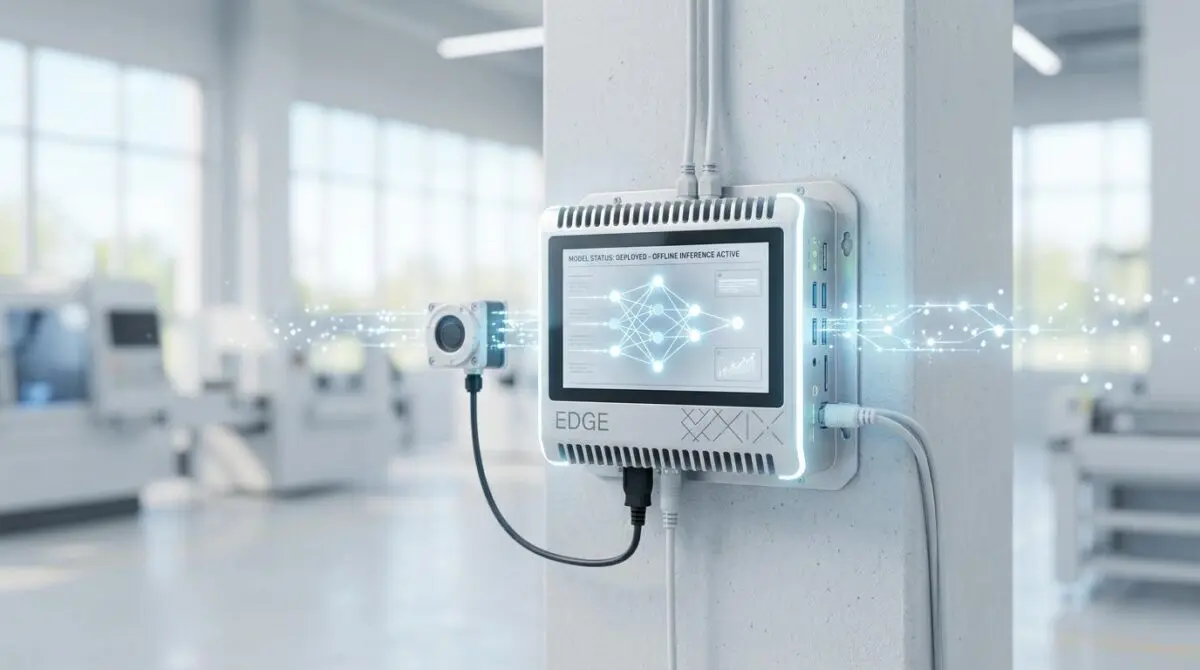
At the center of this revolution is Edge AI and Offline Inference Architecture. This framework represents a radical departure from the traditional model of sending massive data payloads back and forth to distant server farms.
Instead, intelligence is pushed directly to the physical boundary of the network. This brings the computational brain to the exact location where the data is born. For autonomous systems like self-driving fleets, surgical robotics, and industrial drones, this proximity is a matter of operational life and death.
The massive problem being solved here is known in the boardroom as the Connectivity Tax. This tax is a toxic combination of high cloud egress fees, unpredictable network latency, and the crippling legal liabilities associated with data residency.
When a surgical robot is making a micro-incision, it cannot afford the luxury of waiting for a cloud server to process a visual frame. Offline inference provides an unshakeable fail-safe for these critical systems that simply cannot risk a connection lost scenario.
Beyond latency and capital expenditure, the shift to offline architecture directly addresses the escalating 2026 global energy crisis. Centralized data centers have become thermal nightmares, consuming staggering amounts of power and water.
By offloading this computational burden to distributed, low-power edge nodes, enterprises are drastically shrinking their carbon footprint. Edge AI and Offline Inference Architecture is rapidly becoming the ultimate ESG compliance tool masquerading as a performance upgrade.
Market Intelligence & Smart Capital
To understand the velocity of this transition, we must examine where institutional capital is currently flowing. The financial markets have recognized that the era of monolithic, cloud-bound artificial intelligence has reached its physical limits. Smart money is aggressively pivoting toward decentralized hardware and highly compressed software architectures.
Market Intelligence & Data
Edge Workload Dominance
IDC researchers report that 82% of all AI-driven enterprise workloads now reside on edge endpoints rather than centralized clouds as of mid-2026.
Edge Silicon Valuation
The global market for AI-specific edge chips has reached $143B, driven by the mass adoption of SLMs in consumer electronics, according to Deloitte’s 2026 TMT Outlook.
Latency Reduction
Data from MIT Technology Review shows a 90% reduction in average inference latency for healthcare wearables since the 2025 shift to on-device SLM processing.
Voice-to-Action Benchmark
IEEE Spectrum reports that Qualcomm’s 2026 Hexagon NPU has set a new offline industry benchmark of 15ms for local voice-to-action execution.
The data presented above paints a clear picture of a market in hyper-acceleration. As Gartner predicts that 75% of enterprise data will be generated and processed at the edge, venture capital is flooding into the hardware ecosystem required to support it.
We are witnessing a fundamental rewriting of the silicon hierarchy. The historical dominance of centralized processing units is being systematically dismantled by specialized edge endpoints.
While NVIDIA remains an undeniable titan in this space, their strategy has adapted to the decentralized reality. This pivot is perfectly exemplified by NVIDIA’s Jetson Thor platform for advanced robotics and physical AI at the edge, which currently dominates the heavy-duty physical AI landscape.
However, the most aggressive venture capital is currently hunting for asymmetric returns in non-transformer architectures. Startups like Liquid AI and Axelera AI are capturing massive funding rounds because their models require ninety percent less memory than legacy systems.
The Neuromorphic Silicon Evolution
The hardware narrative has shifted away from brute-force computation toward biological efficiency. Venture capital is heavily favoring neuromorphic chip manufacturers like SynSense.
The industry is moving rapidly away from power-hungry GPUs toward brain-inspired silicon that mimics the neural pathways of the human mind. This allows devices to process complex sensory data using a fraction of a watt.
Major consumer tech giants have already internalized this hardware revolution. Companies like Apple and Qualcomm have successfully integrated dedicated Agentic NPUs into all consumer-grade silicon.
This hardware inclusion is not a marketing gimmick but a foundational requirement. It enables fully autonomous software agents to reside permanently on-device, executing complex workflows without ever pinging a cloud server.
This integration bridges the gap between enterprise-grade edge computing and consumer reality. By placing Agentic NPUs in everyday devices, the friction of daily digital interaction is virtually eliminated. Users now experience instantaneous, context-aware artificial intelligence that operates seamlessly in airplane mode.
The Strategic Deep Dive: Privacy Silos and Quantization
The driving force behind this architectural shift is the astonishing evolution of Small Language Models. By 2026, these compact algorithms have achieved functional parity with the massive 2024-era GPT-4 models.
This compression of intelligence has completely altered the enterprise risk calculus. Companies no longer have to choose between cutting-edge intelligence and strict data security.
Enterprises are aggressively deploying what industry insiders call Privacy-Silos. These are localized hardware clusters designed to process highly sensitive, proprietary data without ever establishing an external uplink.
A defense contractor or a private healthcare network can now run state-of-the-art diagnostic algorithms entirely on-premises. The data never leaves the physical building, instantly nullifying external cybersecurity threats and compliance violations.
A 2026 analysis by TechInsights reveals that Tesla’s latest FSD computer has transitioned to a proprietary neuromorphic architecture, allowing the vehicle to process visual data 50x faster than 2024 GPU-based systems while consuming less power than a standard household LED bulb. This insight highlights the exact trajectory of the entire autonomous sector. Speed and efficiency are no longer mutually exclusive; they are compounding variables.
Quantized Personalization at Scale
The killer strategy in today’s market is a concept known as Quantized Personalization. This is the art of shrinking massive neural networks down to two-bit or three-bit precision.
By stripping away unnecessary mathematical weight, these models become incredibly agile. They can run flawlessly on sub-one-hundred-dollar RISC-V processors.
This extreme quantization allows for real-time, zero-latency predictive maintenance in the harshest industrial environments. An offshore oil rig can now monitor millions of micro-vibrations per second, predicting catastrophic equipment failure entirely offline. The intelligence is embedded directly into the sensor itself, removing the need for fragile satellite uplinks.
In the retail sector, Quantized Personalization is driving hyper-personalized consumer experiences that function without internet connectivity. Smart kiosks and digital mirrors can analyze shopper behavior, adjust lighting, and recommend products instantaneously. The friction of waiting for a cloud-based recommendation engine is replaced by a fluid, immediate interaction that drives higher conversion rates.
The Executive Action Plan: The Edge-Mesh Collective
For Chief Executive Officers and technical founders, understanding this shift is only the first step. The true competitive advantage lies in aggressive, structural implementation.
The future trajectory of artificial intelligence is highly collaborative and entirely decentralized. Leaders must prepare their infrastructure for a world where devices talk to each other, not just to the cloud.
Strategic Trajectory
- Implement an ‘Edge-Mesh Collective’ architecture to facilitate dynamic compute sharing across decentralized local devices.
- Leverage peer-to-peer protocols to enable smart watches and sensors to run massive models exceeding individual hardware capacity.
- Transition toward ‘Evergreen Models’ designed for continuous on-device learning and weight adaptation within local environments.
- Eliminate centralized retraining cycles and cloud handshakes to ensure total operational independence for offline inference.
- Scale the deployment of Small Language Models (SLMs) that evolve their intelligence based on direct user-device interaction.
The next major evolution outlined in the trajectory above is the Edge-Mesh Collective. This is a framework where local devices dynamically share compute resources via localized peer-to-peer protocols.
A smart watch, an industrial sensor, and a localized server can pool their processing power in real-time. This allows them to execute massive algorithmic models that no single device could handle independently.
Furthermore, organizations must pivot toward Evergreen Models. These are algorithms designed for continuous, on-device learning.
They subtly evolve their neural weights based on localized environmental data without ever needing a centralized retraining cycle. The model becomes smarter and more adapted to its specific user every single day, completely autonomously.
This eliminates the costly and time-consuming cloud handshake that previously bottlenecked innovation. By ensuring total operational independence, businesses can deploy intelligence into deep mines, remote agricultural fields, and deep-space applications. The edge is no longer just the boundary of the network; it is the new center of computational gravity.
Conclusion: The Autonomous Future
The transition to Edge AI and Offline Inference Architecture is the most significant infrastructural pivot since the invention of cloud computing itself. We are moving from a world of rented, centralized intelligence to owned, decentralized autonomy. The companies that master this architecture will operate faster, cheaper, and with unprecedented security compared to their cloud-dependent competitors.
Eliminating the Connectivity Tax is not just an IT objective; it is a fundamental business imperative that directly impacts the bottom line. As neuromorphic silicon and Small Language Models continue to evolve, the barrier to entry for true offline intelligence will drop to zero. The future belongs to the organizations that can process reality in real-time, exactly where it happens.
Navigating the intersection of technology, capital, and market psychology requires a sharp strategy. To future-proof your business architecture and scale with precision, connect with Andres at Andres SEO Expert.
Frequently Asked Questions
What is the Connectivity Tax in enterprise AI architecture?
The Connectivity Tax is the cumulative cost of high cloud egress fees, unpredictable network latency, and legal liabilities related to data residency. Edge AI and offline inference solve this by processing data at the network boundary, eliminating the need for expensive and unreliable cloud-based round trips.
How does offline inference improve data privacy and security?
Offline inference architecture enables Privacy Silos, which are localized hardware clusters that process sensitive or proprietary data without establishing an external uplink. By keeping data within the physical building, enterprises can nullify external cybersecurity threats and instantly meet strict data residency compliance standards.
What are the advantages of Small Language Models (SLMs) for edge computing?
Small Language Models are highly compressed algorithms that achieve functional parity with massive legacy models while requiring 90% less memory. Their reduced size allows for high-level intelligence to reside permanently on local devices, enabling context-aware AI that operates seamlessly without an internet connection.
What is an Edge-Mesh Collective?
An Edge-Mesh Collective is a decentralized framework where local devices dynamically share compute resources via peer-to-peer protocols. This allows multiple devices, such as sensors and wearables, to pool their processing power in real-time to execute complex algorithmic models that exceed the capacity of any single hardware unit.
How does neuromorphic silicon impact the energy efficiency of AI?
Neuromorphic silicon mimics the neural pathways of the human brain to process data using biological efficiency rather than brute force. This allows edge devices to handle complex sensory tasks using a fraction of a watt, drastically shrinking the carbon footprint compared to traditional, power-hungry GPUs used in centralized data centers.
What is Quantized Personalization in the context of edge AI?
Quantized Personalization is the process of shrinking neural networks to low mathematical precision (such as two-bit or three-bit) to make them incredibly agile. This enables zero-latency predictive maintenance and personalized consumer experiences to run on inexpensive RISC-V processors in environments where cloud connectivity is unavailable.