Key Points
- Agentic RAG Replaces Passive Search: Custom copilots now execute multi-step transactions across siloed legacy systems, moving beyond generic document retrieval to active workflow automation.
- The Rise of Sovereign AI: Enterprises are utilizing Model Distillation to deploy hyper-efficient, 7B-parameter Small Language Models (SLMs) locally, ensuring zero data leakage and absolute intellectual property control.
- Software 2.0 and Self-Healing Logic: The strategic trajectory points toward self-evolving architectures where AI autonomously detects inefficiencies and deploys code patches based on real-time business telemetry.
Table of Contents
The Friction of Legacy Systems
The era of passive, chat-with-your-data bots is officially dead. According to a 2026 Gartner Strategic Technology report, 75% of Global 2000 enterprises have successfully moved beyond generic AI assistants. They are now deploying at least three agentic copilots deeply integrated into their private software stacks.
This shift is not merely a software upgrade. It represents a fundamental rewiring of corporate anatomy. For decades, businesses have suffocated under the weight of integration debt and disconnected data silos.
Proprietary enterprise software traditionally requires months of employee training. It forces human operators to act as manual routers across a labyrinth of disconnected tabs. Workers waste countless hours copying and pasting context between rigid interfaces.
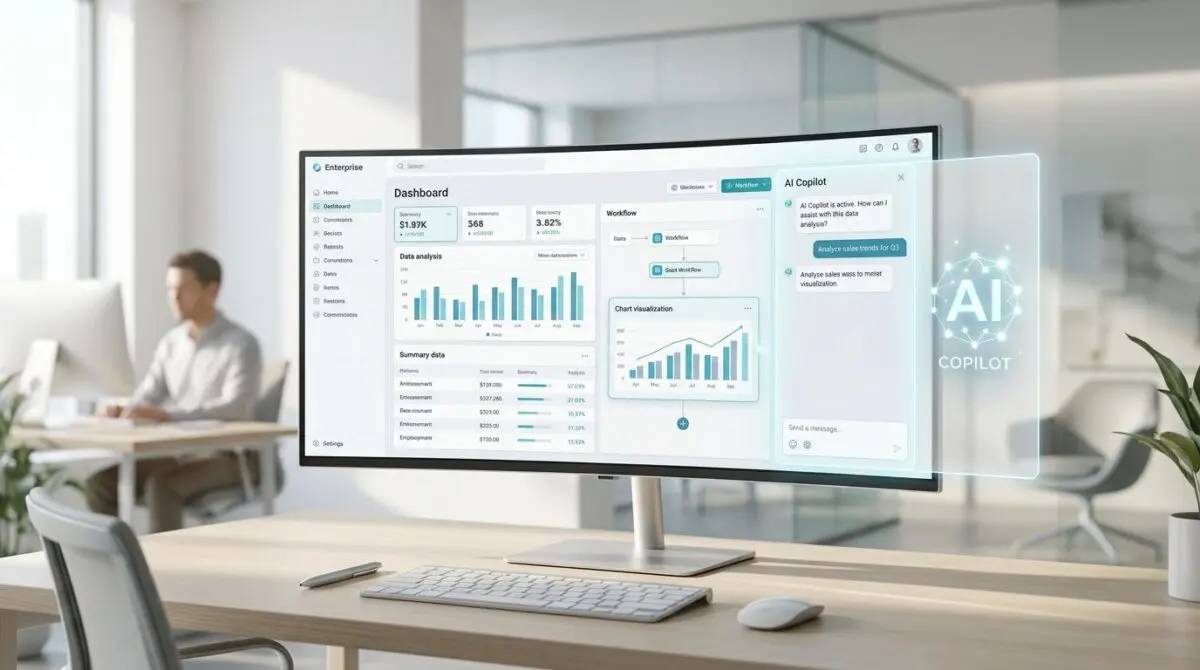
Enter the era of agentic custom enterprise copilots. These specialized systems act as a unified natural language interface. They seamlessly bridge these sprawling legacy gaps.
These copilots effectively digitize the tribal knowledge previously locked in the heads of senior engineers and veteran project managers. This allows a junior employee to execute complex, multi-step workflows effortlessly. They never even need to navigate the underlying legacy user interface.
The friction of software adoption instantly evaporates. The interface becomes entirely conversational. Meanwhile, the backend execution remains rigorously programmatic.
Market Intelligence and Capital Flows
Venture capital is aggressively flowing into AgentOps. This critical layer of tools monitors and audits autonomous AI actions. Heavyweight firms are leading massive funding rounds for startups orchestrating small language models for private clouds.
This influx of smart money signals a massive paradigm shift in how enterprise software is valued. Dominance is currently split between Agent-as-a-Service platforms and low-level infrastructure enablers.
Key players like Microsoft and Salesforce are battling for enterprise dominance with their evolved agent ecosystems. Meanwhile, disruptive startups are carving out highly lucrative niches in autonomous reasoning.
The data below illustrates precisely how this market is accelerating away from traditional SaaS models.
Market Intelligence & Data
Bespoke AI Market Valuation
The market for custom-built enterprise AI agents has reached a staggering $145 billion in 2026 as companies abandon one-size-fits-all SaaS models, according to IDC.
Workflow Velocity Increase
Enterprises utilizing custom-tuned Small Language Models (SLMs) on proprietary data report a 42% faster task completion rate compared to those using generic cloud LLMs, per a 2026 Deloitte analysis.
AI Investment ROI
For every $1 invested in proprietary internal copilots, Fortune 500 firms are realizing a $9 return through the automated elimination of manual data mapping and administrative overhead, according to Morgan Stanley.
Agent-First Architecture
A 2026 study by Andreessen Horowitz found that 85% of new internal software tools are now designed to be ‘Agent-First,’ prioritizing API accessibility for AI over traditional human graphical user interfaces.
These numbers reveal a stark reality for legacy software providers. Companies are rapidly abandoning one-size-fits-all models. They now favor bespoke architectures tailored to their unique operational DNA.
When an enterprise realizes massive ROI by automating manual data mapping, building internally becomes a fiduciary imperative. This marks the death knell for generic SaaS. It signals the dawn of hyper-specialized, agent-first infrastructure.
Capital is no longer chasing user acquisition. Instead, it is aggressively chasing workflow velocity. Startups that guarantee secure, auditable, and autonomous task execution command unprecedented valuations.
A crucial metric driving this capital allocation is the shift toward agent-first architecture. Modern software is no longer designed for human eyes. It is being built specifically for algorithmic consumption.
APIs are being restructured to provide rich, semantic context to AI agents rather than just raw data payloads. This allows the custom enterprise copilot to see the software environment clearly. It operates with the exact same fidelity as a human operator.
The Strategic Deep Dive: Infrastructure and Psychology
To understand the explosive growth of these systems, we must examine the psychological friction of modern enterprise work. Employees are paralyzed by cognitive overload. They are forced to translate human intent into rigid machine logic across dozens of disconnected systems.
Agentic retrieval-augmented generation fundamentally flips this dynamic. Instead of merely surfacing internal documentation, these copilots take action. They execute multi-step transactions across siloed legacy systems.
Imagine a financial analyst commanding the system to reconcile quarterly internal audits against regional compliance. The copilot autonomously queries the database and cross-references the compliance framework. It then generates the final reconciliation report without human intervention.
This marks the transition from read-only AI to read-write autonomy. It removes the human from the tedious execution loop. Workers are finally elevated to purely editorial and strategic roles.
Shattering the Knowledge Silo
The killer strategy in this new landscape involves model distillation. Enterprises are using frontier models to train smaller, hyper-efficient alternatives. These compact models often operate with just seven billion parameters.
Think of this as having a world-renowned polymath mentor a highly specialized intern. The intern does not need to know everything about the universe. They only need absolute mastery over the company’s proprietary codebase.
These distilled models run locally on private infrastructure. This ensures zero data leakage while maintaining high reasoning capabilities for specialized internal logic. The approach is rapidly becoming the gold standard for corporate security and operational velocity.
The broader industry is actively validating this shift toward localized, highly secure autonomy. A 2026 Gartner Strategic Technology report highlights this critical need. Deeply integrated, non-public software stacks are now required to maintain a competitive edge.
By shattering the knowledge silo, companies eliminate single points of failure associated with employee turnover. The intelligence of the organization becomes permanently codified. It is instantly searchable and immediately executable.
Sovereign AI and the SLM Revolution
Corporate leaders are actively pivoting away from public API dependencies. The goal is to prioritize sovereign AI models that reside entirely within their own corporate firewalls. This eliminates the risk of proprietary data feeding external language models.
Recent industry data reveals that NVIDIA’s specialized Inference Microservices (NIMs) now power over 60% of all locally-hosted enterprise agents. This infrastructure provides the necessary compute efficiency. It allows organizations to run these custom models at scale.
Relying on public APIs for core business logic is now viewed as a catastrophic security vulnerability. Sovereign AI ensures that intellectual property generated by the copilot remains strictly within the corporate perimeter.
By owning both the model weights and the inference infrastructure, enterprises transform their proprietary data. It evolves from a static asset into a dynamic workforce. The software no longer just stores information; it acts upon it with autonomous precision.
This localized approach also drastically reduces latency. An agent often needs to execute thousands of micro-transactions per second. In these scenarios, the round-trip delay of a cloud API is simply unacceptable.
The Economics of Localized Compute
The financial mechanics of deploying agentic custom enterprise copilots are fundamentally different from traditional SaaS subscriptions. Instead of paying per-seat licenses, enterprises are investing in fixed-cost compute infrastructure.
This shift from variable operational expenses to capitalized infrastructure provides a massive long-term economic advantage. Once the small language model is trained and deployed, costs plummet. The marginal cost of executing a complex workflow drops to near zero.
Furthermore, these localized models are immune to unpredictable pricing changes and deprecation cycles of public API providers. The enterprise retains total sovereignty over its operational costs. This effectively shields the organization from vendor lock-in.
This economic predictability is highly attractive to institutional investors. It demonstrates a clear maturation of corporate AI strategy. The technology is moving from experimental R&D budgets to core, margin-expanding infrastructure.
The Executive Action Plan
The next evolution of this technology is self-evolving enterprise logic. Forward-thinking founders are preparing for copilots that do more than just assist human workers. These systems will proactively optimize the proprietary code they reside in.
We are rapidly moving toward Software 2.0 paradigms. In this environment, the AI detects inefficiencies in internal business processes. It then suggests, or autonomously writes, code patches to streamline operations.
This creates a software ecosystem that is effectively self-healing and self-optimizing based on real-time business telemetry. To survive this transition, leadership must adopt a proactive, agent-first development strategy.
Strategic Trajectory
- Transition toward ‘Self-Evolving Enterprise Logic’ where copilots move beyond simple assistance to proactive code optimization.
- Adopt ‘Software 2.0’ principles by implementing AI that autonomously detects and remediates inefficiencies in internal business processes.
- Leverage autonomous code patching to streamline operations and update proprietary software in real-time.
- Develop self-healing software architectures that optimize performance based on live business telemetry.
- Shift development focus to agentic systems that proactively manage the codebases they inhabit for maximum operational efficiency.
Executing this roadmap requires a fundamental shift in capital allocation. IT budgets must pivot away from traditional software licensing. Funds must be redirected toward proprietary model training and infrastructure orchestration.
Founders must view their internal codebases not as static tools, but as living environments managed by agentic systems. The role of the Chief Technology Officer is fundamentally shifting. They are moving from managing software deployments to orchestrating a fleet of autonomous digital workers.
Those who master this transition will achieve unprecedented operational efficiency. They will leave their competitors struggling in the dust. Rivals will be weighed down by legacy integration debt and bloated administrative overhead.
The time to audit your internal workflows and identify agentic use cases is now. Delaying this transition is a critical mistake. It will result in an insurmountable velocity deficit in the marketplace.
The Software Singularity
The deployment of agentic custom enterprise copilots is the defining technological arms race of this decade. It serves as the vital bridge between human strategic intent and frictionless digital execution.
We are approaching an era where software writes, repairs, and optimizes itself. The companies that control their own sovereign AI infrastructure will dictate the pace of innovation. The choice is binary: build your own autonomous workforce, or be outpaced by competitors who do.
True market disruption belongs to those who view AI not as a feature, but as the foundational architecture of their business. The future of enterprise software is invisible, autonomous, and hyper-personalized.
Navigating the intersection of technology, capital, and market psychology requires a sharp strategy. To future-proof your business architecture and scale with precision, connect with Andres at Andres SEO Expert.
Frequently Asked Questions
What are Agentic Custom Enterprise Copilots?
Agentic Custom Enterprise Copilots are specialized AI systems that serve as a unified natural language interface across private software stacks. Unlike basic chatbots, these agents autonomously execute multi-step workflows, bridging legacy gaps and digitizing tribal knowledge to streamline complex operations.
How do AI agents reduce enterprise integration debt?
AI agents reduce integration debt by acting as a conversational layer over disconnected data silos and rigid legacy interfaces. They allow employees to execute tasks without manual data entry or navigating disparate systems, effectively automating the translation of human intent into programmatic backend execution.
Why are enterprises adopting Small Language Models (SLMs)?
Enterprises are shifting to SLMs via model distillation to achieve faster task completion rates and better security. These hyper-efficient models run on private infrastructure, providing high reasoning capabilities for specialized internal logic while ensuring zero data leakage to external providers.
What is Sovereign AI and why is it essential for security?
Sovereign AI refers to models that reside entirely within a company’s corporate firewall. It is essential because it prevents proprietary intellectual property from being exposed to public APIs, ensuring that all data generated and processed by AI agents remains under strict corporate control.
What does an Agent-First software architecture entail?
Agent-First architecture prioritizes API accessibility and semantic context for AI agents over traditional human graphical user interfaces. This design allows autonomous systems to interact with the software environment with high fidelity, enabling them to read and write transactions without human intervention.
What is the ROI of building proprietary internal AI copilots?
According to 2026 market data, Fortune 500 firms are realizing a 9:1 ROI on proprietary copilot investments. This is achieved through the elimination of manual data mapping, reduced administrative overhead, and a shift from variable SaaS licensing to fixed-cost compute infrastructure.