




Key Points
- Agentic Decomposition: LLMs break complex prompts into parallel sub-queries to gather multifaceted context across the index simultaneously.
- Passage-Level Extraction: AI engines prioritize 100-300 word information nuggets over full-page metadata for direct answer synthesis.
- Citation Share Tracking: Success requires shifting from legacy rank tracking to monitoring AI Overview sidebar citations and agentic referral traffic.
Table of Contents
The AI Search Context
By April 2026, AI-driven search traffic surged by 527% year-over-year, marking the fastest behavioral shift in digital discovery history. This paradigm shift demands a complete restructuring of how we approach Generative Engine Optimization.
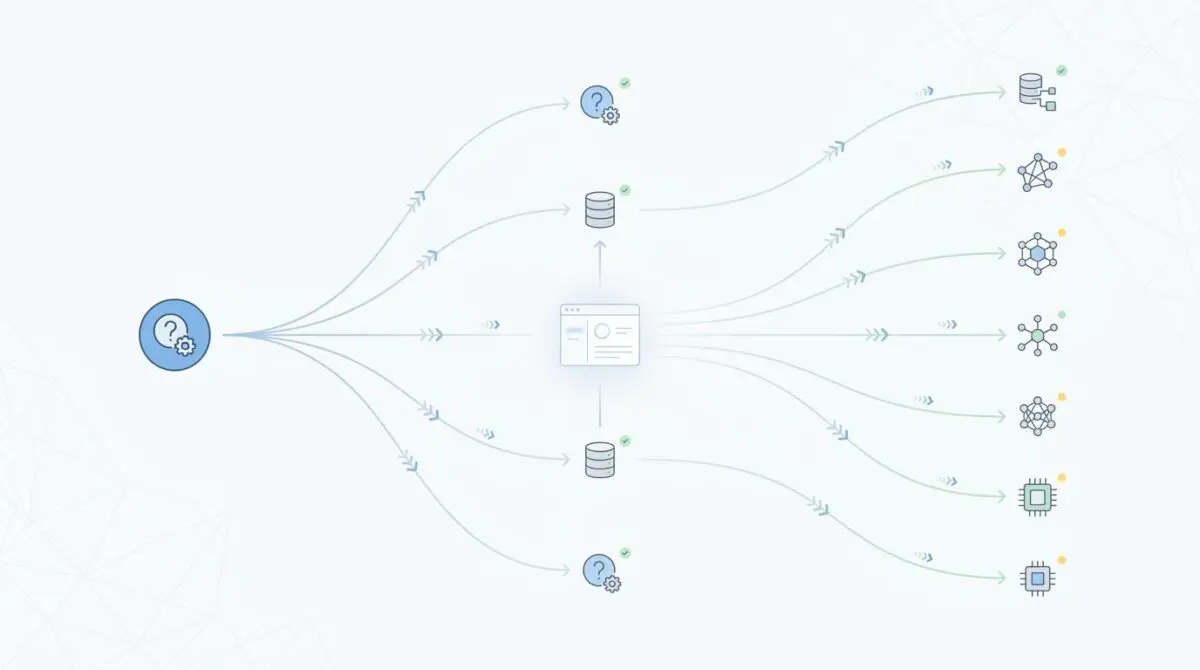
Query Fan-Out is a retrieval architecture where an AI engine decomposes a single, complex user prompt into parallel sub-queries. This allows the system to gather multifaceted context before generating a response.
Instead of matching a keyword to a single URL, the engine fans out to explore definitions, comparisons, and latent intents simultaneously. It then synthesizes the best passages into a single cited answer.
For brands, this represents a massive shift from ranking for one keyword to winning citation share across a web of hidden synthetic queries.
The impact on organic discovery is transformative across all verticals. Traditional organic click-through rates drop by an average of 34.5% when AI Overviews appear.
However, traffic referred by these systems converts at 14.2%. This is nearly five times higher than traditional search, signaling a shift toward high-intent acquisition.
Because 68% of cited sources in 2026 were found outside the top 10 organic results, QFO provides a massive opportunity for niche, authoritative sites.
You can bypass legacy domain leaders by providing the most precise passage-level answer for specific sub-queries in the fan-out chain. This levels the playing field for technically sound websites.
Core Architecture & Pillars
Core Architecture & Pillars
Agentic Decomposition
When a prompt is received, the LLM-orchestrator uses a decomposition layer to break the input into 8-12 discrete ‘reasoning steps.’ Each step is converted into a synthetic search query executed in parallel across the index.
Reciprocal Rank Fusion (RRF)
AI engines use RRF to merge results from diverse sub-queries. Content that appears consistently across multiple fanned-out variations is prioritized for the final citation, regardless of its original SEO rank.
Passage-Level Extraction
QFO focuses on ‘Information Nuggets’ rather than full-page relevance. The retrieval system identifies specific 100-300 word passages that directly resolve a sub-query’s intent, ignoring the rest of the page’s metadata.
Semantic Neighbor Tracking
AI engines track ‘latent semantic neighbors’—queries that aren’t asked but are likely to be next. QFO proactively searches for these to reduce latency in follow-up questions.
To understand how LLMs process information, we must examine the mechanics of agentic decomposition. When a prompt is received, the orchestrator breaks the input into discrete reasoning steps.
Each step is converted into a synthetic search query. These queries are then executed in parallel across the index.
As of May 2026, Google’s AI Mode architecture executes up to 16 simultaneous parallel sub-searches per user prompt to eliminate retrieval latency.
This aligns directly with recent research on multi-query parallelism and LLM reasoning. It demonstrates exactly how AI engines synthesize diverse data streams efficiently.
In WordPress environments, this means a single user visit from an AI agent might trigger multiple hits to different thematic posts in seconds.
If your internal linking is weak, the agent may fail to connect your content clusters during the synthesis phase. Strong semantic architecture is no longer optional.
AI engines use Reciprocal Rank Fusion to merge results from these diverse sub-queries. Content that appears consistently across multiple fanned-out variations is prioritized for the final citation.
This effectively neutralizes legacy SEO metrics in favor of entity density and topical authority.
Plugins like Yoast or RankMath must now be configured to prioritize entity validation over keyword repetition.
AI agents look for consensus signals across your site’s content clusters to validate a fact before citing it. This requires a robust content graph.
Furthermore, QFO focuses on information nuggets rather than full-page relevance. The retrieval system identifies specific 100-300 word passages that directly resolve a sub-query’s intent.
Heavy page builders that bloat HTML hinder AI extraction and reduce your chances of being cited.
Using jump links and HTML5 article tags helps AI crawlers isolate the specific nugget relevant to a fanned-out sub-query.
AI engines also track latent semantic neighbors to proactively search for follow-up questions. This requires a predictive content architecture to pre-answer the fan-out.
The Execution Roadmap
Implementation Roadmap
Activate GA4 ‘AI Assistant’ Channel Group
Navigate to GA4 Admin > Data Settings > Channel Groups. Enable the ‘AI Assistant’ default group (introduced May 2026) to automatically segment traffic from OpenAI, Perplexity, and Google AI Mode. This isolates ‘Agentic Sessions’ from ‘Human Browsing’.
Simulate Fan-Out via API
Use a Python script or tool like Qforia to pass your top 50 ‘money queries’ through a GPT-5 or Gemini 2.0 Ultra instance. Prompt the model to ‘list the 10 sub-queries you would search for to answer this.’ These are your actual targets.
Implement Passage-Optimized Schema
Modify your theme’s functions.php to inject ‘Speakable’ schema and ‘FactCheck’ markup. Ensure each H2/H3 section contains a 150-word ‘Executive Summary’ block that provides a stand-alone answer to one of the simulated sub-queries.
Monitor Citation Share vs. Rank
Switch reporting from ‘Rank Tracking’ to ‘Citation Share.’ Use SearchInsight.ai to track how often your domain appears in the sidebar citations of AI Overviews. If cited but not clicked, optimize the ‘Citation Teaser’ text via meta-descriptions.
Executing a successful GEO strategy requires a fundamental shift in how we track and optimize content. The first step involves activating the GA4 AI Assistant Channel Group.
This isolates agentic sessions from human browsing to provide accurate traffic segmentation.
By navigating to GA4 Data Settings, you can automatically segment traffic from OpenAI, Perplexity, and Google AI Mode.
This isolation is critical for understanding the true ROI of your Generative Engine Optimization efforts.
Next, simulating fan-out via API allows you to uncover the actual synthetic queries generated by LLMs.
By passing your top money queries through a model like GPT-5, you can identify the exact sub-queries targeted by retrieval systems.
These simulated outputs become your new target keywords. You are no longer optimizing for what the user types, but rather what the AI agent queries on their behalf.
Implementing passage-optimized schema is critical for ensuring your content is extracted correctly.
Injecting Speakable schema and FactCheck markup helps AI crawlers isolate the specific nugget relevant to a fanned-out sub-query.
Ensure each heading section contains a concise executive summary block that provides a stand-alone answer. This modular content design is highly favored by agentic retrieval systems.
Finally, monitoring citation share versus traditional rank is essential for measuring success.
As highlighted in recent industry studies on AI Overviews, appearing in sidebar citations often yields higher conversion rates despite lower raw traffic volume.
Switching your reporting from rank tracking to citation share provides a more accurate picture of AI visibility.
If cited but not clicked, optimize the citation teaser text via meta-descriptions to improve click-through rates.
Technical Implementation
To effectively target fanned-out queries, you must simulate the decomposition process programmatically. This allows search architects to map out the exact semantic neighbors an LLM will target.
The following Python script demonstrates how a 2026-era LLM breaks down a primary prompt into parallel sub-queries for Retrieval-Augmented Generation.
By analyzing these outputs, you can structure your HTML5 article tags to answer each synthetic query directly.
Running this script against your core topics reveals the hidden web of agentic search queries.
You can then distribute these sub-queries across your content clusters to maximize reciprocal rank fusion signals.
import openai

def simulate_query_fanout(primary_prompt):
    # This script simulates how a 2026-era LLM decomposes a prompt for search
    client = openai.OpenAI()
    response = client.chat.completions.create(
        model="gpt-5-preview",
        messages=[{"role": "system", "content": "You are an AI Search Retrieval Agent. Break the user prompt into 8-12 parallel sub-queries for RAG."},
                  {"role": "user", "content": primary_prompt}]
    )
    return response.choices[0].message.content

# Example usage for a GEO strategist
sub_queries = simulate_query_fanout("best cloud enterprise ERP 2026 for manufacturing")
print(f"Target these fan-out sub-queries: {sub_queries}")
Once you have generated the sub-queries, map them to specific H2 and H3 tags within your content. Each heading should serve as a direct entry point for the AI crawler.
Validation & Future-Proofing
Validation & Monitoring
- Verify implementation by checking server logs for ‘User-Agent’ strings associated with Google-Other or OAI-Search.
- Monitor the ‘AI Citation Referral’ metric in GA4 to distinguish synthetic agent traffic from organic users.
- Validate QFO strategy success via rising ‘Direct’ or ‘AI Assistant’ traffic with dwell times exceeding 3 minutes.
- Audit ‘Conversion Rate by Referral Source’ to ensure high intent alignment for AI-driven sessions.
Validating your QFO strategy requires rigorous log analysis and traffic segmentation.
Verify implementation by checking server logs for user-agent strings associated with Google-Other or OAI-Search.
These server logs provide undeniable proof that AI agents are crawling your passage-level content.
Monitor the AI Citation Referral metric in GA4 to distinguish synthetic agent traffic from organic users.
A successful strategy will show a rise in Direct or AI Assistant traffic with dwell times exceeding three minutes.
This indicates that users arriving via AI citations are finding highly relevant, deep-dive content.
As LLMs continue to evolve, maintaining a predictive content architecture will be paramount.
Regularly audit your conversion rate by referral source to ensure high intent alignment for AI-driven sessions.
By continuously refining your passage extraction optimization, you can secure long-term visibility in generative engines.
The brands that master query fan-out today will dominate the citation graphs of tomorrow.
Navigating the intersection of traditional SEO and Generative Engine Optimization requires a precise architecture. To future-proof your enterprise stack for AI Overviews and LLM discovery, connect with Andres at Andres SEO Expert.
Frequently Asked Questions
What is Query Fan-Out (QFO) in the context of AI search?
Query Fan-Out is a retrieval architecture where an AI engine decomposes a complex user prompt into 8-12 parallel sub-queries. This allows the system to gather multifaceted context and definitions before synthesizing a single, cited answer for the user.
How does AI-driven search impact traditional organic traffic and conversion?
Traditional organic CTR typically drops by 34.5% when AI Overviews are present; however, traffic referred by these AI systems converts at 14.2%. This is nearly 5x higher than traditional search, signaling a shift toward higher-intent traffic acquisition.
Why is passage-level extraction important for Generative Engine Optimization?
AI engines prioritize ‘Information Nuggets’—specific 100-300 word passages—that directly resolve a sub-query’s intent. By focusing on modular, stand-alone content blocks rather than whole-page relevance, sites can win citations even if they don’t have high legacy SEO rankings.
How does Reciprocal Rank Fusion (RRF) influence AI citations?
Reciprocal Rank Fusion is used by AI engines to merge results from diverse sub-queries. Content that consistently appears across multiple fanned-out variations is prioritized for the final citation, effectively rewarding entity density over traditional keyword repetition.
How can I track AI search performance in Google Analytics 4?
You can activate the ‘AI Assistant’ default channel group within GA4 Data Settings to segment traffic from OpenAI, Perplexity, and Google AI Mode. This allows you to isolate ‘Agentic Sessions’ and monitor specific metrics like ‘AI Citation Referral’ and dwell time.
What technical steps help content get cited in fanned-out AI queries?
Technical optimization includes implementing ‘Speakable’ and ‘FactCheck’ schema, using HTML5 article tags to isolate passages, and including concise 150-word executive summaries under H2/H3 headers to serve as direct entry points for AI crawlers.