Key Takeaways
- NVIDIA BlueField-4 DPU offloads networking, storage, and security from host CPUs, freeing resources for agentic inference.
- Vera BlueField-4 STX Storage Processor powers CMX, a new context-memory tier for KV cache sharing and reuse.
- DOCA software provides a programmable foundation for deploying infrastructure services across the AI factory.
- Extreme co-design across GPU, CPU, and DPU enables higher GPU utilization, predictable latency, and lower cost per token.
Agentic AI Redefines the Infrastructure Data Path: BlueField-4 Takes Center Stage
Agentic AI is shifting inference from isolated model execution into distributed, multi-step workflows that demand tight integration across GPUs, CPUs, memory, networking, storage, and security. NVIDIA’s BlueField-4 DPU and the new Vera BlueField-4 STX Storage Processor, announced July 16, 2026, address this by offloading, accelerating, and isolating infrastructure services directly in the data path. The result is a unified AI factory where context reuse, tenant isolation, and security no longer compete with inference cycles.
Table of Contents
Agentic AI Makes Infrastructure Part of Inference
Agentic workflows turn a single request into a cascade of model calls, tool executions, memory lookups, and policy checks. Each step depends on moving data, preserving context, and enforcing security without slowing GPUs or consuming CPU cycles needed for agent orchestration. This makes the infrastructure data path—networking, storage, security, telemetry—a critical part of the inference pipeline itself.
KV cache, the intermediate state that powers long-context reasoning, has become especially important. When GPU memory is full, systems must evict or recompute cache, introducing latency and cost. NVIDIA’s engineering team explains that this makes KV cache part of the infrastructure data path, requiring fast movement, placement, and retrieval across memory tiers without stalling inference.
BlueField-4: The DPU Powering the AI Factory OS
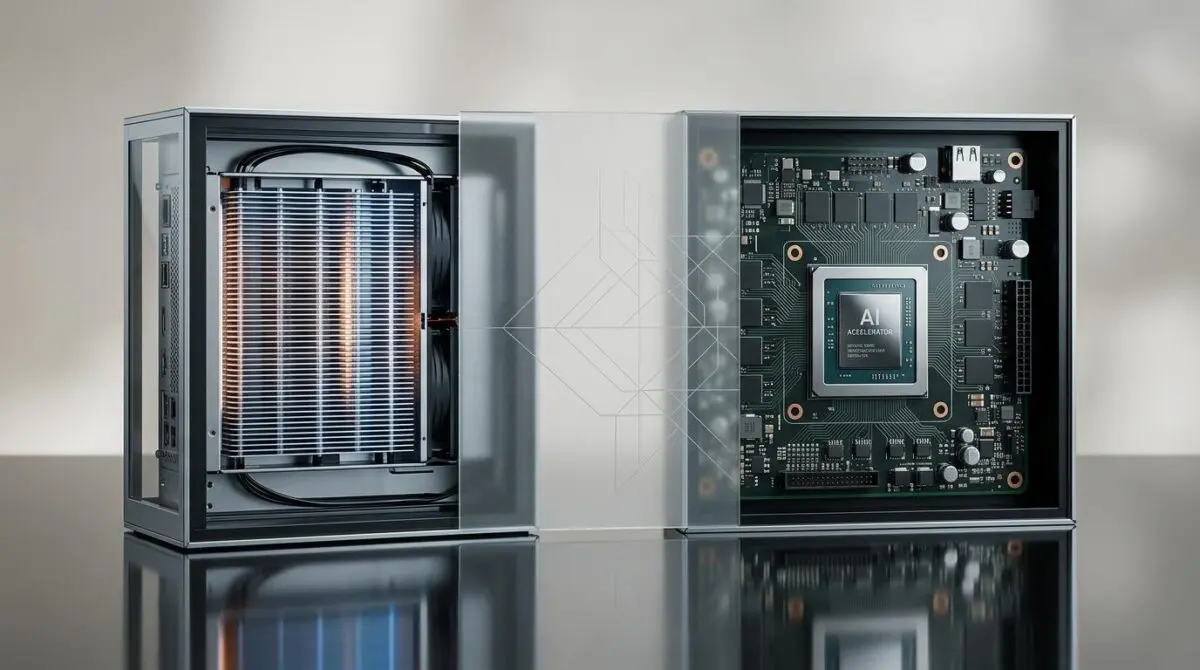
As detailed in NVIDIA’s developer blog, BlueField-4 operates as a dedicated data processing unit across Rubin GPUs and Vera CPUs, integrating up to 800 Gb/s Ethernet or InfiniBand, a 64-core Grace CPU, LPDDR5X memory, PCIe Gen6, and inline acceleration for networking, storage, security, and data movement. Compared to BlueField-3, it doubles networking bandwidth, delivers up to 6x more compute, and offers 4x memory capacity.
The Vera BlueField-4 STX Storage Processor combines the Vera CPU, ConnectX-9 SuperNIC, and up to 1.6 Tb/s Spectrum-X connectivity. It powers NVIDIA CMX, a pod-level context-memory storage tier optimized for KV cache. Using DOCA Memos, CMX manages cache sharing and reuse across compute and storage nodes, reducing prefill overhead and improving token efficiency.
DOCA as the Programmable Foundation
NVIDIA DOCA provides libraries and microservices to build and deploy accelerated infrastructure services. Key capabilities include DOCA Host-Based Networking for server-side routing, BlueField ASTRA for zero-trust multi-tenant deployments, DOCA Memos for KV cache management, and security services for inline policy enforcement and telemetry. This programmable model lets operators adapt to evolving agentic patterns without hardware changes.
Strategic Analysis: Market Impact and Co-Design Evolution
NVIDIA’s extreme co-design approach positions BlueField as more than a NIC—it is the operating system of the AI factory. By embedding compute and inline acceleration directly in the infrastructure path, NVIDIA addresses a critical bottleneck: the growing overhead of context management and security in agentic systems. According to a recent analysis by The Valueist, the CMX platform represents a new category of memory-centric storage that could dramatically reduce per-token costs in long-context workflows.
Competing DPU solutions from AMD Pensando and Intel IPU offer similar offload capabilities, but NVIDIA’s tight integration with its own GPU, CPU, and networking silicon creates a unmatched control plane. A LinkedIn post from Patrick Hough highlights that DPUs like BlueField free up CPU headroom and reduce latency, common in edge and gaming, now scaled to data centers with hundreds of thousands of GPUs. The AI Data Center Guide‘s deep dive on network silicon confirms that BlueField is the canonical example of in-line infrastructure processing.
For enterprises building AI factories, the implications are clear: infrastructure is no longer a bottleneck but an accelerator. BlueField allows providers to offer multi-tenant isolation, predictable latency, and higher GPU utilization without sacrificing security. The shift from host-based to DPU-based services also promises lower total cost of ownership, as CPUs are freed for inference and agent orchestration.
The Future of AI Infrastructure: Programmable Data Paths
As agentic AI scales, the line between compute and infrastructure continues to blur. NVIDIA’s BlueField-4, combined with CMX and DOCA, offers a blueprint for AI factories that treat context as first-class data. Organizations that embrace this programmable data path can expect higher token throughput, lower latency, and stronger security postures.
Staying ahead in the rapidly shifting landscape of AI requires precision. To future-proof your digital strategy and scale effortlessly, you need a foundation built on precision. Optimize your site with advanced speed engineering, secure your infrastructure in high-performance hosting environments, and streamline your entire workflow through autonomous AI pipelines. If you are ready to elevate your systems, Connect with Andres at Andres SEO Expert to build your ultimate architecture.
Frequently Asked Questions
What is Agentic AI and how does it affect infrastructure?
Agentic AI transforms single inference calls into multi-step workflows involving model calls, tool execution, and memory lookups, making the infrastructure data path—networking, storage, security, and telemetry—a critical part of the inference pipeline. This requires tight integration between compute and infrastructure to avoid bottlenecks and ensure low latency.
What is NVIDIA BlueField-4 and how does it differ from BlueField-3?
BlueField-4 is a data processing unit (DPU) that integrates up to 800 Gb/s networking, a 64-core Grace CPU, LPDDR5X memory, PCIe Gen6, and inline acceleration for storage, security, and data movement. Compared to BlueField-3, it doubles networking bandwidth, delivers up to 6x more compute, and offers 4x memory capacity.
What is the Vera BlueField-4 STX Storage Processor and its role?
The Vera BlueField-4 STX combines the Vera CPU, ConnectX-9 SuperNIC, and up to 1.6 Tb/s Spectrum-X connectivity. It powers NVIDIA CMX, a pod-level context-memory storage tier optimized for KV cache management, reducing prefill overhead and improving token efficiency in agentic workflows.
How does DOCA contribute to BlueField-4’s functionality?
NVIDIA DOCA provides a programmable foundation of libraries and microservices to build and deploy accelerated infrastructure services. Key capabilities include DOCA Host-Based Networking, BlueField ASTRA for zero-trust multi-tenancy, DOCA Memos for KV cache management, and inline security enforcement, allowing operators to adapt without hardware changes.
What is KV cache and why is it important for agentic AI?
KV cache is the intermediate state that powers long-context reasoning in large language models. In agentic workflows, efficient movement, placement, and retrieval of KV cache across memory tiers is critical to avoid stalling inference, reducing latency and cost. NVIDIA treats KV cache as part of the infrastructure data path.
How does BlueField-4 improve multi-tenant isolation and security in AI factories?
BlueField ASTRA enables zero-trust multi-tenant deployments by offloading and isolating security policies inline within the DPU, ensuring tenant isolation without consuming GPU cycles. This allows providers to offer predictable latency and higher GPU utilization while maintaining strong security postures.
What is NVIDIA CMX and how does it reduce per-token costs?
CMX (Context-Memory Exchange) is a pod-level storage tier optimized for KV cache management. By enabling cache sharing and reuse across compute and storage nodes via DOCA Memos, it reduces prefill overhead and improves token efficiency, lowering per-token costs in long-context agentic workflows.