Key Takeaways
- NemoClaw orchestrates video AI agents to automatically act on analysis, not just report findings.
- Integration with VSS and RAG cuts response time from hours to minutes across enterprise workflows.
- Real-world deployments demonstrate transformative efficiency gains and accountability improvements.
Video AI Agents Enter the Age of Automated Action
NVIDIA has released a blueprint that integrates context-aware video AI agents into enterprise workflows, enabling systems to not only analyze video footage but also programmatically act on it. The solution, leveraging NemoClaw orchestration, Video Search and Summarization (VSS), and Retrieval-Augmented Generation (RAG), can reduce response times from hours to minutes by automatically creating tickets, alerting teams, and updating databases. This marks a shift from passive video analysis to proactive, automated decision-making.
Table of Contents
Inside the NemoClaw Orchestration Layer
The NemoClaw agent orchestrates a pipeline that combines video understanding, knowledge retrieval, and action generation. It reads skill definitions to learn required parameters, then conducts human-in-the-loop interactions to capture user intent before any processing begins. This scoping ensures the analysis addresses exactly what the user cares about.
Three agent tools work together:
- The Long Video Summary (LVS) tool performs hierarchical summarization with HITL guidance.
- The Knowledge Retrieval (frag) tool calls the RAG Blueprint to fetch organizational context.
- The Report Generation tool produces a structured report with timestamps, narrative analysis, and citations.
These tools collectively turn raw video into actionable intelligence.
A Step-by-Step Workflow
First, a user uploads a video and specifies what to analyze through a series of prompts in the interface. The NemoClaw agent then routes the video to the LVS service and simultaneously queries the RAG Blueprint for relevant enterprise knowledge. After processing, the report generation tool combines findings into a formatted output.
Finally, NemoClaw reads the report and triggers downstream actions. In a demonstration using a meal preparation video, the agent automatically created a Jira ticket summarizing dietary recommendations with appropriate priority and assignment. This same pattern works for inspection footage paired with OEM manuals or retail camera feeds paired with merchandising policies.
The architecture is built in four layers: orchestration by NemoClaw, the VSS agent with its tools, the RAG Blueprint for document retrieval, and an LLM fusion layer that enriches summaries with retrieved context. Data flows downward, with each layer contributing specialized capabilities.
Deployment and Performance
Deploying the full NVIDIA blueprint requires an NVIDIA GPU with at least 24 GB VRAM, Docker Compose, and API keys for NGC and NVIDIA Build. The setup process involves cloning the VSS repository, configuring environment variables, and starting the compose stack. Once deployed, services typically become healthy within 5 to 15 minutes.
Latency overhead from NemoClaw orchestration is minimal because the HITL phase is asynchronous. The actual video processing and knowledge retrieval dominate runtime, as shown in performance benchmarks. The end-to-end pipeline from video upload to ticket creation completes in seconds for typical workflows.
Strategic Analysis: NemoClaw and the Enterprise Agent Era
The release of NemoClaw has been described by TechRadar as signaling ‘the true enterprise agent era.’ The publication noted that NemoClaw does not require Nvidia silicon to run, underscoring a flexible, open strategy that prioritizes integration over lock-in. This flexibility is critical for enterprises with heterogeneous infrastructure.
Just days after NemoClaw’s announcement, LangChain and NVIDIA launched a Deep Agents blueprint based on NemoClaw, providing a reference architecture for building open agent systems with benchmark-leading performance, as reported by PRNewswire. This collaboration validates NemoClaw’s potential as a standard for enterprise agent orchestration.
The real-world impact is already visible. Computacenter deployed the full DETECT-REASON-ACT pipeline on a Run:AI cluster for predictive maintenance. Using VSS to analyze drone, borescope, and thermal inspection footage, combined with RAG for OEM context and NemoClaw for auto-drafting Maximo work orders, they cut footage-to-work-order time from 30-45 minutes to approximately 19 seconds across four asset classes.
Similarly, VAST Data uses NemoClaw to orchestrate a real-time VSS pipeline on the VAST DataEngine, processing live game streams with VAST RAG over VastDB. Built on the NVIDIA blueprint with Cosmos-Reason2 and Nemotron models, it runs end-to-end on NVIDIA DSX AIR. These examples demonstrate the scalability and versatility of the approach.
The implications for enterprise AI are profound. Speed: response times drop from hours to minutes. Scale: thousands of videos can be analyzed across multiple sources. Consistency: reference knowledge is applied uniformly. Accountability: every decision is traced back to video evidence and source documents. Automation: routine workflows run without manual intervention.
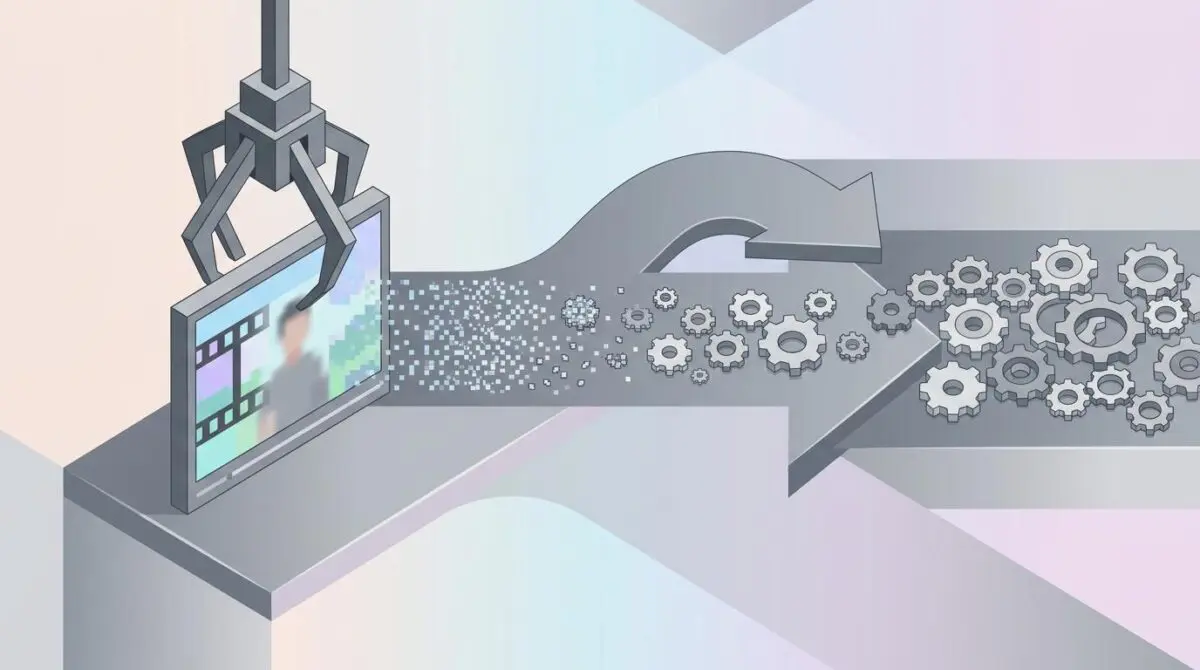
This integration of specialized analysis engines with general-purpose agentic workflows represents a fundamental shift. Video analysis no longer terminates in a static report; it becomes the entry point to an orchestrated workflow that retrieves organizational knowledge, grounds conclusions in evidence, and drives action automatically.
The Future of Video AI Is Automated and Accountable
The combination of VSS, RAG Blueprint, and NemoClaw reframes what video analytics can achieve. No single model or service is optimal for every problem, but specialized systems composed through clean, well-defined APIs can deliver capabilities that exceed the sum of their parts. This is accomplished without sacrificing the modularity, scalability, and governance that enterprise deployments demand.
Enterprises can now act on video insights as quickly as they are generated, consistently and at scale. The footage is already being captured. The next opportunity is to turn it into coordinated, accountable action. The blueprints to do so are available today, and early adopters are already transforming their operations.
Staying ahead in the rapidly shifting landscape of AI requires precision. To future-proof your digital strategy and scale effortlessly, you need a foundation built on precision. Optimize your site with advanced speed engineering, secure your infrastructure in high-performance hosting environments, and streamline your entire workflow through autonomous AI pipelines. If you are ready to elevate your systems, Connect with Andres at Andres SEO Expert to build your ultimate architecture.
Frequently Asked Questions
What is NemoClaw and how does it orchestrate video AI agents?
NemoClaw is an orchestration layer that manages a pipeline of video understanding, knowledge retrieval, and action generation. It reads skill definitions, conducts human-in-the-loop interactions to capture user intent, then routes video to tools like Long Video Summary (LVS), queries RAG for context, and triggers downstream actions such as creating Jira tickets.
How does the video analysis workflow work step by step?
1. User uploads video and specifies analysis through prompts. 2. NemoClaw routes video to LVS service and queries RAG Blueprint for enterprise knowledge. 3. Report generation tool combines findings into a formatted output. 4. NemoClaw reads the report and triggers automated downstream actions like ticket creation or database updates.
What are the key tools in the NemoClaw video agent?
Three tools: Long Video Summary (LVS) for hierarchical summarization with human-in-the-loop guidance, Knowledge Retrieval (frag) to fetch organizational context via the RAG Blueprint, and Report Generation for producing structured reports with timestamps and citations.
What hardware and software are required to deploy the NemoClaw video agent blueprint?
Requires an NVIDIA GPU with at least 24 GB VRAM, Docker Compose, and API keys for NGC and NVIDIA Build. The setup involves cloning the VSS repository, configuring environment variables, and starting the compose stack, with services becoming healthy in 5-15 minutes.
How did Computacenter use this blueprint for predictive maintenance?
Computacenter deployed the DETECT-REASON-ACT pipeline on a Run:AI cluster, using VSS to analyze drone, borescope, and thermal inspection footage, combined with RAG for OEM context and NemoClaw to auto-draft Maximo work orders. This cut footage-to-work-order time from 30-45 minutes to approximately 19 seconds.
What are the strategic benefits of integrating VSS, RAG, and NemoClaw?
Benefits include dramatic speed improvements (hours to minutes), scalability for thousands of videos, consistent application of reference knowledge, traceable accountability via evidence and source documents, and fully automated routine workflows without manual intervention.