Key Takeaways
- A central identity gateway decouples session ownership from request enforcement, cutting repeated logins by 55% across federated AI platforms.
- Redis-backed shared sessions with OIDC standardize validation, token refresh, and logout across all Kubernetes clusters.
- Identity convergence is becoming a competitive requirement, making session state the next sovereignty layer for AI platforms.
Table of Contents
Federated AI Still Breaks at the Data-Plane Login
Modern AI platforms are no longer a single application behind one login screen.
A user can move from a portal to a governed dataset, to a notebook, and then to an assistant that calls services in another cluster without leaving one platform shell. Identity still crosses every control-plane and data-plane boundary along that path.
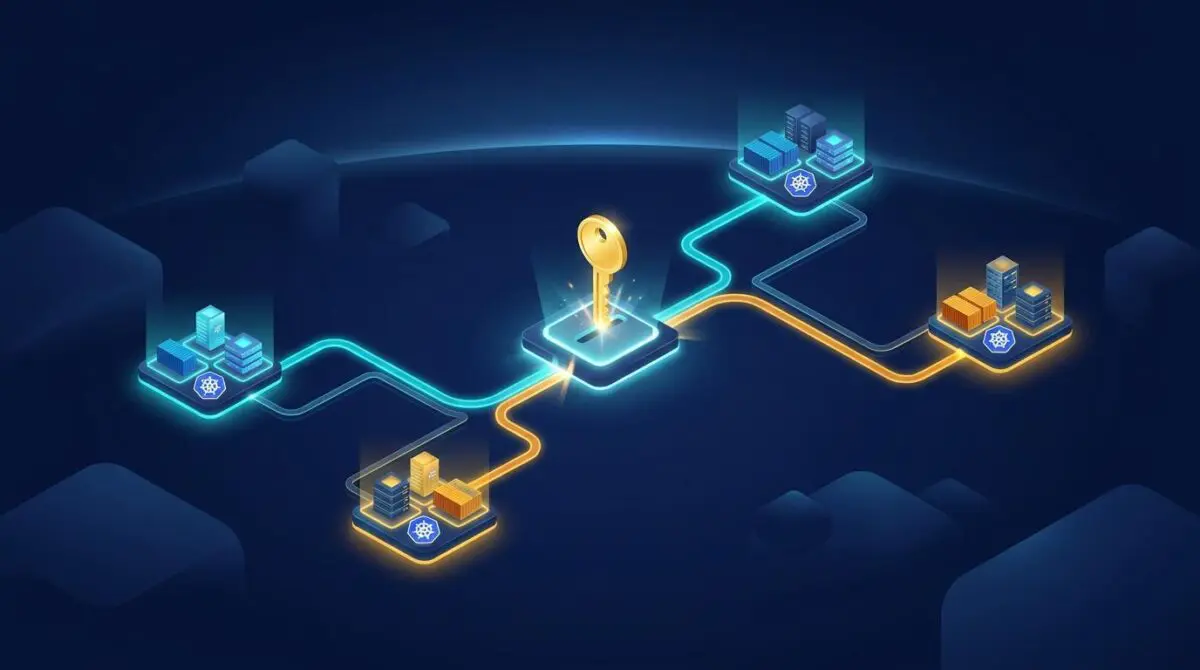
A September 3, 2026, engineering report from NVIDIA details a central identity gateway architecture designed to stop those breaks. The pattern decouples session ownership from request enforcement.
It relies on standard OpenID Connect, a Redis-backed shared session store with explicit time-to-live values, and a minimal identity-validation endpoint that regional gateways can trust. The implementation reduced repeated login events by 55 percent across internal developer platforms spanning Kubernetes clusters in AWS and Oracle Cloud Infrastructure.
Inside the Central Identity Gateway
The distributed model looks simple at first. Each service gateway owns its own login flow, session store, token refresh behavior, and logout scope.
But that model creates structural problems as a platform expands. Sessions stay local to the gateway that created them, logout does not propagate, token refresh becomes uncoordinated, and downstream identity claims vary from service to service.
The central gateway inverts that model by assigning session ownership to one dedicated identity layer.
Login, validation, and platform scope
The central identity gateway owns three responsibilities.
- Session creation — handles the OIDC authorization code flow and writes the authenticated session to a shared store.
- Per-request validation — answers the question of who the user is for any trusted gateway or service.
- Session lifecycle management — coordinates token refresh and logout across the platform.
When a user arrives without a valid platform session, the regional gateway redirects the browser to the central gateway. The central gateway completes the OIDC handshake, stores the session in Redis with a defined TTL, and sets an HTTP-only cookie scoped to the platform domain.
Every subsequent request follows a lighter path. The regional gateway sends the session cookie to a validation endpoint such as /gateway/userinfo.
The central gateway looks up the session and returns trusted claims, including user identity, groups, roles, and session metadata. The regional gateway then injects standard identity headers before forwarding the request to the downstream application.
This removes token parsing and identity-provider integration from every internal service. Applications consume identity from a consistent platform interface instead of recreating authentication plumbing.
Guardrails and failure modes
Centralization makes the identity gateway a critical service. NVIDIA’s engineering report specifies several required controls: mutual TLS or workload identity between gateways, removal of client-supplied identity headers before trusted injection, short access-token lifetimes, and encrypted session storage with strict access controls.
Platform teams must also define failure behavior explicitly. Some environments should fail closed when the session store is unavailable, while others may tolerate short-lived cached validation for resilience.
Logout becomes platform-wide because deleting the shared session record invalidates access everywhere on the next request. Token refresh likewise becomes one coordinated operation rather than a cluster-by-cluster negotiation with the identity provider.
That consolidation reduces upstream identity-provider load. It scales more closely with active users than with the number of user-tool-cluster combinations.
Identity Convergence Is Now a Competitive Requirement for AI Platforms
The pattern outlined by NVIDIA does not exist in isolation. Across Kubernetes-native AI tooling, identity is converging on centralized, policy-scoped access layers.
Stacklok’s official documentation for ToolHive, for example, describes securing MCP servers in Kubernetes with external OIDC providers, Kubernetes service account tokens, and an embedded OAuth server. It pairs those authentication methods with Cedar authorization, where a 401 means token validation failed and a 403 means the request passed authentication but hit a policy denial.
That distinction matters for AI platforms. It separates identity validation from authorization policy, much like the central gateway separates session ownership from request enforcement.
InfoQ’s analysis of Google Cloud Workload Identity Federation at scale makes a similar point for non-human workloads. The author, cloud architect Shijin Nair, describes moving more than 120 projects to workload identity federation in six months while treating legacy long-lived keys as a fixed, shrinking problem.
The InfoQ piece emphasizes that OIDC attribute conditions are the real security gate. If those conditions are too broad, any valid token from a trusted provider can authenticate, which is why precise scoping matters before a regional gateway ever accepts a session or token.
InfoQ also surfaces a live industry debate. Google recommends direct resource access by default for workload identity federation, while some platform teams prefer service account impersonation for centralized revocation and compatibility with controls like VPC Service Controls.
Together, these signals reinforce a larger operational shift. AI platforms that keep session state inside every tool will face rising identity-provider load, inconsistent audit trails, and slower adoption of agentic assistants that need delegated user context.
Session State Becomes the Platform’s Next Sovereignty Layer
For federated AI platforms, the decisive question is no longer which identity provider an organization chooses; it is where session state lives today and how many services are making identity decisions they should not need to make. For teams publishing on the AI infrastructure patterns that will shape this shift, programmatic SEO AI automation is how Andres SEO Expert builds discoverable technical authority — contact the team.
Frequently Asked Questions
What is a central identity gateway in federated AI platforms?
A central identity gateway is a dedicated identity layer that owns session creation, per-request validation, and session lifecycle management across a federated AI platform. It decouples session ownership from request enforcement by using OpenID Connect, a shared Redis-backed session store with time-to-live values, and a validation endpoint trusted by regional gateways. Applications consume identity from a consistent platform interface instead of recreating authentication plumbing.
Why do federated AI platforms still break at the data-plane login?
In a distributed model, each service gateway owns its own login flow and session store, which creates structural problems as the platform expands. Sessions stay local to the gateway that created them, logout does not propagate, token refresh is uncoordinated, and downstream identity claims vary from service to service. This leads to repeated login events and inconsistent identity decisions across Kubernetes clusters and cloud boundaries.
How does a central identity gateway handle logout and session lifecycle management?
The central gateway assigns session ownership to one identity layer. When a user logs out, deleting the shared session record invalidates access everywhere on the next request. Token refresh becomes a single coordinated operation rather than a cluster-by-cluster negotiation with the identity provider, reducing upstream identity-provider load and scaling with active users rather than user-tool-cluster combinations.
What is the difference between authentication and authorization in Kubernetes-native AI tooling?
Authentication validates who the user is, while authorization determines what the user is allowed to do. In systems like Stacklok ToolHive secured with external OIDC and Cedar authorization, a 401 response means token validation failed, while a 403 means the request passed authentication but was denied by a policy. This distinction separates identity validation from authorization policy, mirroring the session ownership and request enforcement separation in a central gateway.
How does workload identity federation secure non-human AI workloads?
Workload identity federation lets non-human workloads authenticate using OIDC tokens without long-lived keys. According to InfoQ analysis of Google Cloud Workload Identity Federation at scale, the real security gate is precise OIDC attribute conditions. If conditions are too broad, any valid token from a trusted provider can authenticate, so precise scoping is essential before a regional gateway accepts a session or token.
What are key best practices for implementing a central identity gateway?
NVIDIA’s engineering report specifies mutual TLS or workload identity between gateways, removal of client-supplied identity headers before trusted injection, short access-token lifetimes, and encrypted session storage with strict access controls. Platform teams must also define failure behavior explicitly, such as failing closed when the session store is unavailable or allowing short-lived cached validation for resilience.