Key Takeaways
- Gemini Robotics ER 2 introduces progress classification and moment-finding to enable real-time task awareness and precise event detection.
- The model functions as a high-level orchestrator, separating reasoning from actuation, and supports multi-robot collaboration via shared semantic understanding.
- Available through Google’s API and GitHub, it offers 4x faster execution and sub-second latency for robotic control.
Google DeepMind Unveils a Reasoning Layer That Lets Robots Watch, React, and Collaborate in Real Time
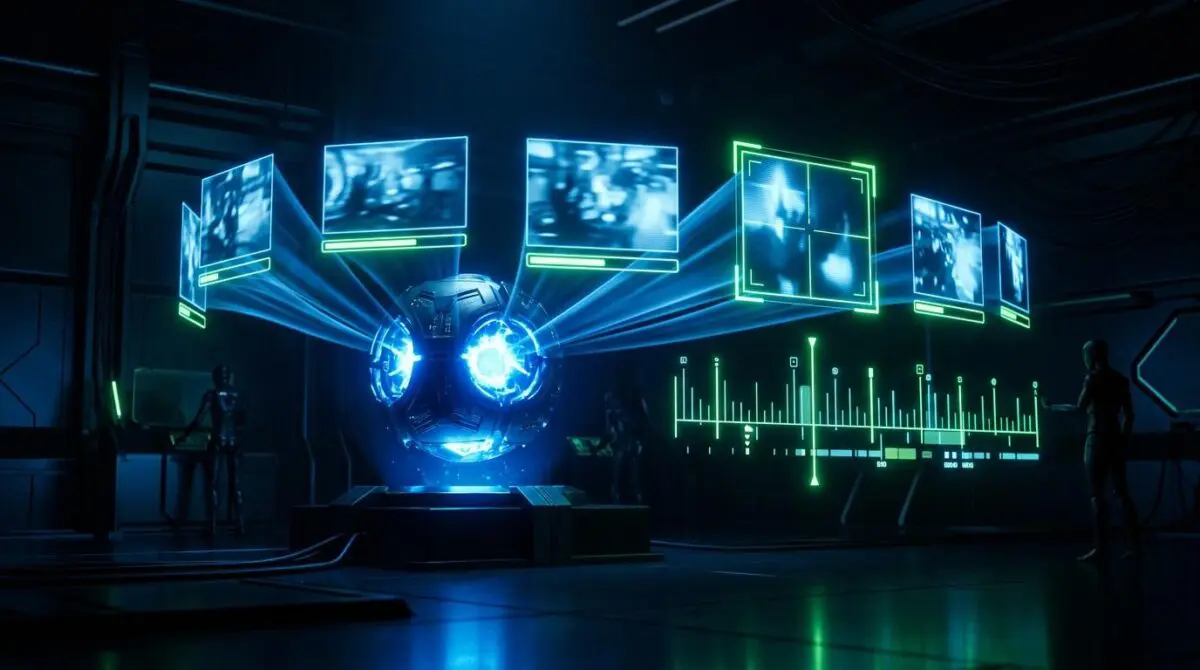
On July 30, 2026, Google DeepMind released Gemini Robotics ER 2, a model engineered to act as the cognitive core for robotic systems. Unlike conventional vision-language-action models that operate on static snapshots, ER 2 consumes continuous video streams, enabling it to track task progress, identify the exact moment an action should conclude, and synchronize multiple robots simultaneously.
The model functions as a high-level orchestrator: it interprets natural language commands, reasons about the physical environment, plans multi-step sequences, and delegates motor execution to lower-level controllers or APIs. This separation of strategic thought from physical actuation allows developers to build more adaptable robots that can self-correct mid-task without restarting entire workflows.
Google DeepMind made the model available today through the Gemini API and Google AI Studio, with a private preview on the Gemini Enterprise Agent Platform. Example configurations and open-source code for integrations with Boston Dynamics’ Spot and other robots are available on GitHub.
Table of Contents
Progress Classification and Moment-Finding: The Two Pillars of Reliable Real-World Robotics
Google DeepMind positions Gemini Robotics ER 2 as an ‘embodied reasoning’ model that moves beyond static spatial awareness.
“Think of Gemini Robotics ER 2 as a high-level brain for robots,” the announcement states.
This brain doesn’t merely issue commands; it watches the robot’s own video feed to gauge how far along a task is and whether the next step should begin.
The model introduces two core capabilities: progress classification and moment-finding. Progress classification segments continuous video into five completion tiers — 0-20%, 20-40%, 40-60%, 60-80%, and 80-100% — equipping robots with real-time situational awareness. According to Google’s internal benchmarks, ER 2 achieves 57.4% accuracy on this task, outperforming prior-generation models and competing frontier systems. That means a robot can detect when a step is partially finished and decide whether to retry, adjust, or advance, reducing cascading failures in long-horizon tasks.
Moment-finding takes precision further by pinpointing the exact video frame where a critical event occurs, such as the moment coffee fills a cup or a bolt is fully tightened. ER 2 hits 91.3% accuracy with a mean absolute distance of just 0.96 seconds from the true event. More importantly, it delivers this precision at sub-second latency and at four times the execution speed of much larger model categories, a critical advantage when controlling hardware in the physical world. This speed springs from tight integration with the Gemini Live API, which provides a bidirectional streaming endpoint optimized for low-latency orchestration.
Tool orchestration receives a significant upgrade. Developers can register low-level control interfaces — VLA models, navigation APIs, or teleoperation systems — as tools, and ER 2 dynamically invokes them to execute multi-step tasks. In a demo built with Boston Dynamics’ Spot robot, the model responded to a natural language snack-fetching command by sequencing navigation and manipulator movements through Spot’s APIs, without the jarring ‘stop-and-think’ pauses that plague earlier systems. The integration code is open-sourced on GitHub, complete with reusable examples.
Multi-robot collaboration gets native support. In a demonstration featuring Apptronik’s Apollo 2 humanoid and a Franka F3 Duo arm, ER 2 enabled the two machines to negotiate handoffs via a shared semantic understanding of the workspace. This capability means heterogeneous fleets — a wheeled rover and a bipedal robot — can divide and conquer tasks that a single form factor could never handle alone.
Safety is not an afterthought. The model achieved significant gains on internal benchmarks for safety instruction following and human proximity detection. In one test, ER 2 autonomously halted a humanoid robot when a person entered its vicinity and only resumed work after the area cleared. Google DeepMind also introduced a new benchmark to evaluate a foundation model’s fitness as a safe orchestrator — one that enforces constraints, monitors environments, and seeks human clarification when ambiguity arises.
What a Robot That Knows When It’s Done Means for the Physical AI Race
Gemini Robotics ER 2 arrives as the robotics industry pivots from scripted automation to real-time, AI-driven adaptability. By decoupling the ‘thinking’ layer from the actuation layer, Google DeepMind is effectively proposing a new open standard for robot software stacks — one where a cloud-hosted reasoning engine orchestrates an ecosystem of low-level controllers. This modularity could dramatically lower the barrier for robotics startups that lack the resources to train bespoke end-to-end models.
The performance numbers Google reports are compelling, especially the 4x execution speed improvement over bulkier models. In a domain where latency determines whether a robot catches a falling object or collides with it, this efficiency edge is not merely academic. The moment-finding accuracy — 91.3% with less than a second of error — hints at practical reliability in real-world settings, though these remain the company’s own internal evaluations. As third-party developers begin integrating ER 2 through the public API, the community will be able to validate these claims across diverse hardware and environments.
The inclusion of multi-robot collaboration and tool calling — with Google Search available as a native tool — suggests that ER 2 is designed to anchor a broader platform play, much as the Gemini API did for text and vision. If robots can query the web on the fly to identify objects or consult a safety protocol, their operational envelope expands dramatically. Paired with the safety orchestration benchmarks, this capability points toward a future where fleets of robots could operate in semi-public spaces with greater autonomy and reduced human oversight.
Still, the 57.4% progress classification accuracy reveals that spatial-temporal reasoning remains a stubborn challenge. Tasks intuitive to humans — knowing how far along you are in cleaning a spill — are still difficult for machines. Google’s own results show fractional progress tracking nudging forward, but the remaining gap means developers must design robust fallback behaviors. The robotics community will be watching closely to see whether subsequent iterations can push this number higher while preserving the model’s latency advantages.
From Task Orchestration to Full Autonomy: The Road Ahead for Embodied Intelligence
Gemini Robotics ER 2 doesn’t just improve a single metric; it refactors the architecture of robot intelligence. By giving machines the ability to watch, time, and coordinate, Google DeepMind is laying the foundation for a new class of physical AI agents that can operate with the fluidity we already expect from conversational assistants. The model’s immediate availability via API means the experimentation phase begins now, and the results will likely shape the next wave of investment in robotics software.
As intelligent orchestration moves from digital assistants to physical robots, the principles of speed, precision, and adaptive automation become ever more relevant to online strategy. At Andres SEO Expert, our programmatic SEO and AI automation pipelines bring similar orchestration logic to digital growth, enabling businesses to scale intelligently. To discuss how these techniques can transform your online presence, connect with Andres, and learn more about Andres SEO Expert’s full technical capabilities.
Frequently Asked Questions
What is Gemini Robotics ER 2?
Gemini Robotics ER 2 is a Google DeepMind model that acts as a high-level cognitive core for robotic systems. It consumes continuous video streams, interprets natural language, reasons about the physical environment, plans multi-step sequences, and delegates motor execution to lower-level controllers or APIs.
How does progress classification work in ER 2?
Progress classification segments continuous video into five completion tiers (0-20%, 20-40%, 40-60%, 60-80%, 80-100%), giving robots real-time situational awareness of task progress. ER 2 achieves 57.4% accuracy on this task, enabling robots to detect partial completion and decide to retry, adjust, or advance.
What is moment-finding and why is it important?
Moment-finding pinpoints the exact video frame where a critical event occurs, such as filling a cup or tightening a bolt. ER 2 achieves 91.3% accuracy with a mean absolute error of 0.96 seconds at sub-second latency and four times the execution speed of larger models, which is crucial for real-time hardware control.
How does ER 2 enable multi-robot collaboration?
ER 2 supports native multi-robot collaboration by allowing robots to negotiate handoffs via a shared semantic understanding of the workspace. In demonstrations, it coordinated an Apptronik Apollo 2 humanoid and a Franka F3 Duo arm, enabling heterogeneous fleets to divide tasks that a single robot could not handle.
What safety features does ER 2 include?
Safety is integrated with significant gains on internal benchmarks for safety instruction following and human proximity detection. In a test, ER 2 autonomously halted a humanoid robot when a person entered its vicinity, resuming only after the area cleared. A new benchmark evaluates foundation models as safe orchestrators.
How does ER 2 compare to previous models in speed and accuracy?
ER 2 delivers four times the execution speed of much larger model categories while achieving 91.3% moment-finding accuracy with less than one-second error. Its progress classification accuracy of 57.4% outperforms prior-generation models and competing frontier systems, though spatial-temporal reasoning remains challenging.
Where can developers access and test Gemini Robotics ER 2?
Google DeepMind made ER 2 available through the Gemini API and Google AI Studio starting July 30, 2026, with a private preview on the Gemini Enterprise Agent Platform. Example configurations and open-source code for integrations with robots like Boston Dynamics’ Spot are on GitHub.