Key Points
- Prompt-as-Code (PaC) Integration: Transitioning from manual vibe checks to automated CI/CD pipelines ensures prompts are treated as immutable, version-controlled artifacts.
- LLM-as-a-Judge Frameworks: Deploying superior models to autonomously grade production outputs across 50+ metrics eliminates the critical blind spots of silent model drift.
- Self-Healing AgentOps: Future-proofing infrastructure requires building telemetry loops that allow AI systems to autonomously suggest and test prompt refinements without human intervention.
Table of Contents
The Core Friction of Silent Failures
According to Gartner, investments in LLM observability and automated testing will account for 50% of all Generative AI deployments by 2028. This massive capital rotation signals a fundamental shift in how enterprise leaders treat artificial intelligence. We are aggressively moving away from ad-hoc experimentation and entering the industrialized era of PromptOps.
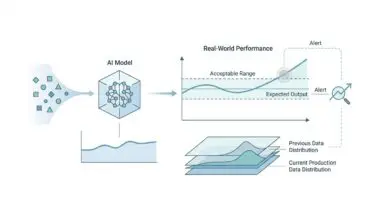
The primary friction haunting modern AI deployments is the terrifying reality of silent failures and model drift. When a foundation model provider silently updates their architecture, your perfectly crafted prompt might suddenly degrade. The stochastic nature of large language models means these regressions are rarely obvious immediately.
Unlike traditional software engineering, a degraded prompt does not throw a standard 500 server error to alert your DevOps team. It simply hallucinates, misdirects users, or bleeds revenue quietly in the background while your dashboards show a healthy system. This creates a massive operational blind spot for executives trying to scale generative applications.
To scale AI safely, businesses must architect automated prompt testing and version control pipelines from the ground up. This infrastructure creates the essential safety net required to deploy autonomous agents without risking catastrophic brand damage. Without it, you are essentially flying blind in a supersonic jet.
PromptOps solves this by bringing deterministic engineering principles to probabilistic systems. It forces organizations to treat prompt engineering not as an art form, but as a rigorous software discipline. This is the only sustainable path to achieving true enterprise-grade AI reliability.
Market Intelligence and Smart Capital
The artificial intelligence observability landscape is currently undergoing a violent and lucrative disruption. Specialized AI quality startups are actively siphoning market share from traditional application performance monitoring giants. These agile disruptors understand that legacy metrics like latency and uptime are insufficient for evaluating cognitive architectures.
Market Intelligence & Data
Market Size 2026
The global market for LLM observability and prompt management platforms reached this valuation in mid-2026, according to The Business Research Company.
Adoption of Versioning
Nearly three-quarters of AI developers now use dedicated versioning tools to manage prompt iterations, as reported in the 2026 Katalon State of Software Quality Report.
Reduction in Debugging
Organizations utilizing prompt version control see a nearly 50% drop in time spent on prompt management and debugging, per data from Latitude.so.
CAGR Growth
The Enterprise LLMOps platform market is projected to grow at this rate through 2030, driven by the shift from pilots to industrialized AI, according to Virtue Market Research.
Following the Institutional Money
Institutional venture capital is flowing heavily into this highly technical niche at unprecedented speeds. Over $1.1 billion in venture capital was deployed specifically into LLM observability and evaluation startups between early 2024 and April 2026. The smart money recognizes that the foundational layer of AI trust is where the next decacorns will be minted.
Meanwhile, legacy infrastructure players are scrambling to acquire smaller prompt-registry startups to maintain their enterprise foothold. They realize that traditional infrastructure monitoring is completely blind to the nuanced linguistic failures of generative models. If they do not acquire this capability, they risk total obsolescence in the Agentic AI era.
The data clearly shows that the market is maturing rapidly, a reality validated by The Business Research Company. Smart money is betting heavily that whoever controls the testing and validation layer will ultimately control the entire enterprise AI stack. This is not just a feature update; it is a battle for the central nervous system of modern software.
For technology executives, this capital rotation is a clear signal to audit your current AI infrastructure. Relying on basic API wrappers without a robust evaluation layer is now considered a critical business liability. The market has spoken, and the mandate is automated quality assurance.
The Strategic Deep Dive: Prompt-as-Code
High-performing engineering teams have officially abandoned manual vibe checks in favor of rigorous, automated CI/CD pipelines. Prompts are no longer treated as casual text strings living in a developer’s local environment. They have evolved into immutable Prompt-as-Code artifacts that demand strict governance.
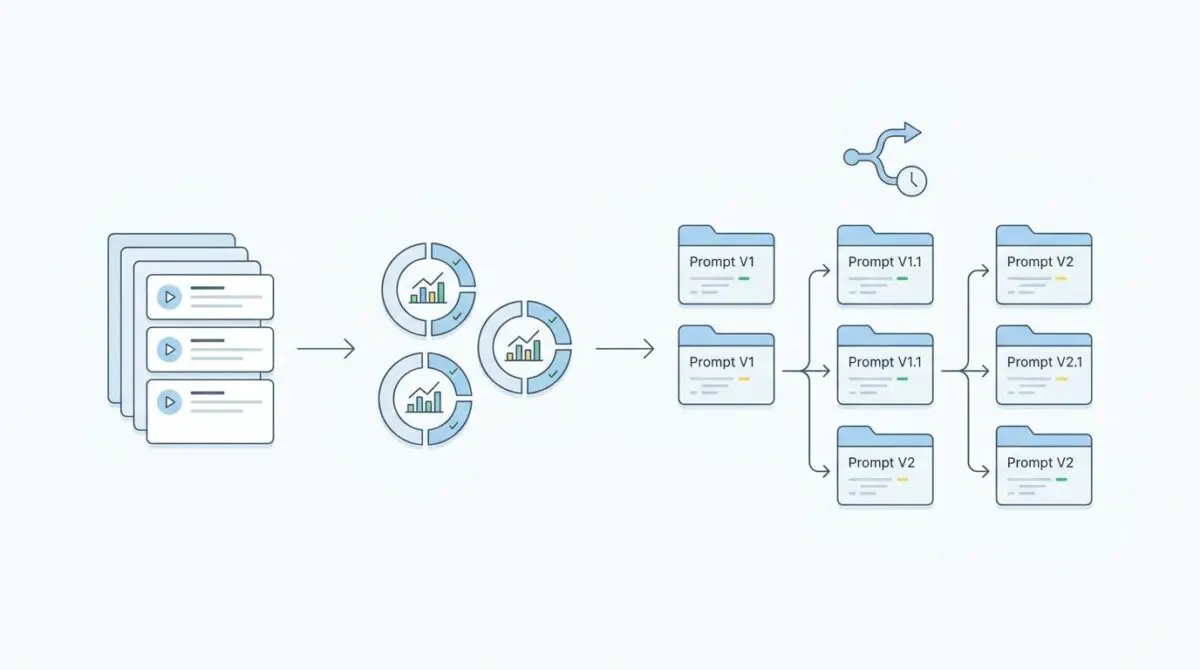
This paradigm shift demands that prompts live inside enterprise version control systems. By treating prompts exactly like production code, organizations can track every single iteration and rollback breaking changes instantly. This creates a pristine audit trail that satisfies both engineering standards and compliance regulations.
When a developer attempts to update a prompt, the change must trigger an automated pipeline before it ever reaches production. This pipeline runs the new prompt against a golden dataset of expected inputs and outputs. If the prompt degrades the model’s performance on these historical benchmarks, the merge request is automatically rejected.
Automating the LLM-as-a-Judge Framework
The most potent and disruptive strategy in modern PromptOps is the implementation of LLM-as-a-judge frameworks. Instead of relying on slow and subjective human QA teams, superior models are deployed to grade the outputs of your production models. This creates a highly scalable, automated evaluation loop that operates at machine speed.
These automated judges evaluate responses across more than 50 distinct, research-backed metrics. They analyze complex vectors like faithfulness to the source material, contextual relevancy, and potential toxicity. A prompt change is only merged into the main branch if it successfully passes these automated regression suites on massive synthetic datasets.
This framework completely eliminates the bottleneck of manual human review, allowing product teams to iterate on AI features rapidly. It provides mathematical confidence that a new prompt variation is actually an improvement, rather than just a subjective preference. This is how you achieve velocity without sacrificing safety.
Version Control and the Collaborative Bottleneck
Implementing strict version control also solves a massive collaborative bottleneck between technical and non-technical teams. Prompt engineering is inherently multidisciplinary, requiring input from linguists, domain experts, and software engineers. A centralized prompt registry allows product managers and engineers to co-edit prompts without the terrifying risk of causing production regressions.
The operational results of this structured approach are undeniable and highly lucrative. Implementing structured prompt engineering processes and versioning reduces AI-generated errors by up to 76% in enterprise environments compared to ad-hoc prompting. This metric alone justifies the immediate investment in a dedicated PromptOps infrastructure.
This dramatic reduction in debugging time is exactly why the enterprise LLMOps market is expanding so aggressively, a trend heavily tracked by Virtue Market Research. The industry focus has shifted entirely from building flashy, brittle pilots to engineering resilient, industrialized AI systems that can survive contact with real users.
By democratizing prompt access while enforcing strict deployment guardrails, organizations unlock unprecedented agility. Teams can experiment with different personas, temperatures, and context windows in isolated branches. Only the mathematically proven winners are promoted to the production environment.
The Executive Action Plan: AgentOps
The next frontier of artificial intelligence is the inevitable and rapid transition from standard LLMOps to complex AgentOps. Testing methodologies must evolve beyond single-turn prompt evaluations to encompass vast, multi-agent decision paths. As AI agents begin to trigger external APIs and make autonomous decisions, the testing surface area expands exponentially.
Strategic Trajectory
- Facilitate the strategic transition from standard LLMOps to advanced AgentOps frameworks.
- Evolve testing protocols to encompass multi-agent decision paths beyond single-turn prompt interactions.
- Architect infrastructure for Self-Healing Pipelines to autonomously refine prompts based on production telemetry.
- Implement automated suggestion and testing mechanisms to minimize human intervention in the prompt engineering lifecycle.
- Standardize the loop-closure between production insights and autonomous prompt refinement by late 2026.
Forward-thinking founders are already preparing their infrastructure for the impending era of self-healing pipelines. AI systems will soon autonomously use production telemetry to suggest, test, and deploy prompt refinements in real-time. If a prompt begins to drift in production, the system will automatically fork a new version and optimize it against the failure data.
This autonomous loop will effectively eliminate human intervention from the routine prompt engineering lifecycle. The role of the human engineer will elevate from writing prompts to designing the evaluation criteria that govern the self-healing system. Executives who fail to build this automated foundation today will find their teams drowning in technical debt tomorrow.
To prepare for this shift, organizations must start aggressively logging all prompt inputs, outputs, and user feedback scores today. This historical telemetry is the fuel that will power your future self-healing pipelines. Data is the ultimate defensive moat in the AI ecosystem, and prompt telemetry is the most valuable data of all.
Furthermore, leaders must foster a culture where prompt engineering is viewed as a rigorous engineering discipline. This means enforcing code reviews for prompt changes, maintaining comprehensive test coverage, and treating AI failures as critical system bugs. Cultural alignment is just as important as the technological tooling.
Conclusion: Future-Proofing AI Architecture
The era of manual prompt engineering and casual vibe checks is officially dead. The future belongs exclusively to organizations that treat AI interactions with the exact same rigorous testing and version control as mission-critical software. PromptOps is no longer an optional luxury; it is the fundamental prerequisite for surviving the generative AI revolution.
By embracing automated LLM-as-a-judge frameworks and centralized prompt registries, you are not just preventing silent failures and model drift. You are actively building the scalable, resilient infrastructure required to dominate the Agentic AI era. You are transforming unpredictable probabilistic models into reliable, enterprise-grade business engines.
Navigating the intersection of technology, capital, and market psychology requires a sharp strategy. To future-proof your business architecture and scale with precision, connect with Andres at Andres SEO Expert.
Frequently Asked Questions
What is PromptOps and why is it essential for enterprise AI?
PromptOps (Prompt Operations) is a discipline that applies rigorous software engineering principles, such as CI/CD and automated testing, to the management of AI prompts. It is essential for enterprise AI because it transforms probabilistic models into reliable systems, preventing silent failures and ensuring consistent performance as models evolve.
How does prompt version control reduce AI-generated errors?
By treating prompts as immutable code artifacts in systems like GitHub, organizations can track every iteration and perform automated regression testing. Research indicates that structured prompt versioning can reduce AI-generated errors by up to 76% by ensuring only mathematically proven prompt variations reach production.
What are silent failures in large language models?
Silent failures occur when a model update or architectural change causes a prompt to degrade without triggering a standard 500 server error. These failures often result in hallucinations or model drift, which can quietly bleed revenue and damage brand reputation while technical dashboards erroneously show a healthy system.
What is an LLM-as-a-judge framework?
LLM-as-a-judge is an automated evaluation loop where superior AI models are used to grade the outputs of production models. This framework analyzes performance across dozens of metrics, including faithfulness and contextual relevancy, allowing for high-velocity testing without the bottleneck of manual human QA.
What is the difference between LLMOps and AgentOps?
While LLMOps focuses on the lifecycle of single-turn prompt interactions, AgentOps expands this to encompass complex, multi-agent decision paths and autonomous actions. AgentOps utilizes self-healing pipelines and production telemetry to autonomously refine AI agents as they interact with external APIs and make multi-step decisions.