Key Takeaways
- Rubin GPU features 336B transistors, 224 SMs, 896 Tensor Cores, third-gen Transformer Engine with up to 50 PFLOPS NVFP4, and 288 GB HBM4 at 22 TB/s bandwidth.
- The Vera Rubin NVL72 rack integrates liquid cooling, cable-free MGX design, hot-swappable NVLink switch trays, and DSX MaxLPS power smoothing to enable up to 40% more GPUs per power envelope.
- Competitive tension rises as AMD’s Helios rack offers 432 GB HBM4 per GPU and open-standards interconnect, while NVIDIA’s Dynamo framework delivers up to 30x speedup on MoE inference.
NVIDIA Unveils Vera Rubin: Up to 10x Agentic Inference Efficiency
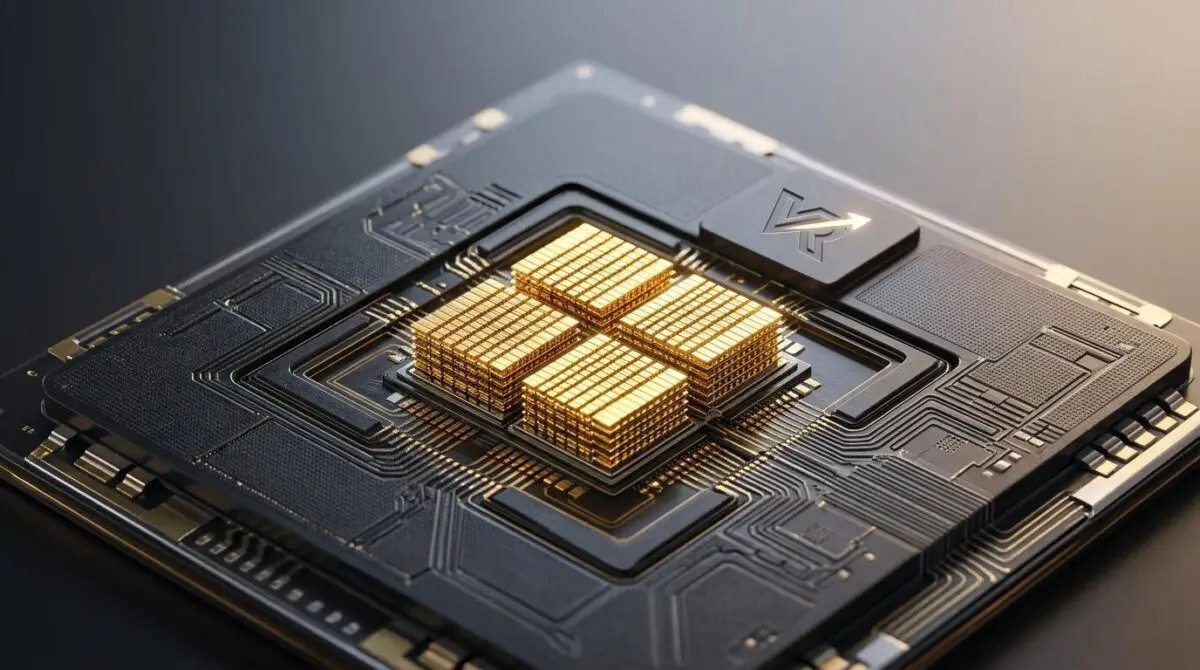
NVIDIA has officially detailed the Vera Rubin platform, positioning it as the next-generation infrastructure for agentic AI workloads. Built around the Rubin GPU with 336 billion transistors and 288 GB of HBM4 memory delivering 22 TB/s bandwidth, the platform claims up to 10 times more agentic throughput per unit of energy compared to the previous Blackwell architecture. The announcement, published on NVIDIA’s technical blog on July 21, 2026, outlines a comprehensive hardware and system-level redesign aimed at sustaining the growing demands of multistep reasoning, tool use, and long-context inference.
Table of Contents
Inside the Rubin GPU: Architecture Designed for Agentic Workloads
Compute Density and Memory Subsystem
The Rubin GPU is built on TSMC 3nm process and consists of two reticle-limited compute dies unified via the high-bandwidth NV-HBI interconnect. It packs 224 streaming multiprocessors and 896 Tensor Cores, supported by the third-generation Transformer Engine capable of up to 50 petaflops of NVFP4 performance. A centralized L2 cache, GigaThread Engine, and MIG partitioning enhance utilization across diverse agentic tasks.
Memory bandwidth sees a major leap: HBM4 with 12-Hi stacks provides up to 288 GB capacity and 22 TB/s peak bandwidth, a 2.8x increase over Blackwell. The enhanced Tensor Memory Accelerator (TMA) improves data movement efficiency for complex layouts, while NVLink 6 offers 3,600 GB/s for GPU-to-GPU communication and NVLink-C2C delivers 1,800 GB/s for CPU coherence. PCIe Gen 6 provides 256 GB/s host connectivity.
Accelerating Critical Inference Paths
Rubin introduces several innovations to reduce overhead in agentic inference. For mixture-of-experts (MoE) models, the new inline descriptor update for TMA reduces metadata management overhead, enabling more efficient weight and token movement across experts. The Tensor Cores double K-dimension instruction throughput, reducing loop iterations in matrix operations at high tensor-parallel scales.
Attention acceleration combines activation sparsity with adaptive compression. By compressing intermediate attention scores into a structured 2:4 sparse format, Rubin reduces compute and data movement in softmax and the subsequent attention GEMM. Exponential throughput for softmax improvements reaches 2x for FP32 and 4x for BF16/FP16 over Blackwell. Additionally, fine-grained dependent kernel triggering enables earlier consumer kernel execution, minimizing idle GPU time during producer-consumer transitions.
System-Level Design for Rack-Scale AI
The Vera Rubin NVL72 rack integrates compute, networking, liquid cooling, and power management into a single domain. The third-generation MGX architecture eliminates cables between compute and switch trays, and hot-swappable NVLink switch trays improve maintainability. Power smoothing via DSX MaxLPS uses state-of-charge intelligent power smoothing to reduce average power consumption by approximately 10% and peak power by 20%.
At the AI factory level, DSX MaxLPS enables up to 40% more GPUs within the same power envelope by recovering stranded power. The rack supports 45-degree-C liquid cooling and dynamic power steering across GPUs, racks, and workloads. These system-level co-design efforts target sustained high utilization for continuously operating agentic workloads.
Strategic Analysis: NVIDIA vs. AMD and the Market Implications
AMD’s Helios Rack Presents a Credible Alternative
While NVIDIA’s Vera Rubin platform sets ambitious targets, AMD has countered with its Helios AI rack, announced at Computex 2026. According to Wccftech, the Helios rack, based on Instinct MI455X GPUs with CDNA 5 architecture, offers 432 GB HBM4 per GPU at 19.6 TB/s bandwidth, exceeding Rubin’s 288 GB capacity per GPU. The Helios rack delivers 2.9 exaflops of FP4 compute and uses a UALink over Ethernet scale-up interconnect offering 260 TB/s, comparable to NVLink 6.
AMD is positioning Helios as an open-standards alternative to NVIDIA’s proprietary ecosystem, with Microsoft, OpenAI, Meta, and Oracle already committed to deployments in the second half of 2026. This competitive tension underscores the intensifying race for inference infrastructure, especially as agentic AI demands shift focus from training to continuous inference.
NVIDIA Dynamo and the Software Moat
NVIDIA has reinforced its hardware announcements with software innovations like Dynamo, an open-source distributed inference framework. According to AIMultiple, Dynamo demonstrated up to 30x speedup on DeepSeek-R1 671B running on GB200 NVL72, and more than doubled Llama 70B performance on Hopper. The framework disaggregates prefill and decode phases to optimize throughput, a critical capability for agentic inference where long contexts and iterative reasoning dominate.
Dynamo 1.0 can achieve up to 7x throughput improvement on Blackwell with DeepSeek R1 compared to non-disaggregated serving, as reported by TechTimes. This software moat, combined with the seven-chip codesign (Vera CPU, Rubin GPU, NVLink 6 switch, ConnectX-9 SuperNIC, BlueField-4 DPU, Spectrum-6 switch, Groq 3 LPX), creates a vertically integrated stack that NVIDIA claims can reduce MoE training GPU count by 4x and inference token cost by 10x versus Blackwell.
The Path Forward for Agentic AI Infrastructure
The Vera Rubin platform marks a significant step in AI infrastructure evolution, specifically tailored for the era of agentic systems. With its focus on energy efficiency, rack-level integration, and software-defined orchestration, NVIDIA aims to lower the total cost of ownership for running continuous, multistep inference workloads at scale.
However, the emergence of credible alternatives like AMD’s Helios and the rapid growth of custom ASICs (projected 44% growth in 2026 per TechTimes) indicate that the inference market is far from settled. The Jevons paradox, noted by AIMultiple, suggests that cheaper inference costs may actually drive increased demand for GPU compute in the long run. For enterprises, the choice will hinge not just on peak performance but on ecosystem maturity, software tooling, and operational flexibility.
Staying ahead in the rapidly shifting landscape of AI requires precision. To future-proof your digital strategy and scale effortlessly, you need a foundation built on precision. Optimize your site with advanced speed engineering, secure your infrastructure in high-performance hosting environments, and streamline your entire workflow through autonomous AI pipelines. If you are ready to elevate your systems, Connect with Andres at Andres SEO Expert to build your ultimate architecture.
Frequently Asked Questions
What is NVIDIA Vera Rubin and how does it improve agentic AI inference?
NVIDIA Vera Rubin is a next-generation GPU platform designed for agentic AI workloads, claiming up to 10x more agentic throughput per unit of energy compared to Blackwell. It improves inference through architectural innovations like HBM4 memory, enhanced Tensor Cores, attention acceleration, and system-level power management.
How does the Rubin GPU architecture differ from Blackwell?
The Rubin GPU uses TSMC 3nm process, 336 billion transistors, 224 streaming multiprocessors, 896 Tensor Cores, and a third-generation Transformer Engine with up to 50 petaflops of NVFP4 performance. It introduces a centralized L2 cache, GigaThread Engine, and advanced memory subsystem with 288 GB HBM4 at 22 TB/s bandwidth, a 2.8x increase over Blackwell.
What are the key memory and bandwidth improvements in Vera Rubin?
Vera Rubin features HBM4 memory with 12-Hi stacks providing 288 GB capacity and 22 TB/s peak bandwidth, a 2.8x improvement over Blackwell. Enhanced Tensor Memory Accelerator (TMA) improves data movement, NVLink 6 offers 3,600 GB/s GPU-to-GPU, NVLink-C2C 1,800 GB/s for CPU coherence, and PCIe Gen 6 provides 256 GB/s host connectivity.
How does the Vera Rubin NVL72 rack optimize power and cooling?
The Vera Rubin NVL72 rack integrates compute, networking, liquid cooling, and power management. It uses DSX MaxLPS power smoothing to reduce average power by ~10% and peak power by 20%, enabling up to 40% more GPUs within the same power envelope. It supports 45-degree-C liquid cooling and dynamic power steering for sustained high utilization.
How does NVIDIA Dynamo enhance inference performance?
NVIDIA Dynamo is an open-source distributed inference framework that disaggregates prefill and decode phases to optimize throughput. It demonstrated up to 30x speedup on DeepSeek-R1 671B on GB200 NVL72 and more than doubled Llama 70B performance on Hopper. On Blackwell with DeepSeek R1, Dynamo 1.0 achieves up to 7x throughput improvement versus non-disaggregated serving.
How does AMD’s Helios rack compare to NVIDIA’s Vera Rubin?
AMD’s Helios rack, based on Instinct MI455X GPUs with CDNA 5, offers 432 GB HBM4 per GPU at 19.6 TB/s bandwidth, exceeding Rubin’s 288 GB capacity, and delivers 2.9 exaflops of FP4 compute. It uses an open-standards UALink over Ethernet interconnect. While Rubin focuses on proprietary ecosystem and software moat, Helios positions as an open alternative with commitments from major tech companies.
What is the strategic significance of the Vera Rubin platform for AI infrastructure?
Vera Rubin represents a shift toward infrastructure tailored for agentic AI, emphasizing energy efficiency, rack-level integration, and software-defined orchestration. It aims to lower total cost of ownership for continuous multistep inference. However, competition from AMD Helios and custom ASICs highlights that the inference market remains dynamic, with ecosystem maturity and software tooling being key differentiators.