Key Takeaways
- DeepSeek V4 reaches general availability; Alibaba unveils Qwen 3.8 open-weight model with 2.4 trillion parameters.
- Both models deliver near-frontier performance at drastically lower prices—up to 137x cheaper than rivals.
- Chinese AI labs accelerate chip independence, reducing reliance on US technology through domestic hardware.
Weekend AI Offensive: DeepSeek V4 and Alibaba’s Qwen 3.8 Take on Frontier Models
Over the weekend, two of China’s largest AI labs—DeepSeek and Alibaba—launched major updates to their flagship models, intensifying the competition with US frontier AI providers. DeepSeek moved its V4 model to general availability, while Alibaba unveiled the open-weight Qwen 3.8 with 2.4 trillion parameters. Both companies claim their systems approach or rival the top models from OpenAI and Anthropic, but at a fraction of the cost.
Table of Contents
The Technical Details Behind the Weekend Launches
DeepSeek V4, which first entered preview three months ago, reached general availability on July 19. Even in preview, it achieved an 80.6% score on SWE-bench Verified for coding tasks, approaching Anthropic’s Claude Opus 4.6. The V4 variant, including V4 Pro, features dynamic pricing: off-peak usage of V4 Pro costs $0.87 per million tokens, compared to $50 for the same volume from Anthropic’s Fable 5.
Hours after DeepSeek’s announcement, Alibaba’s Qwen team unveiled Qwen 3.8, an open-weight model with 2.4 trillion parameters. It ranks among the largest open-weight models ever released. A preview is already live on Alibaba’s Token Plan and Qoder coding platforms. The pricing for Qwen 3.8 preview is set at one-tenth of Alibaba’s standard rates, signaling aggressive undercutting of frontier models.
These launches follow the release of Kimi K3 by Chinese startup Moonshot, a 2.8-trillion-parameter open-weight model that also claims near-frontier performance. As detailed in Cybernews’ coverage, the pattern is clear: Chinese AI labs are not only catching up on capability but are engineering the cost curve downward.
The Cost War: How DeepSeek and Alibaba Are Undercutting US Giants
The price-performance gap is staggering. Independent cost-per-task comparisons from social media analytics reveal that DeepSeek V4 Flash executes a benchmark task for $0.02, while Claude Fable 5 costs $2.75 per task—a 137x difference. Another data point: DeepSeek V4 Flash has an Intelligence score of 29 (on a 56-point scale for Claude Opus 4.8) but costs just $0.06 per million tokens versus $3.85.
Beyond raw pricing, DeepSeek V4 Pro has been reported to beat GPT-5.5 on coding benchmarks, according to discussions on Polymarket. While these claims need independent verification from leaderboards like Chatbot Arena, they underscore the rapid capability convergence among leading AI models.
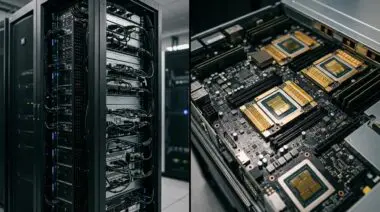
Equally important is the strategic push for chip independence. DeepSeek optimized V4 for Huawei’s Ascend line, bypassing Nvidia, and reportedly develops its own inference chip to reduce dependence on external suppliers. Alibaba follows suit with its Zhenwu M890 AI chip. Washington’s export restrictions have inadvertently accelerated China’s domestic chip ecosystem, insulating these AI labs from future supply chain disruptions.
The New AI Order in the East
The dual launches mark a turning point in global AI competition. Chinese AI labs are no longer just followers; they are setting the pace on pricing and open-weight availability. For enterprises and developers worldwide, this means more choice and lower costs—but also a fragmented ecosystem where performance parity meets aggressive cost structures.
Staying ahead in the rapidly shifting landscape of AI requires precision. To future-proof your digital strategy and scale effortlessly, you need a foundation built on precision. Optimize your site with advanced speed engineering, secure your infrastructure in high-performance hosting environments, and streamline your entire workflow through autonomous AI pipelines. If you are ready to elevate your systems, Connect with Andres at Andres SEO Expert to build your ultimate architecture.
Frequently Asked Questions
What is DeepSeek V4 and how does it compare to frontier models like Claude and GPT?
DeepSeek V4, now generally available, achieves an 80.6% score on SWE-bench Verified for coding tasks, approaching Anthropic’s Claude Opus 4.6. Its Pro variant reportedly beats GPT-5.5 on coding benchmarks, though independent verification is pending. DeepSeek V4 also offers dynamic pricing, with off-peak V4 Pro costing $0.87 per million tokens compared to $50 for similar volume from Anthropic’s Fable 5.
What are the key specifications of Alibaba’s Qwen 3.8?
Alibaba’s Qwen 3.8 is an open-weight model with 2.4 trillion parameters, making it one of the largest open-weight models ever released. A preview is available on Alibaba’s Token Plan and Qoder coding platforms, with pricing set at one-tenth of Alibaba’s standard rates.
How do the costs of Chinese AI models compare to US models?
The cost difference is dramatic. Independent task comparisons show DeepSeek V4 Flash executing a benchmark task for $0.02, while Claude Fable 5 costs $2.75 per task—a 137x difference. DeepSeek V4 Flash has an Intelligence score of 29 (on a 56-point scale) but costs $0.06 per million tokens versus $3.85 for comparable models.
What is the significance of releasing Qwen 3.8 as open-weight?
Open-weight release allows developers and enterprises to download, customize, and deploy the model on their own infrastructure, reducing reliance on API providers and enabling fine-tuning for specific applications. It also promotes transparency and faster innovation in the AI community.
How are Chinese AI labs like DeepSeek and Alibaba achieving lower costs?
They are optimizing for domestic chips (e.g., DeepSeek V4 for Huawei Ascend, Alibaba’s Zhenwu M890 AI chip) to bypass Nvidia and reduce hardware costs. They also develop their own inference chips and leverage aggressive pricing strategies to undercut US giants, while benefiting from China’s accelerated domestic chip ecosystem driven by US export restrictions.
What is the role of domestic chips like Huawei Ascend in these AI models?
Domestic chips such as Huawei’s Ascend line are crucial for chip independence. DeepSeek optimized V4 for Ascend, and Alibaba uses its Zhenwu M890 chip. This reduces dependence on Nvidia and mitigates supply chain disruptions caused by US export controls, while also driving down inference costs.
How do these launches affect the global AI competition?
These launches mark a turning point: Chinese AI labs are no longer followers but are setting the pace on pricing and open-weight availability. They create a fragmented ecosystem with more choice and lower costs for enterprises, intensifying competitive pressure on US frontier providers like OpenAI and Anthropic.