Key Takeaways
- NVIDIA ovrtx SDK now available as prerelease on GitHub for integrating RTX sensor simulation into existing apps.
- The lightweight C/Python API supports camera, lidar, radar, and semantic segmentation outputs from OpenUSD scenes.
- Combines with other Omniverse libraries for physics, streaming, and storage, enabling end-to-end physical AI validation.
NVIDIA Releases ovrtx to Bring RTX Sensor Simulation to Mainstream Development
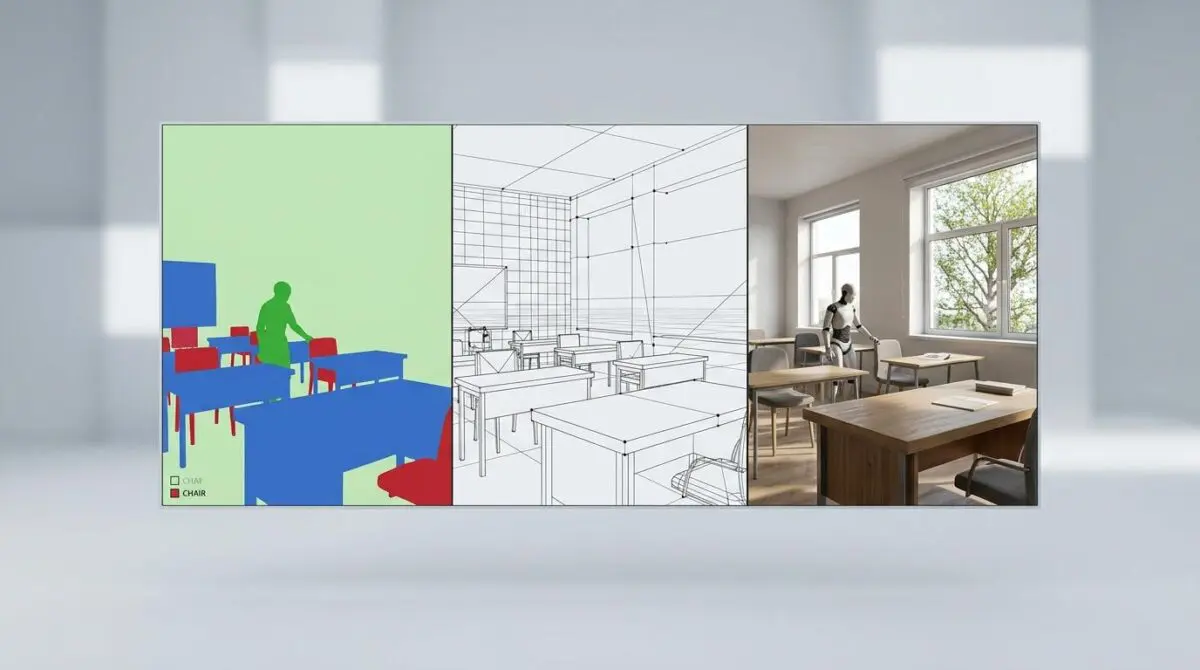
NVIDIA has released ovrtx, a lightweight C and Python SDK that enables developers to integrate RTX-based sensor simulation into existing applications without rebuilding their core architecture. Announced at SIGGRAPH 2026, the library, now part of the NVIDIA Agent Toolkit, is available as prerelease software on GitHub. It provides a modular, API-driven approach to generating camera, lidar, radar, and semantic segmentation outputs from OpenUSD scenes, placing control firmly inside the host application loop.
Table of Contents
Core Breakdown: How ovrtx Works
ovrtx is designed to slot into existing application architecture. The host application creates a renderer instance, loads OpenUSD content, defines render products and render variables, steps simulation from its own loop, and reads outputs as tensors on CPU or GPU.
Integration Steps
- Create renderer: Initialize an ovrtx renderer instance with GPU configuration.
- Load OpenUSD: Point renderer to a USD file or compose references.
- Configure outputs: Define RenderProducts for sensors (e.g., camera, lidar) and RenderVars for outputs (color, depth, normals, point clouds).
- Step simulation: Call step() from the application loop with a time delta.
- Read results: Map tensors to CPU or GPU memory for display or downstream processing.
Key components include the Omniverse RTX renderer, the ovstage runtime for shared USD stage access, and OpenUSD as the data layer. ovrtx can be used standalone or combined with other libraries like ovphysx for physics, ovstream for streaming, and ovstorage for data management.
Practical Examples
As detailed on NVIDIA’s developer blog, the GitHub repo includes a minimal ‘hello world’ example that loads a scene and renders a single image. The Omniverse Realtime Viewer skill shows how to build a browser-streamed viewer with ovrtx and ovstream. For physics integration, the ovrtx-plus-ovphysx sample demonstrates a two-process architecture. PTC Onshape Render Studio is exploring ovrtx for cloud-native rendering, with Director Brendan Hack noting: ‘ovrtx gives us a lower-level API path for bringing NVIDIA RTX into systems cloud-native design tools while keeping the application architecture and product experience in our control.’
Strategic Analysis: Physical AI in the Era of Frontier Models
The release comes at a pivotal moment. Recent reports highlight a surge in AI model releases, including DeepSeek V4, Alibaba’s Qwen 3.8, and Kimi K3 with 2.8 trillion parameters. As these frontier models push the boundaries of reasoning and scale, their deployment in physical domains demands equally advanced simulation infrastructure. Synthetic data generation and perception testing — capabilities directly enabled by ovrtx — become critical for validating behavior in autonomous vehicles, robotics, and digital twins.
NVIDIA’s shift to a modular library model reflects a broader industry trend: decoupling simulation from monolithic platforms. By offering ovrtx as a lightweight SDK, the company enables teams to embed RTX sensor simulation into their own tools, reducing dependency on large software stacks. This aligns with the growing emphasis on agent-ready workflows and the need for trusted, grounded data in AI pipelines.
Furthermore, the inclusion of ovrtx in the NVIDIA Agent Toolkit signals a strategic push toward bridging generative AI with physical simulation. As models like DeepSeek V4 compete on cost and performance, the ability to generate high-fidelity sensor outputs programmatically will differentiate winning platforms in autonomous systems, manufacturing, and Smart City initiatives.
Conclusion: Embracing Modular Simulation for the Future
NVIDIA’s ovrtx SDK provides a pragmatic path for developers to add physically grounded RTX sensor simulation to any application. By maintaining host control and leveraging OpenUSD, it fits naturally into existing design, robotics, and digital twin workflows. As physical AI matures, tools like ovrtx will be essential for generating the data that trains and validates next-generation autonomous systems.
Staying ahead in the rapidly shifting landscape of AI requires precision. To future-proof your digital strategy and scale effortlessly, you need a foundation built on precision. Optimize your site with advanced speed engineering, secure your infrastructure in high-performance hosting environments, and streamline your entire workflow through autonomous AI pipelines. If you are ready to elevate your systems, Connect with Andres at Andres SEO Expert to build your ultimate architecture.
Frequently Asked Questions
What is NVIDIA ovrtx?
NVIDIA ovrtx is a lightweight C and Python SDK that enables developers to integrate RTX-based sensor simulation (camera, lidar, radar, semantic segmentation) into existing applications without rebuilding core architecture. It provides a modular, API-driven approach using OpenUSD scenes and is part of the NVIDIA Agent Toolkit.
How does ovrtx integrate with existing applications?
ovrtx slots into the host application’s loop: create a renderer instance, load OpenUSD content, define render products and render variables, call step() with a time delta, and read outputs as tensors on CPU or GPU. The host maintains control throughout.
What sensor outputs can ovrtx generate?
ovrtx can generate outputs for camera (color, depth, normals), lidar (point clouds), radar data, and semantic segmentation maps, all from OpenUSD scenes using the Omniverse RTX renderer.
Can ovrtx be combined with physics simulation?
Yes, ovrtx can be used alongside other libraries like ovphysx for physics simulation. The GitHub repo includes a two-process sample (ovrtx-plus-ovphysx) demonstrating this integration.
How does ovrtx relate to the NVIDIA Agent Toolkit?
ovrtx is included in the NVIDIA Agent Toolkit, signaling a strategic push to bridge generative AI with physical simulation. It enables agent-ready workflows by providing trusted, grounded sensor data for AI pipelines.
What are some practical use cases for ovrtx?
Use cases include synthetic data generation for autonomous vehicles, perception testing, robotics simulation, digital twins, browser-streamed viewers (Omniverse Realtime Viewer), and cloud-native rendering (PTC Onshape Render Studio).
Why is modular sensor simulation important for Physical AI?
As frontier AI models grow in scale, modular simulation like ovrtx enables teams to embed RTX sensor simulation into their own tools, reducing dependency on monolithic platforms. It provides high-fidelity synthetic data critical for validating autonomous systems in vehicles, robotics, and manufacturing.