Key Takeaways
- Classic RAG offers low, predictable latency but fails on multi-hop queries and vocabulary mismatch; agentic RAG handles complex reasoning with variable latency and higher cost.
- Choose classic RAG for bounded, well-specified queries and stable knowledge bases; choose agentic RAG for ambiguous, multi-source questions where hallucination risk is unacceptable.
- Guardrails differ: classic RAG focuses on retrieval quality (hybrid search, chunking); agentic RAG requires tool allowlists, iteration caps, and distributed tracing for auditability.
The Retrieval Architecture Fault Line Dividing Enterprise Automation
The engineering team behind n8n’s automation platform has published a comprehensive analysis that crystallizes a growing tension in enterprise AI: the choice between classic retrieval-augmented generation and its more autonomous successor, agentic RAG. Their breakdown, released July 29, 2026, maps precisely where linear retrieval pipelines collapse under real-world query complexity — and what organizations sacrifice when they adopt the agentic alternative.
Classic RAG earned its place in production stacks by grounding language models in external data, eliminating the guesswork that produces confident hallucinations. Yet the n8n technical team argues this architecture carries a hidden assumption that cracks under pressure: it treats every query as if a single retrieval pass will suffice.
The analysis lands at a pivotal moment for automation practitioners. As AI workflows graduate from demos to production systems handling ambiguous, multi-source questions, the architectural foundation beneath retrieval suddenly determines whether a system delivers trustworthy answers or silently fabricates them.
Table of Contents
How Linear Pipelines and Agentic Control Loops Actually Differ Under Load
According to n8n’s analysis, the classic RAG pipeline follows a predictable, stateless trajectory. A query arrives, triggers retrieval against an external knowledge source, and feeds the returned context into a language model for generation. Depending on configuration, retrieval may employ vector similarity search, keyword matching, hybrid approaches, or structured SQL queries. Then the pipeline forgets everything and waits for the next request.
This simplicity delivers concrete advantages. Latency remains tightly bounded because every request traverses identical steps. Infrastructure overhead stays lean — a single retriever, one embedding model, and the indexing layer beneath it. When outputs drift, the debugging surface is compact enough for manual inspection. A support chatbot answering FAQs from a stable knowledge base represents the ideal terrain for this design.
The architecture unravels, however, the moment an answer spans multiple documents or requires sequential reasoning. The n8n engineering team identifies three recurring failure patterns that haunt production deployments. Multi-hop questions — like determining which vendors joined after a compliance audit — demand the audit date from one source and the vendor roster from another, but a single retrieval pass fetches only the first hop.
Vocabulary mismatch creates a second fracture point. A user searches for ‘time off’ while internal policy documents use ‘paid leave,’ and even semantic search can miss the connection when embedding spaces fail to align. Hybrid search combining keywords with embeddings reduces this risk, yet many classic pipelines rely exclusively on one retrieval method. The third failure emerges from chunk boundaries: when evidence straddles two chunks and retrieval returns only one, the model fills the gap with fabricated coherence.
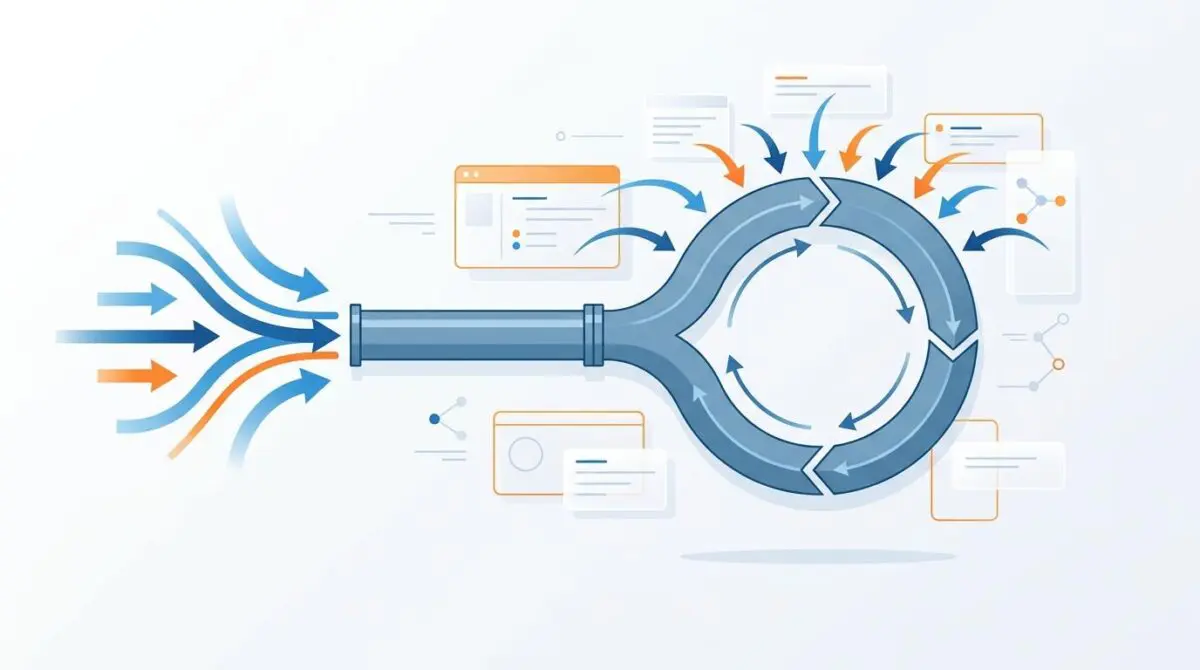
Agentic RAG replaces the fixed pipeline with a control loop. Instead of asking which chunks match a query, the system asks what information it needs and which tools can supply it. The n8n analysis describes this shift in operational terms:
The agent retrieves, reads what came back, evaluates whether the evidence is enough, and decides its next move — reformulate the query, switch sources, call an API, or stop and answer.
This pattern, built on the ReAct framework of reasoning, acting, and observing in cycles, gives the agent authority to decompose broad questions into subqueries, tackle them sequentially, and synthesize multi-source evidence. Configured with memory, the agent carries context across iterations rather than starting cold on every pass. The SOC 2 vendor example illustrates the gap concretely: an agentic system retrieves the audit date, recognizes the vendor list is still missing, fires a second query against a different source, then merges both into a grounded response — work a single-shot retriever cannot perform.
Three capabilities distinguish the agentic approach from a fixed pipeline. First, it decomposes and plans, splitting complex questions into sequenced subqueries where each result feeds the next. Second, it self-evaluates and reformulates, rewriting queries when initial retrieval comes back thin rather than forcing an answer from weak context. Third, it routes adaptively — directing pricing questions to SQL databases, policy inquiries to vector stores, and real-time requests to web search, all within a single agent that avoids confusing one knowledge domain with another.
The architectural tradeoffs are stark. Classic RAG offers low, predictable latency and a compact debugging surface at the cost of silent failures on complex queries. Agentic RAG delivers adaptability and multi-step reasoning but introduces variable latency, higher token consumption, and distributed traces that demand sophisticated observability. The n8n team emphasizes that this is not a generational upgrade where the new pattern retires the old — it is a calculated trade between speed and reasoning depth.
Guardrails for Both Architectural Patterns
Because the two patterns fail differently, their protective measures diverge. Classic RAG guardrails concentrate on retrieval quality: scoping results to user permissions enforced at query time, indexing with hybrid search to catch exact terms that embeddings miss, and governing chunk sizes with sensible overlap so answers never fracture at document boundaries.
Agentic RAG guardrails must additionally fence in autonomy. The n8n analysis recommends constraining tools with explicit allowlists so a misread prompt cannot trigger unauthorized actions, enforcing hard caps on iterations and token budgets to prevent runaway reasoning loops, and instrumenting every step of the agent’s decision trail. Distributed tracing transforms an opaque agent into something auditable, while evaluation against curated test sets converts subjective assessments into defensible metrics.
What the RAG Schism Means for Automation Practitioners
The architectural divide between classic and agentic RAG carries implications that extend well beyond academic taxonomy. For teams building production automation systems, the decision framework outlined by n8n’s engineering group surfaces an uncomfortable truth: most organizations learn the expensive way, starting with classic RAG, slamming into its limits on real user queries, then rebuilding from scratch inside an agentic framework.
The cost calculus shifts dramatically between the two approaches. Classic RAG delivers predictable per-request expenses that make budgeting straightforward — every query costs roughly the same. Agentic systems, by contrast, scale costs with reasoning steps and token consumption, introducing variability that complicates financial planning for high-volume automation workloads.
Observability emerges as the hidden differentiator. A linear pipeline produces a small, inspectable surface where debugging means examining a handful of retrieval results. An agentic loop generates distributed traces spanning multiple reasoning steps, tool calls, and reformulation attempts. The n8n platform addresses this by rendering both patterns on a visual canvas with step-by-step execution history, collapsing what would otherwise require stitching together disparate libraries and log streams.
For the automation industry specifically, this analysis reframes the conversation around AI agent capabilities. The market has rushed toward agentic architectures with enthusiasm that occasionally outpaces operational readiness. Yet the n8n team’s framework suggests a more measured approach: interrogate actual query patterns, measure how often a single retrieval genuinely satisfies user intent, and only then commit to the governance overhead that autonomous agents demand.
The decision criteria are refreshingly practical. Choose classic RAG when queries are bounded and well-specified, latency tolerances are tight, and the knowledge base is stable and carefully chunked. Choose agentic RAG when queries routinely join evidence across multiple systems, users send ambiguous or underspecified requests that need reformulation, and silent hallucination carries unacceptable risk — requiring the system to escalate or flag insufficient evidence rather than guess.
Architecture Decisions That Outlast the Hype Cycle
The n8n engineering team’s analysis performs a valuable service by stripping the RAG versus agentic RAG debate of its trend-chasing momentum and restoring it to its proper domain: an architecture decision governed by query complexity, latency budgets, and observability investment. The question is not whether agentic RAG is newer or more sophisticated, but whether an organization’s real queries — not the polished demo examples — justify a control loop that must then be governed, monitored, and constrained in production.
Automation professionals who internalize this framework position themselves to avoid the costly rebuild cycle that traps early adopters. The platform on which these architectures are built determines how painful governance becomes when systems scale beyond proof-of-concept. Running both the linear pipeline and the agentic loop on a unified canvas, with execution history and step-by-step observability baked in from the start, turns what is typically a fragmented migration into an extension of existing workflows.
For organizations constructing AI-powered automation pipelines, the technical foundations that support these architectural choices determine whether intelligent retrieval systems scale or crumble under production demands. Engineering teams evaluating agentic architectures need infrastructure that handles variable latency patterns and token-intensive reasoning loops without degrading user-facing performance.
Andres SEO Expert provides AI automation and programmatic workflow engineering that helps teams design, deploy, and govern intelligent pipelines without the expensive rebuild cycles that plague early adopters. For automation stacks that require reliable, low-latency infrastructure to support these architectural decisions, managed cloud hosting and infrastructure services deliver the performance baseline that agentic systems demand under load. To discuss how retrieval architecture fits your specific automation requirements, reach out to Andres for a consultation grounded in production realities rather than vendor slide decks.
Andres SEO Expert brings the technical depth required to distinguish architectural signal from industry noise — precisely the capability that separates scalable automation investments from costly experiments.
Frequently Asked Questions
What is the main difference between classic RAG and agentic RAG?
Classic RAG uses a fixed, stateless pipeline: retrieve once, generate once. Agentic RAG employs a control loop where the system retrieves, evaluates, decides if more info is needed, and iterates—decomposing questions, reformulating queries, and routing to different tools.
When should you choose classic RAG over agentic RAG?
Choose classic RAG when queries are bounded and well-specified, latency tolerances are tight, and the knowledge base is stable and carefully chunked. It’s ideal for FAQs from a single source where a single retrieval pass suffices.
What are common failure patterns of classic RAG in production?
The article identifies three failure patterns: multi-hop questions that require evidence from multiple documents, vocabulary mismatch where user terms differ from indexed terms, and chunk boundary problems where answers split between two retrieved chunks, causing hallucination.
How does agentic RAG handle multi-hop queries?
Agentic RAG decomposes a broad question into subqueries, retrieves each piece sequentially, and synthesizes evidence from multiple sources. For example, to find which vendors joined after an audit, it retrieves the audit date first, then queries for vendors added after that date.
What guardrails are needed for agentic RAG?
Key guardrails include constraining tools with allowlists to prevent unauthorized actions, enforcing hard caps on iterations and token budgets to avoid runaway loops, and instrumenting every step with distributed tracing for auditability and evaluation against curated test sets.
Why does the article say most organizations learn the expensive way?
Most teams start with classic RAG due to its simplicity, then hit its limits on real user queries—like multi-hop or ambiguous questions—forcing them to rebuild from scratch using an agentic framework, incurring higher cost and rework.
How does observability differ between classic and agentic RAG?
Classic RAG produces a small, inspectable surface—debugging means examining a few retrieval results. Agentic RAG generates distributed traces across multiple reasoning steps, tool calls, and reformulations, requiring sophisticated observability to track decision trails.