Key Points
- Veracity Scoring: AI models filter content using mathematical trust markers rather than traditional ranking signals.
- Entity Synchronization: Mapping your brand into Knowledge Graphs is essential for LLM fact verification and citations.
- Provenance Metadata: Implementing cryptographic signatures ensures synthetic filters recognize your original experience.
Table of Contents
The AI Search Context
According to a Q1 2026 report by Gartner, 70% of digital marketing budgets are now allocated to AI Visibility Optimization, with E-E-A-T being the primary ranking factor for generative response citations.
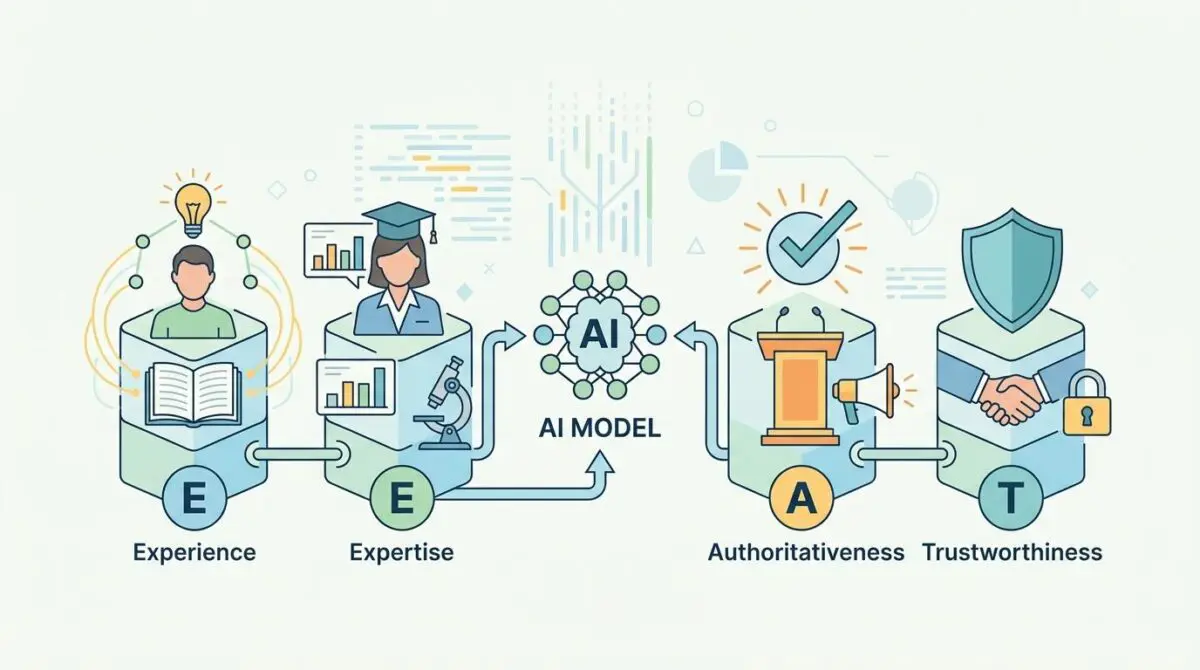
In the evolving search landscape, Experience, Expertise, Authoritativeness, and Trustworthiness have transitioned from traditional ranking signals to strict filtering mechanisms.
Advanced AI models like Gemini 2.5 and GPT-5 utilize Veracity Scoring to determine which content sources are reliable enough for synthesis.
Without verified markers, a brand’s content is relegated to the untrusted tier of the latent space.
This effectively erases the brand from the generative response layer where over 65% of user queries are resolved.
Generative models process information by plotting semantic relationships within massive vector databases.
When a user submits a prompt, the engine retrieves context based on proximity and mathematical trust weights.
If your digital assets lack explicit E-E-A-T signals, their vector embeddings are penalized during the retrieval phase.
This means your insights are bypassed in favor of domains that have explicitly defined their authority through structured metadata.
The era of relying solely on keyword density and basic backlink profiles is officially over.
Today, securing visibility requires a foundational shift toward entity-based validation and semantic proof.
Core Architecture and Pillars
Core Architecture & Pillars
Entity-Graph Synchronization
AI models rely on structured Knowledge Graphs (Wikidata, DBpedia) to verify facts. Strategic E-E-A-T requires mapping the brand and its authors as unique entities (nodes) with defined relationships (edges) to established high-authority concepts.
Verifiable Experience Signals
With the 2025 ‘Synthetic Content Flood,’ LLMs now prioritize ‘Originality Nuggets’—specific data points or insights that do not exist in the training set. This is measured by the delta between your content and the consensus of the base model.
Citable Authority Chains
Authoritativeness is determined by the ‘Authority Chain,’ where an LLM tracks how many other trusted entities cite a specific source as the origin of a claim. This is a digital version of peer-reviewed citations applied to the entire web.
Transparency & Trust Metadata
Trust is quantified by the consistency of information across different platforms and the presence of transparency protocols like C2PA (Coalition for Content Provenance and Authenticity) for media and secure, traceable hosting environments.
Establishing semantic proof requires aligning your entire digital footprint with established Knowledge Graphs.
The Experience component must remain mathematically distinguishable from synthetic text through verified first-party data.
DeepMind’s May 2026 update to the Gemini architecture introduces ‘Source Veracity Weights,’ where information from sites with Schema.org Person and Organization markup is prioritized by 45% over non-structured data (Source: Google AI Blog).
This prioritization directly impacts Retrieval-Augmented Generation (RAG) pipelines that synthesize final user answers.
High trust signals correlate directly with Citation Frequency, which has completely replaced traditional Click-Through Rate as the primary visibility KPI.
To achieve this, brands must transition from unstructured text publishing to structured knowledge deployment.
Every article, author profile, and media asset must be treated as an interconnected node.
These nodes are continuously evaluated by AI crawlers looking for transparency and factual consistency.
When your nodes consistently align with verified facts, your domain achieves a state of semantic resonance.
This resonance acts as a multiplier for your Veracity Score across all major language models.
The Execution Roadmap
Implementation Roadmap
Identity Node Creation
Create or claim the brand’s Wikidata entry and use Schema.org ‘Organization’ and ‘Person’ markup to link all digital assets. Ensure the ‘sameAs’ property includes every verified social and professional profile to create a singular entity identity for AI engines.
Semantic Content Structuring
Rebuild content templates in WordPress to follow the ‘Claim-Evidence-Source’ model. Use H2/H3 headers as direct answers to ‘What/How/Why’ questions, followed by a ‘Verification Block’ that provides raw data or a first-hand account to satisfy the ‘Experience’ requirement.
Implement C2PA and Provenance
Integrate Content Credentials (C2PA) into the WordPress media library to sign original images and videos. This provides a cryptographic proof of origin that AI models like SearchGPT use to distinguish original media from AI-generated deepfakes.
RAG-Friendly API Distribution
Optimize the site’s REST API and XML sitemaps to prioritize ‘High-EEAT’ nodes. Use a ‘Reference-First’ layout where the bibliography or source list is clearly marked with HTML5 <cite> and <address> tags for easy LLM ingestion.
Executing this roadmap transforms a standard website into a highly trusted node for AI crawlers.
Identity node creation anchors your brand in the semantic web, providing a definitive source of truth.
Semantic structuring ensures that every claim is immediately backed by verifiable evidence.
Integrating Content Credentials (C2PA) establishes a cryptographic layer of provenance for all media assets.
This prevents AI filters from flagging your original research and imagery as synthetic regurgitation.
Finally, a reference-first API distribution layout guarantees that large language models ingest your highest-trust content first.
By exposing raw data sets alongside your editorial content, you feed the exact Originality Nuggets that LLMs crave.
This methodology satisfies the strict parsing requirements of modern generative engines.
It also insulates your domain from algorithm updates that penalize thin or unverified content.
Every piece of content must function as an independent, verifiable entity within your broader ecosystem.
Technical Implementation
Establishing verifiable entity identity requires precise structured data deployment.
The following JSON-LD configuration maps the author and publisher to distinct semantic nodes.
This schema explicitly defines the relationships between the creator, the organization, and the core knowledge domains.
{ "@context": "https://schema.org", "@type": "NewsArticle", "headline": "Advanced GEO Strategies", "author": { "@type": "Person", "name": "Jane Doe", "jobTitle": "Senior AI Architect", "sameAs": [ "https://linkedin.com/in/janedoe", "https://twitter.com/janedoe" ], "knowsAbout": [ "Artificial Intelligence", "Semantic Search" ] }, "publisher": { "@type": "Organization", "name": "GEO Labs", "logo": { "@type": "ImageObject", "url": "https://example.com/logo.png" } }, "mainEntityOfPage": { "@type": "WebPage", "@id": "https://example.com/article" }, "datePublished":"2026-05-28T16:20:03-04:00" }Inject this payload into the head of your WordPress templates using a specialized Knowledge Graph tool.
Ensure that the entity references match the exact URIs found in Wikidata or DBpedia.
This explicit linking prevents entity disambiguation errors during the crawling phase.
When an AI engine processes this code, it instantly cross-references the author’s credentials.
If the credentials match the broader web consensus, the content is assigned a high Veracity Score.
This technical execution bridges the gap between human-readable content and machine-readable trust signals.
It is a non-negotiable step for any brand attempting to dominate generative search environments.
Validation and Future-Proofing
Validation & Monitoring
- Verify implementation by querying Perplexity Pro or SearchGPT for expert leadership and specific claim sources.
- Monitor the ‘AI Overview’ report in Google Search Console (v2026) to track live Citation Density.
- Audit Entity Trust Scores across top-performing pages to ensure cross-platform information consistency.
- Validate C2PA metadata attachment to media assets to ensure cryptographic proof of origin.
Continuous validation is required as generative models update their base training weights.
Querying live AI engines for specific claims helps confirm that your authority chains remain intact.
Monitoring the AI Overview report provides granular data on how frequently your nodes are cited.
Any drop in Entity Trust Scores usually indicates a synchronization error between your site and the broader Knowledge Graph.
Future-proofing your strategy means maintaining strict editorial standards as AI models become more sophisticated.
The mathematical thresholds for trust and authority will continue to rise as synthetic content floods the web.
Brands that proactively engineer their E-E-A-T signals today will secure an insurmountable advantage.
Those who ignore this shift will find their digital presence entirely erased from the generative layer.
Navigating the intersection of traditional SEO and Generative Engine Optimization requires a precise architecture. To future-proof your enterprise stack for AI Overviews and LLM discovery, connect with Andres at Andres SEO Expert.
Frequently Asked Questions
How has E-E-A-T evolved for generative search engines?
E-E-A-T has transitioned from traditional ranking signals to strict filtering mechanisms within the generative response layer. Advanced AI models now use these markers as Veracity Scores to determine if content is reliable enough for synthesis in AI Overviews and RAG pipelines.
What are Originality Nuggets and why do LLMs prioritize them?
Originality Nuggets are specific data points or unique insights that do not exist in an LLM’s initial training set. Models prioritize this content because it provides a measurable delta from the consensus, proving verifiable human experience in a digital landscape flooded with synthetic content.
How does entity-graph synchronization affect AI visibility?
By mapping a brand and its authors as unique nodes in Knowledge Graphs like Wikidata or DBpedia, search engines can verify facts and relationships. This synchronization provides semantic proof, allowing AI crawlers to assign higher mathematical trust weights to the brand’s digital assets during the retrieval phase.
What is the significance of C2PA metadata for modern SEO?
C2PA (Coalition for Content Provenance and Authenticity) provides cryptographic proof of origin for digital media. By integrating these credentials, brands can distinguish original research and imagery from AI-generated deepfakes, ensuring their assets are not filtered out by the veracity-checking algorithms used by SearchGPT and Gemini.
Why is Citation Frequency replacing CTR as a primary visibility KPI?
In generative search, over 65% of queries are resolved within the AI response layer without a traditional click. Consequently, visibility is measured by how often an LLM cites a brand as a source, making Citation Frequency the most critical metric for measuring reach and authority in a post-search environment.
How do Source Veracity Weights impact Retrieval-Augmented Generation (RAG)?
Source Veracity Weights prioritize information from domains using structured metadata, such as Schema.org Person and Organization markup. This structured data is prioritized by up to 45% during the RAG process, ensuring that only high-trust, verified nodes are ingested to synthesize final user answers.