Key Takeaways
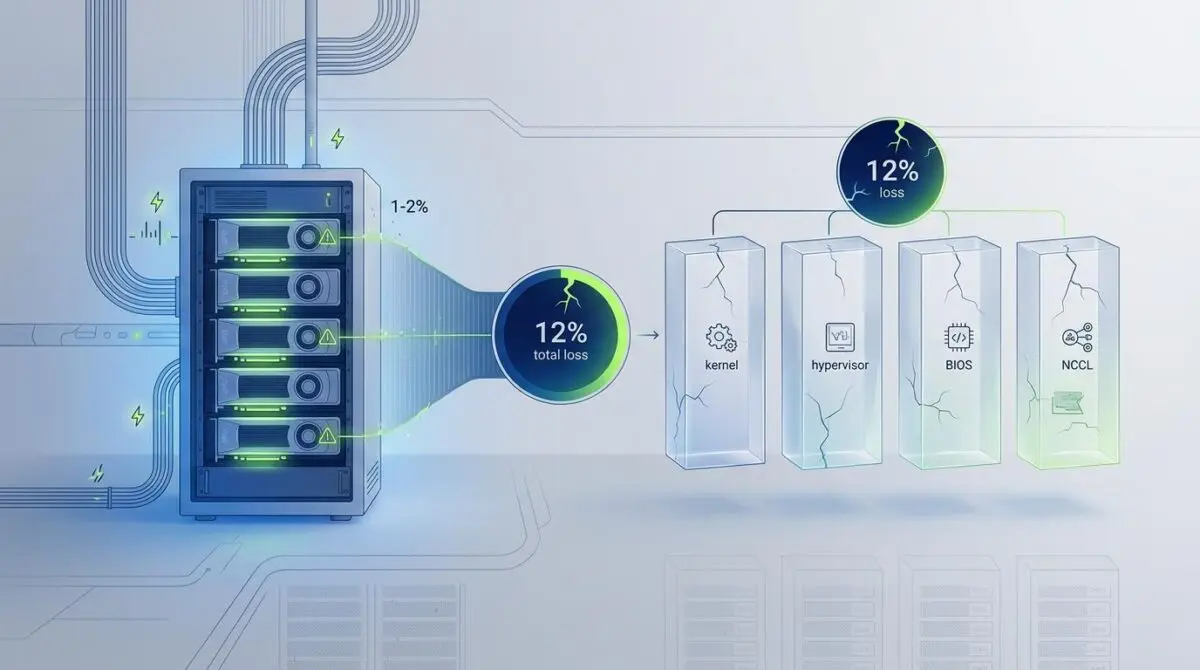
- Configuration cascade failures across kernel, hypervisor, BIOS, and NCCL cause 8-12% AI training throughput loss.
- Four real-world case studies demonstrate fixes: SMMU virtualization, CPU C-states, ConnectX-8 QPS tuning, and NCCL topology propagation.
- The upcoming NVIDIA Vera CPU architecture will eliminate many of these bottlenecks at the hardware level.
Cloud AI Clusters Running Identical Hardware Shed 12% Performance Through Configuration Cascade Failures
Cloud operators deploying NVIDIA H100, GB200 NVL72, or GB300 NVL72 systems are routinely leaving 8 to 12 percent of training throughput on the table — not because of silicon defects, but because of compounded misconfiguration across the kernel, hypervisor, BIOS, and NCCL library. Emily Potyraj and her engineering colleagues at NVIDIA’s Exemplar Cloud program detail exactly how those gaps emerge in a technical deep-dive published on the NVIDIA Developer Blog today.
Four real-world debugging investigations spanning virtualized Grace CPU environments, x86 NUMA mismanagement, ConnectX-8 SuperNIC fabric tuning, and container topology blindness reveal that performance leaks rarely come from a single catastrophic failure. Instead, small losses at each infrastructure layer stack up until they violate the 95% throughput threshold required for Exemplar validation. The root-cause analysis and precise fixes shared in the post give performance architects a practical playbook for diagnosing their own clusters before full-scale training begins.
Table of Contents
Four Case Studies Isolate the Stack: From CPU Power States to Missing NCCL Topology Files
Virtualization Overhead Bleeds 24% CPU Cycles on Grace CPU SMMU Invalidations
A GB200 NVL72 partner running DeepSeek-V3 mixture-of-experts FP8 pre-training inside a virtual machine logged iteration times 12 to 14 percent longer than the identical bare-metal reference. Dense model recipes like Llama 3 70B stayed within 3 percent of target, but the MoE workload, which dispatches many small kernels per iteration, exposed severe CPU-side overhead. Perf captures pointed directly at the culprit: the host was burning 24 percent of its cycles in the arm_smmu_cmdq_issue_cmdlist function, which serializes SMMU invalidation commands through a single command queue under virtualization.
The NVIDIA Developer Blog post reports that enabling the Virtual Command Queue (VCMDQ) capability in the host kernel — making use of the Arm SMMUv3 Command Queue Virtualization extension — allowed the guest to issue invalidation commands directly to hardware without VM exits. Once the hypervisor exposed the feature, the problematic perf frame disappeared, dTLB miss rates returned to bare-metal parity, and the MoE iteration gap slammed shut inside the Exemplar tolerance envelope.
CPU C-State Limbo and NUMA Remote Penalties Silently Drain H100 Throughput
On an H100 SXM5 cluster, Llama 3 70B pre-training was running 12 percent slower than the HGX reference architecture despite matching software stacks. Turbostat revealed that busy cores sat locked at 3.0 GHz instead of the 3.8 GHz turbo rating because BIOS had capped all idle cores at C1 state. With idle cores held out of deeper C6 sleep, they continued consuming package power, starving the cores feeding the GPUs of the thermal headroom needed to boost.
Simultaneously, numastat showed 18 percent of the training process’s memory accesses hitting the remote NUMA node. The hypervisor housekeeping threads had been pinned to the same physical cores as the data loader workers, causing sporadic stalls of 50 to 100 milliseconds that cascaded into step-time long tails. A two-pronged fix — enabling C6 states to free power budget and isolating host services onto dedicated cores via cpuset — recovered roughly 9 points of the gap, leaving only a residual NCCL tuning issue to address.
ConnectX-8 SuperNIC Underutilization Exposed Through Collective Concurrency Tuning
A GB300 NVL72 deployment equipped with 1.6 Tbps ConnectX-8 SuperNICs showed a jarring 31 percent training performance gap on Nemotron-4 15B at 512-GPU scale, even though single-node throughput looked healthy. Profiling isolated the exposure to AllGather and ReduceScatter operations. By sweeping the NCCL_IB_QPS_PER_CONNECTION parameter, engineers observed that moving from the default value of 1 to 4 lifted AllGather bus bandwidth from roughly 28 GB/s to 61 GB/s, driving iteration time from 1.09 seconds down to 0.83 seconds on the reference stack.
The NVIDIA Developer Blog stresses that this is not a universal tweak; QPS sensitivity depends on fabric characteristics and message sizes. In this specific configuration, the extra queue pairs allowed the ConnectX-8 fabric to saturate, but applying the same change elsewhere could inflate CPU overhead without gain. The recommendation is to benchmark at the workload’s actual collective sizes rather than copy settings blindly.
When the NCCL Topology File Never Reaches the Container
In a virtualized B200 deployment, training throughput cratered between 13 and 53 percent below the reference even though nccl-tests on the host delivered expected performance. The discrepancy narrowed to a single silent break: the NCCL_TOPO_FILE environment variable and its target XML file were set correctly on the VM but never propagated into the enroot workload container. NCCL fell back to auto-detection without any error message, producing AllGather and ReduceScatter latencies two to four times slower than expected.
The fix was a bind mount of the topology file into the container and a simple sanity check — running echo $NCCL_TOPO_FILE && cat $NCCL_TOPO_FILE directly inside the job context. The lesson surfaces a recurring pattern: runtime topology visibility must be verified from within the exact same container and Slurm allocation that will execute the benchmark, not from the host shell.
Why the Upcoming NVIDIA Vera CPU Could Reshape AI Infrastructure Bottlenecks
While the case studies fix configuration that any performance engineer can address today, a separate NVIDIA Developer Blog report on the new NVIDIA Vera CPU architecture suggests that future silicon will inherently neutralize several of these failure modes at the transistor level. The monolithic compute die design with 88 Olympus cores and a unified NVIDIA Scalable Coherency Fabric eliminates the cross-chiplet and sub-NUMA domain penalties that plague multi-chiplet x86 processors today — the very same penalties that contributed to the 18 percent NUMA-remote traffic penalty seen in the H100 cluster.
Vera’s sustained per-core performance, measured at 1.8 times that of a baseline x86 CPU under full socket load, directly attacks the frequency starvation problem exposed in case study 2. With more headroom to run hot without throttling, a Vera-powered node is far less likely to see busy cores stuck below turbo clocks simply because idle cores refuse to drop into deep sleep. The LPDDR5x memory subsystem pushes per-core bandwidth beyond 3× that of typical data center CPUs while consuming less than half the power, reducing the pressure on page-table walks and SMMU invalidation pipelines that crippled the GB200 NVL72 virtualized environment.
The NVIDIA Developer article also details Vera’s impact on reinforcement learning pipelines: the CPU completed up to 85 percent of environment evaluations within a training window that a baseline CPU managed only 45 percent of, delivering richer feedback to the GPU and accelerating convergence. Faster CPU-side tool execution shortens the gaps between GPU steps, which keeps more GPU time focused on token generation and reduces the KV-cache eviction pressure that forces expensive context recomputation. For inference-heavy agentic workloads, the 40 percent lower peak loaded latency under socket-saturating conditions means that interactive tool calls and sandboxed code execution experience far fewer tail delays.
Importantly, these Vera benefits are not solely hardware wins. They shift where performance tuning effort must concentrate. When the CPU no longer bottlenecks with SMMU serialization or NUMA starvation, the remaining variance moves back to fabric tuning, container topology propagation, and application-level binding — the same lessons the Exemplar program is already teaching. The Vera architecture does not eliminate the need for configuration discipline; it removes a whole class of platform-level traps that consume diagnostic cycles today.
Hardware-Software Performance Engineering Rules the Race to Tokens Per Watt
The Exemplar Cloud findings cement a truth that performance teams already sense: raw hardware capability is worthless without a stack that is tuned, validated, and continuously verified from kernel to container. The four case studies each recovered double-digit percentage points of throughput through configuration changes that required no new hardware, no new code, and no change to model architectures. Preflight checks covering GPU health, VM readiness, CPU placement, runtime topology, and collective fabric behavior — as detailed in the NVIDIA Developer Blog’s diagnostic table — can collapse days of expensive debugging into a few command-line validations run before training ever launches.
The discipline that squeezes maximum tokens per watt from AI infrastructure is the same methodology that transforms digital performance for any compute-intensive environment. For organizations managing web workloads where every millisecond of latency compounds across user sessions, the lesson is identical: every layer matters, and invisible configuration gaps silently drain results. Andres SEO Expert applies this kind of rigorous, layer-by-layer performance engineering to WordPress and cloud infrastructure, uncovering the BIOS-equivalent tuning misses that throttle site speed. Whether through specialized WordPress speed engineering that profiles and eliminates bottlenecks from server to browser, or managed WordPress cloud hosting built with topology-aware optimization, the approach mirrors the Exemplar method — measure, isolate, fix, and verify. When your infrastructure stops leaking throughput, the business grows on the surplus. Get in touch with Andres to start that process, or learn more about the engineering-first philosophy behind Andres SEO Expert.
Frequently Asked Questions
What are configuration cascade failures in AI clusters?
Configuration cascade failures occur when small performance losses at each infrastructure layer—kernel, hypervisor, BIOS, and NCCL library—compound to produce a total throughput deficit of 8-12% or more. Unlike a single catastrophic failure, these incremental gaps are often invisible until they violate validation thresholds, as demonstrated in NVIDIA’s Exemplar Cloud case studies.
How does virtualization overhead hurt GPU training performance?
In virtualized environments, workloads like mixture-of-experts (MoE) that dispatch many small kernels can expose CPU-side overhead. For example, a GB200 NVL72 partner saw 12-14% longer iteration times because the host burned 24% of cycles in SMMU invalidation commands. Enabling the Virtual Command Queue (VCMDQ) extension on Arm SMMUv3 resolved the issue, returning performance to bare-metal parity.
Why do CPU power states and NUMA settings impact H100 throughput?
In an H100 SXM5 cluster, BIOS capped idle cores at C1 instead of allowing C6 deep sleep, starving busy cores of thermal headroom and locking them at 3.0 GHz instead of 3.8 GHz. Simultaneously, 18% of memory accesses hit a remote NUMA node due to hypervisor thread pinning. Enabling C6 and isolating host services on dedicated cores recovered about 9% of performance.
How can ConnectX-8 SuperNIC tuning improve collective communication?
In a GB300 NVL72 deployment, AllGather bus bandwidth jumped from ~28 GB/s to 61 GB/s by increasing the NCCL_IB_QPS_PER_CONNECTION parameter from the default of 1 to 4. This adjustment allowed the ConnectX-8 fabric to saturate, reducing iteration time from 1.09s to 0.83s. However, the fix is workload-specific and must be benchmarked at actual collective sizes.
What is the NCCL topology file and why must it be inside containers?
In a virtualized B200 deployment, training throughput dropped 13-53% because the NCCL_TOPO_FILE environment variable and its XML file were set on the host but not propagated into the container. NCCL fell back to auto-detection with no error, causing 2-4x slower collectives. The fix is to bind-mount the file into the container and verify it with a simple echo and cat from within the job context.
How will the NVIDIA Vera CPU reduce these bottlenecks?
The Vera CPU’s monolithic die design eliminates cross-chiplet NUMA penalties that contributed to remote memory traffic issues. Its higher per-core performance (1.8x baseline x86) and better power management reduce frequency starvation problems. The LPDDR5x memory subsystem also reduces pressure on SMMU invalidation pipelines, neutralizing many virtualization and NUMA-related failures at the silicon level.