Key Takeaways
- The assistant runs pre-answer checks (human request, repetition, historical context, sensitive topics) before replying.
- About 25% of conversations escalate to a human, with the assistant initiating half of those handoffs.
- Full transcripts and issue summaries travel with each escalation, so customers never explain themselves twice.
Table of Contents
WordPress.com’s Support Assistant Is Now Deciding When to Step Aside
WordPress.com has moved beyond simply offering an AI support layer and is now publishing the exact escalation logic behind it. In an August 19 update, the platform detailed how its Support Assistant decides between solving a ticket and handing the conversation to a human Happiness Engineer.
Most customer questions are resolved autonomously. The more important metric is that roughly one in four conversations ends with a human, and in about half of those cases the assistant initiates the handoff.
That design choice repositions the assistant from a deflection tool into a routing layer. The goal is not to keep users away from humans but to move them to the right resolution path quickly.
Inside the Pre-Answer Checks That Gate Every AI Response
According to WordPress.com’s August 19 update, the assistant was trained on the same documentation library that the platform’s Happiness Engineers use. It also has access to the customer’s site and account state, so its answers are built around actual configuration rather than generic help content.
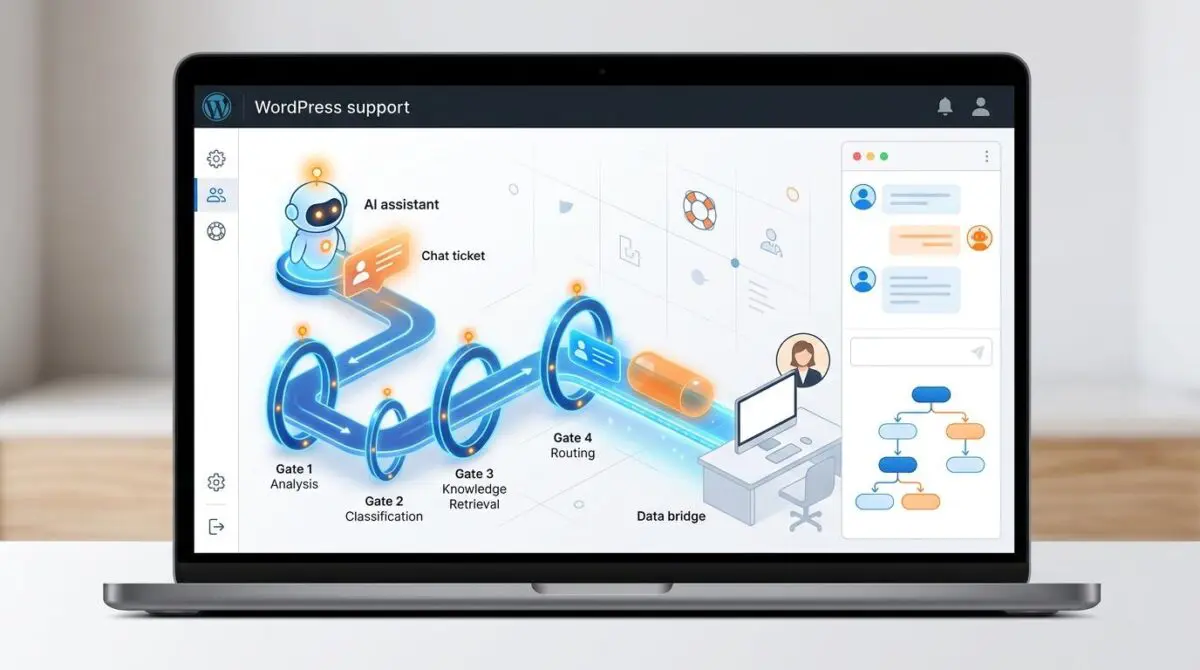
Before composing any reply, the system pauses and runs through a decision set tied to the live conversation. The checks include whether the person has already asked for a human, whether the same request occurred earlier in the thread, whether the customer has contacted support about the issue previously, and whether the topic belongs in a human-only category.
Only after that gate does the assistant write a reply. Some conversations jump directly to the Happiness Engineering team without any back-and-forth.
- Human request check: Has the customer already asked for a person?
- Repetition check: Has the same request appeared earlier in the conversation?
- Historical context check: Has the customer contacted support about the same issue before?
- Sensitive topic check: Does this category require human-only handling?
The assistant’s default is still to solve the problem. It escalates when an issue needs investigation, when there is no reliable answer, or when a suggested fix has already failed.
When a customer explicitly asks for a person, the assistant does not stall or refuse. It may ask for one or two clarifying details if that can resolve the issue on the spot, while making clear that a human is still available.
The platform tested a one-exchange attempt before transfer. Many problems were resolved in that single extra exchange, and users who still wanted human support received it without having to ask again.
If a customer has already explained the exact same issue to a human Happiness Engineer recently and it remains unresolved, the assistant skips the usual questions. It names the issue, acknowledges the time already spent, and offers the handoff in one step.
When an escalation occurs, the human team receives the full chat transcript and a summary of the issue. The customer does not start from zero.
The Broken Handoff Landscape That Makes Context Retention a Competitive Weapon
Across the broader customer experience market, the AI-to-human handoff remains the weakest link. CMSWire’s analysis of a Five9 survey puts numbers behind that disconnect.
- Decision-maker confidence: 96 percent say their organization preserves context effectively.
- Consumer reality: 83 percent repeat themselves after a transfer; 35 percent say it happens often or always.
- Frustration cost: only 12 percent feel no frustration at transfer, and 28 percent are unlikely to use AI support again.
- Trust mechanism: visible human escalation lifts consumer trust from 26 percent to 55 percent.
The same survey reveals internal contradictions. Among leaders claiming strong handoff performance, 37 percent admit customers repeat information, 37 percent say agents lack visibility into the prior AI interaction, and 30 percent report transcript inaccuracies.
The platform’s published approach maps directly to those pressure points. The assistant’s pre-answer checks target the exact information loss that drives repeated effort and churn.
Sending a full transcript and summary to the human team addresses the agent visibility gap that 37 percent of decision-makers themselves acknowledge. The platform’s claim that customers do not explain twice is a direct response to the 83 percent repeat rate.
CX Network has proposed a five-minute handoff standard for customer service. Within that window, the customer should know the human agent understands the issue, owns the next step, and will not send them back through the same work.
The platform’s flow comes close in principle. The assistant prepares the transfer, identifies the issue, and delivers context to the Happiness team before the human replies.
The difference is that the platform has productized the handoff inside a website support environment, not just an enterprise contact center. CX Network also argues that agents need authority matching the escalation reason; otherwise, a transfer is only a more polite delay.
Because the Happiness Engineers are the same team whose documentation trained the assistant, the risk of a handoff landing with an agent who cannot act is reduced.
The larger recommendation from CMSWire is to treat the AI-to-human handoff as a product, not a transfer. The success metric is not whether the bot solved it but whether the customer repeated anything.
The foundational principle is a warm transfer: the AI passes context before the human joins. WordPress.com applies this natively inside its support flow rather than bolting it on as a contact center feature.
The Support Bar Just Moved for WordPress Operators
The platform has turned the support handoff from an operational afterthought into a visible product differentiator. For WordPress teams applying context-aware AI escalation to their own support and content workflows, programmatic SEO and AI automation at Andres SEO Expert connects the same decision-layer thinking to scalable site growth — contact us here.
Frequently Asked Questions
How does WordPress.com’s Support Assistant decide when to escalate to a human?
The Support Assistant runs through a decision set tied to the live conversation. It checks whether the customer has already asked for a human, whether the same request appeared earlier in the thread, whether the customer has contacted support about the same issue before, and whether the topic falls into a human-only category. It defaults to solving the problem, but escalates when an issue needs investigation, there is no reliable answer, or a suggested fix has already failed.
What pre-answer checks does the Support Assistant perform before composing a reply?
Before writing any reply, the assistant pauses to check if the customer has explicitly asked for a human, if the same request was made earlier in the conversation, if the customer has previously contacted support about this issue, and if the topic belongs in a human-only category. Only after passing this gate does the assistant compose a response, and some conversations skip directly to the Happiness Engineering team.
What happens when a customer explicitly asks for a human?
When a customer asks for a person, the assistant does not stall or refuse. It may ask for one or two clarifying details if that can resolve the issue on the spot, while making clear that a human is still available. The platform tested a one-exchange attempt before transfer, and many problems were resolved in that single extra exchange. Users who still wanted human support received it without having to ask again.
How does the Support Assistant handle customers who have already contacted support about the same issue?
If a customer has already explained the exact same issue to a human Happiness Engineer recently and it remains unresolved, the assistant skips the usual questions. It names the issue, acknowledges the time already spent, and offers the handoff in one step. The customer does not have to start from zero.
What information does the human team receive after an escalation?
When an escalation occurs, the human team receives the full chat transcript and a summary of the issue. This ensures the customer does not need to repeat themselves and the agent has visibility into the prior AI interaction. The platform’s goal is that customers do not explain twice.
Why is context retention becoming a competitive weapon in customer support?
Across the broader customer experience market, the AI-to-human handoff remains the weakest link. CMSWire reports that 83 percent of consumers repeat themselves after a transfer, yet 96 percent of decision-makers say their organization preserves context effectively. WordPress.com addresses this gap by sending a full transcript and summary to the human team, lowering frustration and increasing trust. Visible human escalation lifts consumer trust from 26 percent to 55 percent.