




Key Takeaways
- Cloudflare introduces region hints for Smart Tiered Cache, enabling precise upper-tier selection for public cloud origins behind anycast IPs.
- Eliminates cross-continental hairpinning by routing cache misses through the closest Cloudflare data center to the actual cloud region.
- Supports AWS, GCP, Azure, and Oracle Cloud, with more providers to come. Configure via dashboard, API, or Terraform.
- Automatically detects anycast origins using speed-of-light physics and falls back to multiple tiers when no hint is provided.
Table of Contents
The Hairpin Problem: Cloud Origins Meet Anycast
Cloudflare just closed a major performance gap for enterprises running workloads on public clouds. Its Smart Tiered Cache now supports region hints for origins hosted on AWS, GCP, Azure, and Oracle Cloud, fixing a notorious hairpinning issue that plagued anycast IPs.
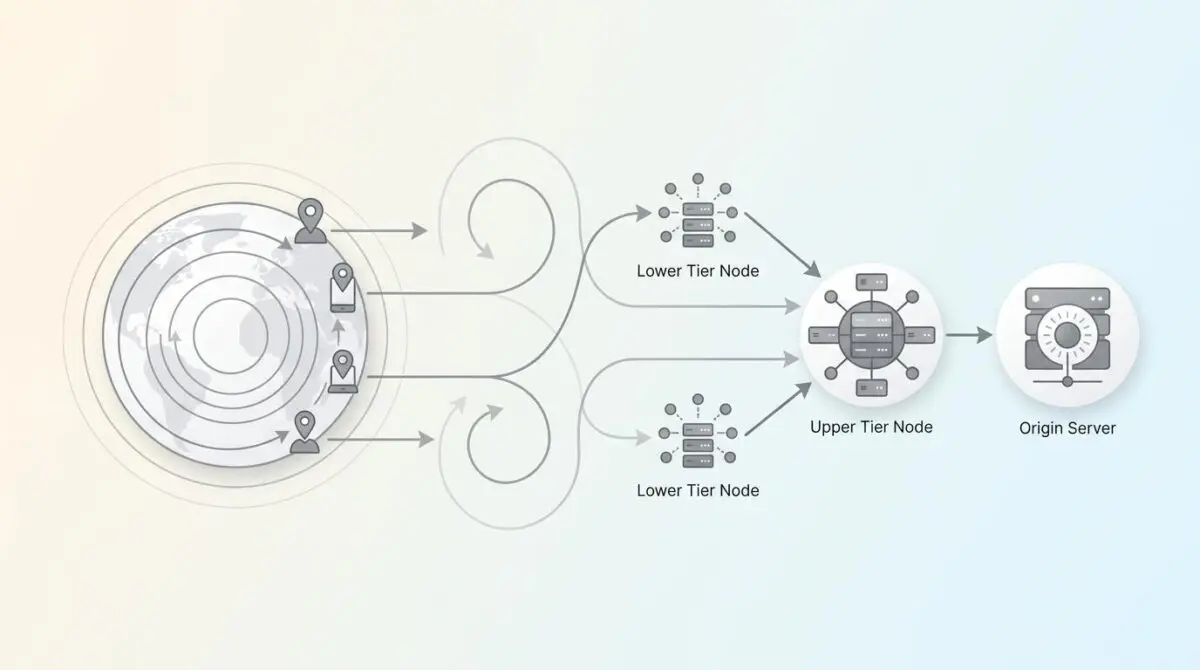
Until today, if your origin sat in Singapore behind a cloud anycast IP, Cloudflare’s latency probes might pick Chicago as the optimal upper tier. Result: a user in Asia sends a request to a nearby Cloudflare data center, which routes it cross-continent to Chicago, which then fetches from Singapore—adding hundreds of milliseconds. As originally reported by Cloudflare, this was one of the most consistently reported customer issues.
How Smart Tiered Cache Works
Smart Tiered Cache, launched in 2021, works by measuring real-time latency from every Cloudflare data center to your origin IP. It then selects the single best upper-tier data center to funnel all cache misses through. This concentrates cache misses, boosting hit ratios and reducing origin load.
The system automatically detects anycast origins using a physics constraint: if probe latencies from two checkpoints are faster than the speed of light would allow for a single location, the origin is anycast. Previously, this triggered a fallback to multiple upper tiers—safe, but inefficient.
The Anycast Challenge: Why Cloud Origins Break Standard Caching
Public cloud load balancers and front-end services often use anycast or regional unicast IPs. A single IP can appear equally close to dozens of Cloudflare data centers because it represents the cloud provider’s edge, not a physical server. Standard Smart Tiered Cache could not lock onto one upper tier, leading to hairpins and wasted cross-continental traffic.
According to recent analysis comparing Cloudflare vs Amazon CloudFront, organizations leveraging multi-cloud architectures have been demanding better support for cloud-native networking. This update directly answers that call.
New Region Hint Feature: Tell Cloudflare Where Your Origin Lives
With the new Origin Configuration section in the Cloudflare dashboard, you can set a region hint for any detected anycast IP. Simply pick a cloud region like aws:us-east-1 or gcp:europe-west1, and Cloudflare maps it to the optimal primary and fallback upper tiers.
Behind the scenes, Cloudflare fetches IP range files from each provider every few hours, matches subnets against its continuously refreshed probe database (every 15 minutes), and selects the upper tier with the strongest signal. Fallbacks come from different PoPs to ensure resilience.
Configuration is available via dashboard, API, and Terraform, enabling integration into infrastructure-as-code workflows.
Strategic Analysis: Why This Matters for Performance
This isn’t just a minor feature—it’s a competitive differentiator. As noted in Cloudflare’s own 2026 OAuth announcement, Smart Tiered Cache now enables precise upper-tier selection for public cloud origins. With the explosive growth of edge computing and hybrid cloud, anycast-avoidance is becoming table stakes.
Compared to Amazon CloudFront, Cloudflare’s approach is more automated: CloudFront requires manual origin configurations for regional endpoints, while Cloudflare’s system can auto-detect anycast and fall back gracefully even without hints. The pricing advantage also leans Cloudflare’s way for high-volume cache operations, especially given recent reports highlighting R2’s free tier attractiveness for media storage.
Moreover, by eliminating hairpins, this update directly improves Core Web Vitals—specifically LCP and FID—for sites hosted on public clouds. Organizations scoring 100/100 on PageSpeed Insights will find this a critical tool.
Conclusion & Next Steps
Cloudflare’s region hints turn a pain point into a performance lever. For any business running on AWS, GCP, Azure, or Oracle Cloud, this is an instant win: better cache hit ratios, lower latency, and fewer origin connections—all with a simple toggle.
Staying ahead in the rapidly shifting landscape of Performance requires precision. To future-proof your digital strategy and scale effortlessly, you need a foundation built on precision. Optimize your site with advanced speed engineering, secure your infrastructure in high-performance hosting environments, and streamline your entire workflow through autonomous AI pipelines. Connect with Andres at Andres SEO Expert to build your ultimate architecture.
Frequently Asked Questions
What is the hairpin problem in CDN caching?
The hairpin problem occurs when a user’s request to a cloud origin behind an anycast IP is routed to a distant upper-tier data center instead of a nearby one, adding significant latency. For example, a user in Asia might have their request sent to Chicago before fetching from Singapore.
How does Cloudflare’s Smart Tiered Cache work?
Smart Tiered Cache measures real-time latency from every Cloudflare data center to the origin IP and selects the single best upper-tier data center to funnel cache misses through. This concentrates cache misses, improves hit ratios, and reduces origin load.
Why do cloud origins cause problems for standard tiered caching?
Cloud origins often use anycast or regional unicast IPs, making a single IP appear equally close to many data centers. Standard Smart Tiered Cache could not lock onto one upper tier, leading to hairpins and inefficient cross-continental traffic.
What is the new Region Hint feature in Cloudflare?
The Region Hint feature allows you to set a cloud region (e.g., aws:us-east-1) for any detected anycast IP in the Origin Configuration section. Cloudflare maps it to the optimal primary and fallback upper tiers, eliminating hairpins.
How do I configure region hints in Cloudflare?
You can configure region hints via the Cloudflare dashboard under Origin Configuration, via API, or Terraform. Simply pick the cloud region, and Cloudflare automatically selects the best upper tiers using its probe database and provider IP ranges.
Why is this update important for website performance?
By eliminating hairpins, region hints reduce latency, improve cache hit ratios, and directly enhance Core Web Vitals like LCP and FID. This is critical for organizations hosting on public clouds and aiming for top PageSpeed scores.
How does Cloudflare’s region hint compare to Amazon CloudFront’s approach?
Cloudflare’s system is more automated: it auto-detects anycast origins and falls back gracefully without hints. CloudFront requires manual configuration for regional endpoints. Cloudflare also offers pricing advantages for high-volume cache operations.