





Key Takeaways
- Kimi K3 achieved only 32.2% on the ExploitBench benchmark, compared to top US models averaging 76.2%.
- The Chinese model failed all 41 tasks requiring arbitrary code execution, a key indicator of advanced cyberattack ability.
- Real-time research indicates Kimi K3 may have been created via distillation from Anthropic’s Claude Fable, raising questions about true autonomous capability.
- The findings challenge narratives of rapid Chinese AI offensive capability growth, though reliance on Western models may complicate security assessments.
Kimi K3 Underperforms in US-UK Cyberattack Benchmark
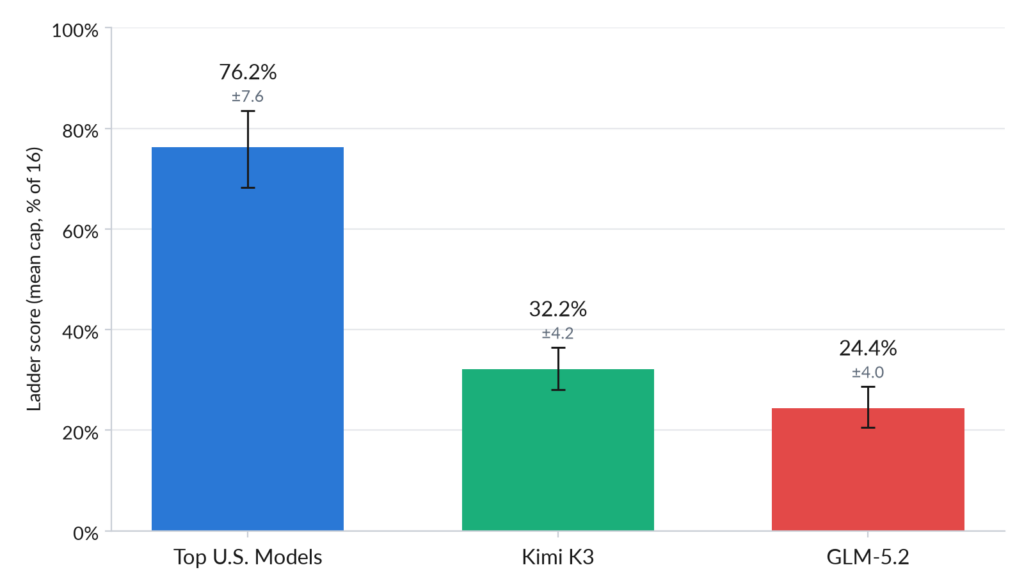
A joint study by the UK Artificial Intelligence Security Institute (AISI) and the US Centre for AI Standards and Innovation (CAISI) has revealed that China’s leading large language model, Kimi K3, significantly trails American counterparts in cyberattack capability. The model, developed by Chinese unicorn Moonshot AI, scored just 32.2 percent on the ExploitBench benchmark, while top unnamed US models averaged 76.2 percent.
The study, published on July 23, 2026, tested Kimi K3 across 41 ExploitBench tasks designed to measure an AI’s ability to develop exploits for cybersecurity vulnerabilities. Notably, Kimi K3 failed to achieve arbitrary code execution — the highest-level exploit granting full control of a target system — on any task, whereas leading US models succeeded on 20 tasks.
Table of Contents
Benchmark Breakdown: ExploitBench Scores Reveal Wide Gap
The ExploitBench evaluation placed Kimi K3’s overall score at 32.2 percent, outperforming domestic competitor Zhipu AI’s GLM-5.2, which scored 24.4 percent. However, both Chinese models lagged far behind the 76.2 percent average of leading US models, which the study left unnamed.
According to the South China Morning Post, more telling than the aggregate score is the failure at the highest difficulty levels. Arbitrary code execution, a critical capability for gaining full system control, was achieved by US models on nearly half of the tasks. Kimi K3 could not complete any. This gap suggests fundamental differences in training data, architecture, or optimization strategies between Chinese and US AI systems.
Distillation Dependence: A Cloud Over Kimi K3’s Capabilities
Real-time research adds a complicating dimension. Reports from sources like Gigazine indicate that Kimi K3 may have been created through distillation of Anthropic’s Claude Fable, a US-developed model. If true, this means Kimi K3’s cyberattack abilities could be derivative rather than original, raising questions about the true extent of China’s independent AI offensive capability.
Distillation involves training a smaller model to mimic a larger one’s outputs. While legitimate, it can mask underlying limitations. If Kimi K3 relied on Claude Fable, its ExploitBench performance may reflect the ceiling of a distilled model rather than a homegrown breakthrough. This claim has not been independently verified, but it aligns with the score gap and the model’s structure.
Implications for AI Security and Market Competition
The study directly challenges Washington’s brewing anxiety about China’s rapid AI advancement. While Chinese open-source models have gained attention, this data shows they remain significantly behind in offensive cyber capability — a domain where even small leads can be decisive.
Yet the distillation angle introduces a strategic twist. If Chinese models depend on US technology for their best performance, export controls on model weights and distillation techniques could become a new battleground. Regulators may need to consider not just direct access but also indirect acquisition through distillation, a process that is hard to trace and enforce.
For AI safety practitioners, the results underscore the importance of benchmark diversity. ExploitBench captures one dimension; other areas like resilience, evasion, and autonomy may tell different stories. Holistic evaluation remains critical as both nations race to deploy advanced AI in security-sensitive contexts.
Navigating the New AI Arms Race
The Kimi K3 findings offer a data-driven reality check amid heated rhetoric. China’s models are progressing, but the path is uneven and possibly reliant on Western foundations. Understanding these nuances is essential for investors, policymakers, and developers building the next generation of AI systems.
For organizations seeking to stay ahead in this fast-evolving landscape, technical excellence and strategic insight are non-negotiable. Whether you are optimizing AI pipelines, hardening infrastructure, or scaling intelligent systems, performance and security depend on expert guidance. Explore how our programmatic SEO and AI automation services can align your technology stack with the latest advancements. For deeper collaboration, reach out to Andres at Andres SEO Expert to transform insights into action.
Frequently Asked Questions
What is Kimi K3 and why did it underperform in the US-UK cyberattack benchmark?
Kimi K3 is a large language model developed by Chinese unicorn Moonshot AI. A joint study by the UK AI Security Institute and the US Centre for AI Standards and Innovation found that Kimi K3 scored only 32.2% on ExploitBench, a benchmark measuring ability to develop cybersecurity exploits, far below the 76.2% average of top US models.
How did Kimi K3 compare to US models on ExploitBench?
Kimi K3 scored 32.2% overall, outperforming domestic competitor GLM-5.2 (24.4%) but significantly behind the 76.2% average of leading unnamed US models. Critically, US models achieved arbitrary code execution on 20 tasks, while Kimi K3 succeeded on none.
What is the significance of Kimi K3 failing to achieve arbitrary code execution?
Arbitrary code execution is the highest-level exploit, granting full control of a target system. Kimi K3’s inability to achieve it on any of 41 tasks suggests fundamental differences in training data, architecture, or optimization compared to US models, which succeeded on nearly half the tasks.
Is Kimi K3 derived from distillation of Anthropic’s Claude Fable?
Reports from sources like Gigazine indicate Kimi K3 may have been created through distillation of Anthropic’s Claude Fable, a US-developed model. If true, its cyberattack capabilities would be derivative rather than original, raising questions about China’s independent AI offensive capability. This claim has not been independently verified.
What are the implications of this study for AI security and export controls?
The study challenges concerns about China’s rapid AI advancement, showing Chinese models still lag significantly in offensive cyber capability. If Chinese models depend on US technology via distillation, export controls on model weights and distillation techniques could become a new battleground, as distillation is hard to trace and enforce.
How does this study affect the narrative about China’s AI advancement?
The findings offer a data-driven reality check: while Chinese open-source models have gained attention, they remain behind in critical areas like exploit development. The potential reliance on US foundations through distillation suggests progress may be uneven and partially dependent on Western technology, altering the competitive landscape.