


Key Takeaways
- Three isolated Kubernetes tenant clusters share one NVIDIA L40S GPU using KAI Scheduler and vCluster.
- Guaranteed quotas ensure each team gets 0.33 GPU with bursting to full capacity when idle.
- This open-source pattern eliminates the tradeoff between GPU underutilization and fragile shared clusters.
Table of Contents
Single GPU, Three Teams, Zero Friction: NVIDIA Lays Out a Kubernetes Multi-Tenancy Blueprint
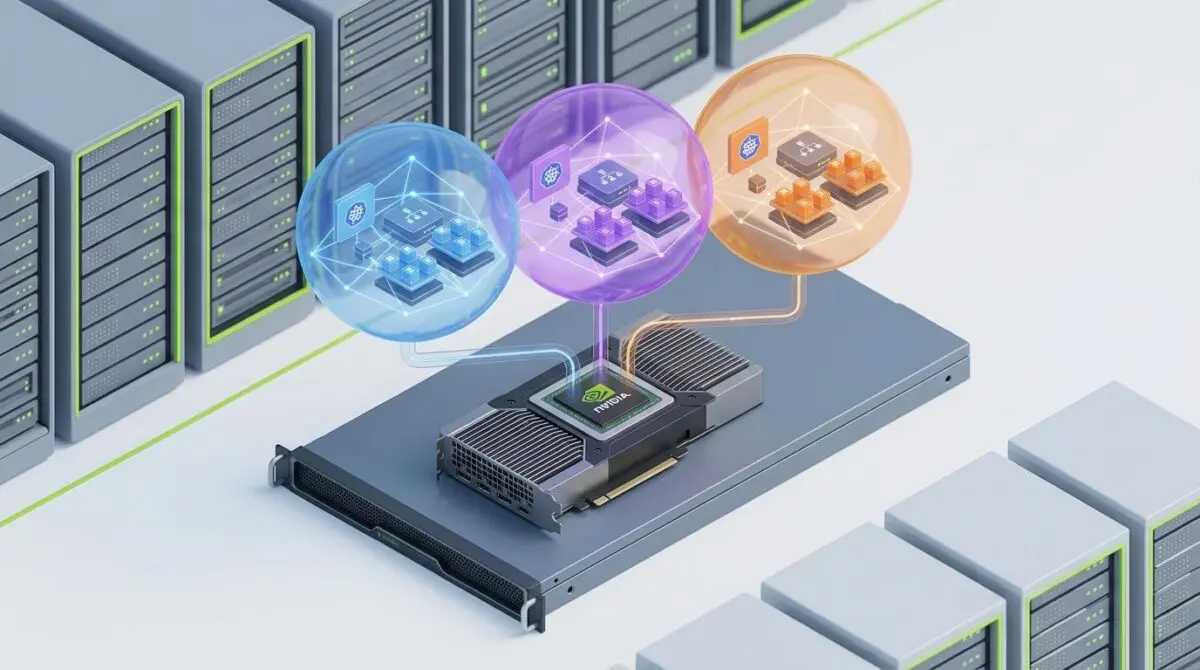
NVIDIA’s Developer team published a technical walkthrough today, demonstrating how engineering teams can run three fully isolated Kubernetes tenant clusters on a single physical GPU node without hardware partitioning.
Ekin Karabulut and Saiyam Pathak detail a reference architecture that combines the open-source KAI Scheduler with vCluster, delivering per-team control planes, independent RBAC policies, and guaranteed GPU quotas—all while sharing one NVIDIA L40S accelerator.
The pattern eliminates a persistent infrastructure tradeoff in AI platform engineering: the choice between wasting silicon through underutilization or forcing teams into fragile, high-coordination shared clusters.
The Architectural Anatomy of GPU Sharing Across Isolated Control Planes
KAI Scheduler operates alongside the default Kubernetes scheduler, intercepting pods labeled with schedulerName: kai-scheduler and routing them through a hierarchical queue system that models organizational structure.
The tutorial defines one parent queue—ml-org—with a total budget of one GPU, and three child queues representing an NLP team, a Vision team, and a Recommender Systems team.
Each child queue receives a guaranteed quota of 0.33 GPU with the ability to burst up to the full GPU when sibling queues sit idle.
vCluster provisions the isolation layer by spinning up a virtualized Kubernetes control plane per tenant, complete with its own API server, CRDs, and cluster-admin scope—indistinguishable from a dedicated cluster.
A critical configuration detail emerges in the setOwner: false setting within the vCluster sync configuration, which prevents vCluster from rewriting pod ownership chains and allows KAI Scheduler’s pod-grouper to correctly trace workload hierarchies for gang scheduling decisions.
The demo, detailed in NVIDIA’s tutorial, runs on a NVIDIA Brev GPU instance on Nebius, using MicroK8s v1.36.2, KAI Scheduler v0.16.4, and vCluster CLI 0.35.1—all openly available tooling that replicates on any Kubernetes distribution with the NVIDIA GPU Operator installed and Container Device Interface enabled.
Three pods, representing independent workloads from each team, land on the same physical node yet remain invisible to one another from within their respective vCluster contexts.
Queue inspection confirms precise allocation: each team consumes exactly 330m of GPU capacity, the fractional equivalent of their guaranteed share on the L40S.
Smarter Scheduling, Fewer Chips: What This Means for AI Infrastructure Economics
The NVIDIA Run:ai Scheduler documentation reinforces the strategic significance of this pattern by describing a mature quota framework that enforces multi-level resource isolation across departments and projects, including deserved quota, over-quota weight, and configurable placement strategies per node pool.
Non-preemptible workloads stay within guaranteed boundaries while preemptible jobs absorb surplus capacity, creating a fluid allocation model that mirrors what the KAI Scheduler-vCluster tutorial achieves at a smaller scale but generalizes to clusters spanning thousands of nodes.
Gang scheduling support with multi-level pod-group structures ensures that distributed training runs and disaggregated inference workloads—where partial placement equals wasted allocation—atomically reserve resources across shared infrastructure.
Research published in IEEE Transactions on Parallel and Distributed Systems introduces gPooling, a hardware-agnostic accelerator pooling framework that uses driver-level interception to create elastic virtual devices on demand, further validating the industry trajectory toward fine-grained GPU sharing rather than coarse device-level assignment.
The gPooling paper demonstrates that intercepting at the driver layer reduces resource fragmentation and queueing delays, enabling workloads with modest or bursty requirements to share accelerators without the overhead of virtual machine-based isolation—a complementary approach to the control-plane-level isolation that vCluster provides.
The convergence of hierarchical scheduling, virtualized control planes, and driver-level pooling suggests that AI platform teams are rapidly moving past the era of dedicated GPU silos.
Infrastructure efficiency is no longer bound by physical topology but by scheduling logic and namespace boundaries, which means the economic case for overprovisioning GPU hardware weakens with each new release of these open-source toolchains.
The Utilization Frontier Is Now a Software Problem
The reference architecture that Karabulut and Pathak document represents more than a configuration tutorial—it codifies a design philosophy where GPU isolation becomes a schedulable property rather than a hardware prerequisite, collapsing the distance between dedicated infrastructure and shared pools.
When three teams can each operate as cluster administrators on a single accelerator without mutual interference, the argument for procuring additional GPUs to satisfy organizational boundaries evaporates.
For AI platform engineers managing constrained compute budgets, the KAI Scheduler and vCluster combination offers a path to higher utilization without compromising developer autonomy—a rare alignment of operational efficiency and team velocity.
These same principles of resource orchestration and infrastructure efficiency extend well beyond GPU clusters. Whether you are engineering high-performance cloud environments or architecting AI-driven content pipelines, the discipline of extracting maximum output from shared resources is universal. Andres SEO Expert builds on that exact philosophy—optimizing digital infrastructure for speed, scalability, and measurable performance. Explore how managed cloud hosting engineered for technical teams eliminates infrastructure bottlenecks, or see how AI-powered automation pipelines transform content operations at scale. To discuss infrastructure strategy or technical SEO architecture, reach out directly and learn more about the methodology behind Andres SEO Expert.
Frequently Asked Questions
What is KAI Scheduler and how does it enable GPU sharing in Kubernetes?
KAI Scheduler is an open-source Kubernetes scheduler that works alongside the default scheduler. It intercepts pods labeled with schedulerName: kai-scheduler and routes them through a hierarchical queue system, allowing GPUs to be shared among multiple teams with guaranteed quotas and bursting capabilities.
How does vCluster provide tenant isolation on shared GPU infrastructure?
vCluster provisions a virtualized Kubernetes control plane per tenant, complete with its own API server, CRDs, and cluster-admin scope. This makes each tenant cluster appear as a dedicated cluster while actually running on the same underlying GPU node, providing full isolation from other tenants.
Can this multi-tenancy GPU setup be replicated on any Kubernetes distribution?
Yes, with NVIDIA GPU Operator installed and Container Device Interface (CDI) enabled, the pattern works on any Kubernetes distribution. The tutorial uses MicroK8s v1.36.2, KAI Scheduler v0.16.4, and vCluster CLI 0.35.1, but all tools are openly available and portable.
Why is the setOwner: false setting critical in the vCluster sync configuration?
The setOwner: false setting prevents vCluster from rewriting pod ownership chains. This allows KAI Scheduler’s pod-grouper to correctly trace workload hierarchies for gang scheduling decisions, ensuring that distributed training workloads are scheduled atomically.
How do guaranteed GPU quotas and bursting work in this reference architecture?
Each child queue in the hierarchical model receives a guaranteed quota (e.g., 0.33 GPU for the L40S) and can burst up to the full GPU when sibling queues are idle. This allows teams to exceed their baseline when spare capacity exists, maximizing utilization without compromising guarantees.
What is gang scheduling and why is it important for shared GPU clusters?
Gang scheduling ensures that all resources for a distributed training job are reserved simultaneously. In shared GPU environments, partial placement leads to wasted allocations, so gang scheduling with multi-level pod-group structures prevents this by atomically reserving resources across shared infrastructure.
How does the KAI Scheduler and vCluster combination impact GPU infrastructure costs?
By enabling multiple teams to safely share a single GPU without performance interference, this pattern reduces the need for dedicated GPU silos and overprovisioning. The result is higher utilization and lower infrastructure costs, making the utilization frontier a software problem rather than a hardware procurement issue.