Executive Summary
- Orchestrates containerized applications to ensure high availability for AI-driven automation workflows.
- Automates the deployment, scaling, and management of stateless services and programmatic SEO pipelines.
- Provides self-healing capabilities through declarative configuration and automated control loops.
What is Kubernetes?
Kubernetes, often abbreviated as K8s, is an open-source container orchestration platform designed to automate the deployment, scaling, and management of containerized applications. Originally developed by Google, it provides a robust framework for running distributed systems resiliently. In the context of AI automations, Kubernetes manages the lifecycle of containers—lightweight, standalone packages of software—ensuring that the underlying infrastructure can handle fluctuating computational demands without manual intervention.
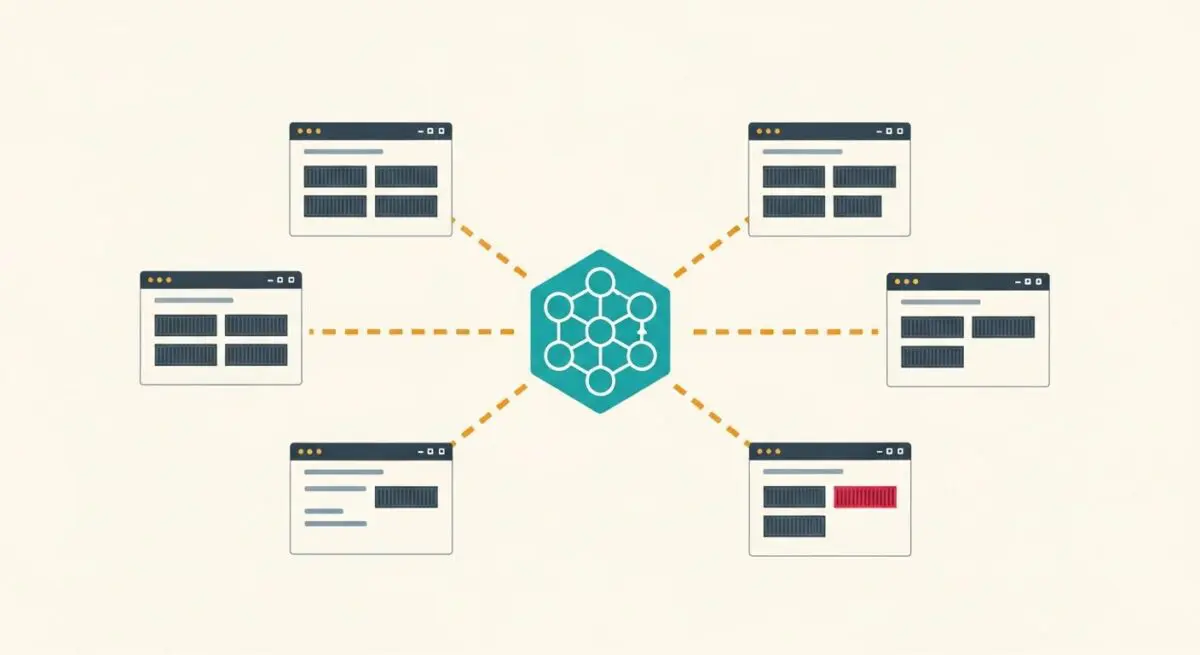
At its core, Kubernetes operates on a cluster architecture consisting of a control plane and multiple worker nodes. The control plane maintains the desired state of the cluster, while nodes host the applications in the form of Pods. This architecture is fundamental for modern AI content operations, as it allows for the seamless execution of complex data pipelines, large-scale web scraping, and the deployment of large language model (LLM) inference engines across a distributed environment.
The Real-World Analogy
Imagine a massive international shipping port. Each piece of software or AI agent is a standardized shipping container. Without a system, the port would be chaos—ships would not know where to dock, and containers would be lost. Kubernetes acts as the Port Authority and Automated Crane System. It knows exactly which ship (server) has space, where each container (application) needs to go, and if a container falls over or breaks, the system immediately replaces it with an identical one. It ensures the entire operation runs 24/7, regardless of how many ships arrive at once.
Why is Kubernetes Critical for Autonomous Workflows and AI Content Ops?
For high-scale AI content operations, Kubernetes is the engine that enables stateless automation. When executing programmatic SEO tasks that require thousands of concurrent API calls or processing massive JSON payloads, a single server is often insufficient. Kubernetes allows engineers to scale these tasks horizontally by spinning up additional pods as demand increases. This ensures that AI agents and content generation scripts do not experience downtime or latency during peak processing periods.
Furthermore, Kubernetes facilitates a microservices architecture, allowing different components of an automation workflow—such as data ingestion, LLM processing, and CMS publishing—to operate independently. This modularity improves fault tolerance; if the publishing service fails, the data ingestion service continues to run, preventing a total system collapse. It also optimizes resource utilization, ensuring that expensive GPU or CPU resources are only consumed when active workloads require them.
Best Practices & Implementation
- Implement Horizontal Pod Autoscaling (HPA): Configure HPA to automatically adjust the number of pods based on CPU utilization or custom metrics, ensuring your AI workflows scale dynamically with demand.
- Utilize Helm Charts for Version Control: Use Helm to manage Kubernetes applications through reproducible templates, simplifying the deployment of complex automation stacks across different environments.
- Define Resource Requests and Limits: Explicitly set CPU and memory limits for every container to prevent a single runaway AI process from consuming all cluster resources and impacting other services.
- Adopt GitOps Workflows: Use tools like ArgoCD or Flux to manage cluster state via Git repositories, ensuring that infrastructure changes are audited, versioned, and easily reversible.
Common Mistakes to Avoid
One frequent error is over-provisioning resources, where teams allocate excessive CPU and memory to pods, leading to significant cloud waste. Conversely, failing to set resource limits can lead to “noisy neighbor” issues where one container crashes the entire node. Another common mistake is manual configuration (ClickOps); relying on manual dashboard changes instead of declarative YAML files makes the infrastructure impossible to replicate or scale reliably in a production environment.
Conclusion
Kubernetes provides the essential orchestration layer for scaling AI-driven automations, ensuring that complex content pipelines remain resilient, efficient, and highly available.