Executive Summary
- Mitigates data loss caused by Intelligent Tracking Prevention (ITP), ad-blockers, and the deprecation of third-party cookies.
- Enables secure, server-to-server (S2S) data transmission, ensuring higher data integrity and improved Event Match Quality (EMQ) scores.
- Optimizes machine learning algorithms for ad platforms by providing a more complete signal set for attribution and bidding.
What is Conversion API?
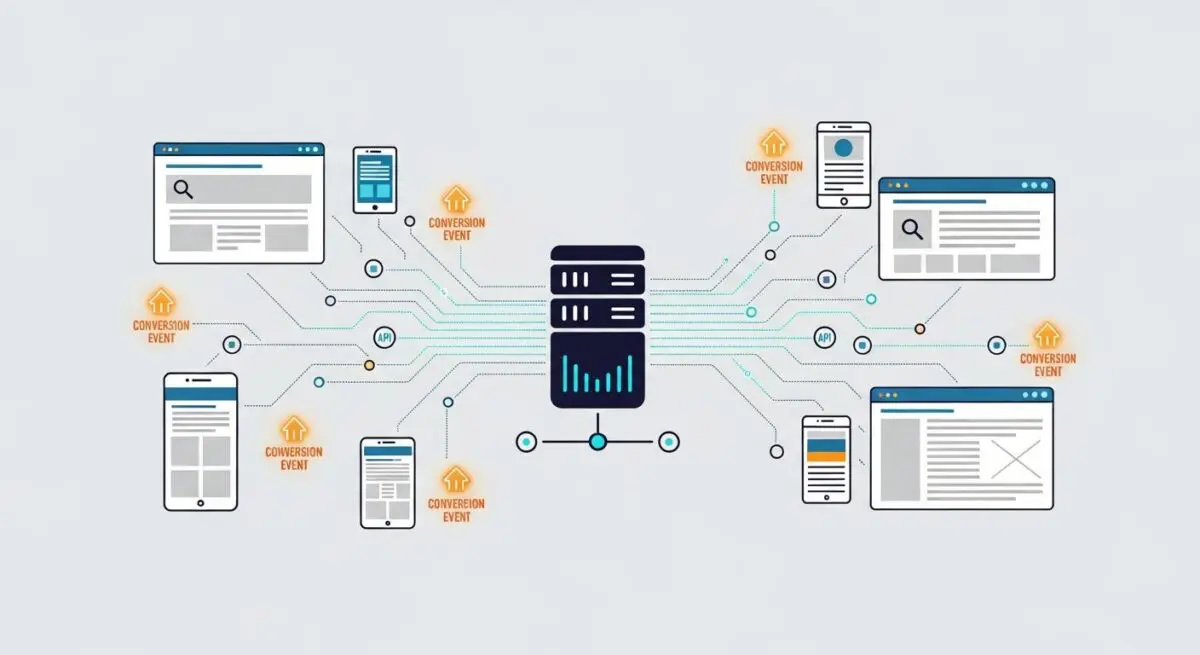
The Conversion API (CAPI) is a server-side interface that allows advertisers to send web events, offline events, and customer actions directly from their server to a marketing platform’s server. Unlike traditional browser-side tracking, which relies on the execution of JavaScript snippets (pixels) within a user’s browser, the Conversion API establishes a direct communication channel. This architecture is designed to bypass the inherent limitations of client-side tracking, such as browser crashes, slow loading times, and increasingly restrictive privacy settings. In a modern MarTech stack, CAPI acts as a bridge between a brand’s internal database or Customer Data Platform (CDP) and the advertising ecosystem, ensuring that conversion data remains resilient in a privacy-first digital landscape.
Technically, the Conversion API functions by capturing user interactions on the backend. When a user completes a transaction or triggers a specific event, the server logs this data and transmits it via an API call—typically using a RESTful architecture—to the destination platform (e.g., Meta, Google, or TikTok). This process involves the transmission of hashed personally identifiable information (PII), such as email addresses or phone numbers, alongside event-specific data like transaction value and currency. By moving the tracking logic from the client to the server, organizations gain granular control over what data is shared, enhancing both security and compliance with global data protection regulations like GDPR and CCPA.
The Real-World Analogy
To understand the difference between a browser pixel and a Conversion API, imagine the difference between a message in a bottle and a direct fiber-optic telephone line. A browser pixel is like a message in a bottle thrown into a turbulent ocean. It might reach its destination, but it could also be lost due to storms (ad-blockers), intercepted by barriers (privacy settings), or simply sink if the bottle breaks (browser crashes). The Conversion API, conversely, is the direct fiber-optic line connecting two secure offices. The message is sent directly from the source to the recipient without being subject to external environmental factors. It is faster, more reliable, and ensures that the information arrives exactly as intended, regardless of what is happening in the ‘ocean’ of the public internet browser.
How Conversion API Impacts Marketing ROI & Data Attribution?
The implementation of a Conversion API has a profound impact on Marketing Return on Investment (ROI) by addressing the ‘signal loss’ phenomenon. As browsers like Safari and Firefox implement stricter Intelligent Tracking Prevention (ITP) and Google Chrome moves toward the phase-out of third-party cookies, traditional pixel-based attribution has become increasingly fragmented. This fragmentation leads to ‘dark’ conversions—actions taken by users that are not attributed to the correct marketing channel. By utilizing CAPI, marketers can recover these lost signals, leading to a more accurate representation of the customer journey. When attribution models have access to a more complete dataset, the perceived Cost Per Acquisition (CPA) often decreases because the system can finally ‘see’ the conversions it was previously missing.
Furthermore, CAPI significantly enhances the performance of automated bidding strategies. Modern advertising platforms rely heavily on machine learning (ML) to optimize ad delivery. These ML models require high-volume, high-quality data to function effectively. By providing a consistent stream of server-side data, CAPI ensures that these algorithms have the necessary inputs to identify high-value users and optimize bids in real-time. This leads to better audience targeting, reduced budget waste, and a higher overall Return on Ad Spend (ROAS). In the context of SEO and GEO (Generative Engine Optimization), the data integrity provided by CAPI allows for better alignment between organic search intent and paid conversion outcomes, creating a unified data layer for cross-channel analysis.
Strategic Implementation & Best Practices
- Implement Redundant Tracking with Deduplication: For maximum signal resilience, use a hybrid approach by running both the browser pixel and the Conversion API. To avoid double-counting conversions, ensure that both sources send a unique
event_id, allowing the receiving platform to merge identical events. - Prioritize Event Match Quality (EMQ): The effectiveness of CAPI depends on the platform’s ability to match the server event to a specific user. Send as many hashed customer parameters as possible (e.g.,
emfor email,phfor phone) to increase match rates and attribution accuracy. - Utilize Server-Side Google Tag Manager (sGTM): Implementing CAPI through a server-side GTM container provides a scalable framework. It allows for a single server-side stream to distribute data to multiple vendors, reducing server load and simplifying the management of data privacy rules.
- Monitor Data Latency: Ensure that server-side events are sent as close to real-time as possible. Significant delays between the user action and the API call can negatively impact the platform’s ability to attribute the conversion within the standard attribution window.
Common Pitfalls & Strategic Mistakes
One of the most frequent errors in enterprise implementation is the failure to properly deduplicate events. When a brand sends the same purchase event via both the pixel and the API without a matching event_id, the advertising platform may report double the actual revenue, leading to inflated ROI metrics and disastrous budget allocation decisions. Another common mistake is the omission of the external_id or other unique identifiers that are critical for matching users who are not currently logged into a social platform. Finally, many organizations neglect the privacy implications of server-side tracking; failing to hash PII before transmission or ignoring user opt-out preferences (Consent Mode) can lead to significant regulatory risks and loss of consumer trust.
Conclusion
The Conversion API is no longer an optional enhancement but a foundational requirement for data-driven marketing architectures. By establishing a robust server-to-server connection, brands can ensure data continuity, optimize algorithmic performance, and maintain a competitive advantage in an increasingly cookie-less digital economy.