



Executive Summary
- Leverages hashed first-party data (PII) to facilitate deterministic matching across advertising ecosystems, bypassing third-party cookie deprecation.
- Enables sophisticated full-funnel orchestration through automated CRM-to-platform synchronization and RFM-based segmentation.
- Optimizes Customer Acquisition Cost (CAC) by implementing rigorous exclusion logic and high-intent lookalike modeling based on seed audience attributes.
What is Custom Audiences?
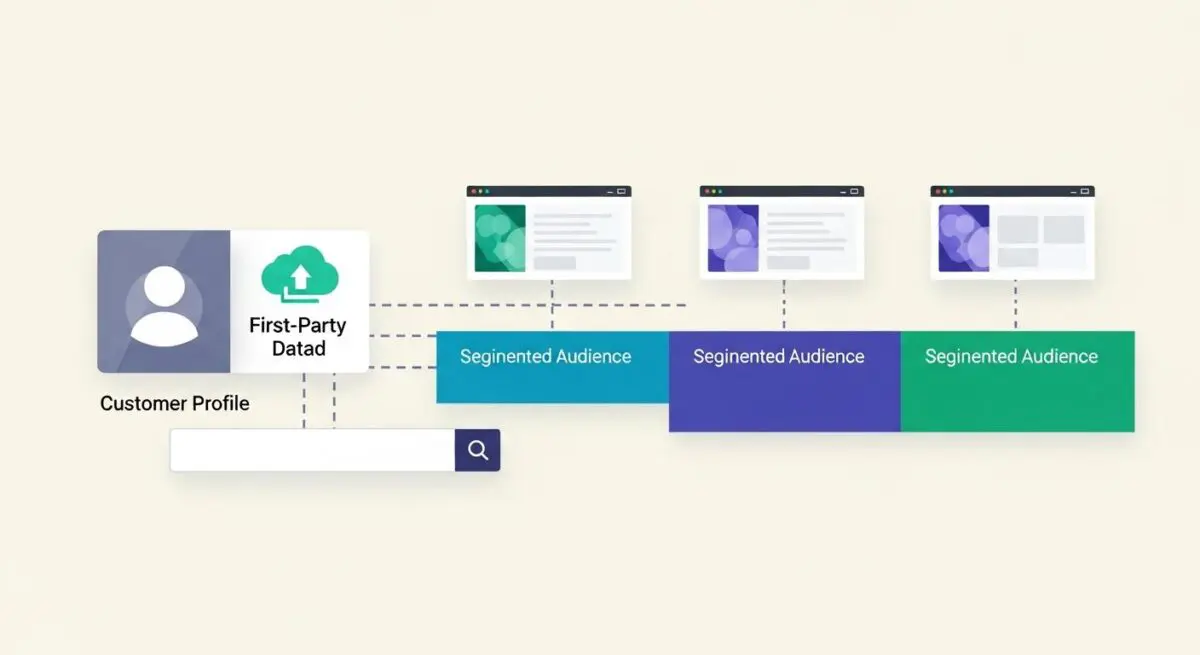
Custom Audiences represent a sophisticated targeting mechanism within the modern MarTech stack that allows advertisers to bridge the gap between their internal Customer Relationship Management (CRM) systems and external advertising platforms. At its core, this technology utilizes first-party data—such as email addresses, phone numbers, or mobile advertiser IDs (MAIDs)—to identify and reach specific individuals across digital ecosystems like Meta, Google, and LinkedIn. Unlike interest-based or behavioral targeting, which relies on probabilistic inferences, Custom Audiences utilize deterministic matching. This process involves the secure hashing of Personally Identifiable Information (PII) using algorithms such as SHA-256 before the data is uploaded, ensuring that user privacy is maintained while enabling high-precision targeting.
In the context of a data-driven marketing architecture, Custom Audiences serve as the foundational layer for advanced personalization and lifecycle marketing. By integrating a Customer Data Platform (CDP) or a Data Warehouse (e.g., Snowflake or BigQuery) directly with advertising APIs, organizations can eliminate data silos and ensure that their audience segments are updated in near real-time. This technical synergy allows for the execution of complex marketing strategies, such as cross-selling to existing customers, re-engaging lapsed users, or suppressing current subscribers from acquisition campaigns to prevent budget leakage. As the industry shifts toward a privacy-first paradigm characterized by the deprecation of third-party cookies, the strategic importance of Custom Audiences as a first-party data activation tool cannot be overstated.
The Real-World Analogy
To understand Custom Audiences, imagine a high-end, members-only concierge service at an international airport. Without a Custom Audience, a brand is like a promoter standing in the middle of the terminal with a megaphone, shouting about a luxury lounge to every traveler who passes by, regardless of their ticket class or destination. This is inefficient and intrusive. However, with a Custom Audience, the brand is the concierge who holds a digital manifest of every frequent flyer currently in the building. Instead of shouting, the concierge identifies specific individuals on the list and sends a personalized, discreet invitation directly to their mobile device as they walk past. The concierge doesn’t need to guess who the valuable customers are; they already have the verified data. This ensures that the message reaches the right person at the right time, while those not on the list remain undisturbed, preserving the brand’s resources and the audience’s experience.
How Custom Audiences Impacts Marketing ROI & Data Attribution?
The implementation of Custom Audiences has a profound impact on Marketing ROI by significantly increasing the efficiency of media spend. By targeting users who have already interacted with the brand, advertisers typically see a marked increase in Click-Through Rates (CTR) and Conversion Rates (CVR) compared to broad targeting. This efficiency directly translates to a lower Customer Acquisition Cost (CAC) and a higher Return on Ad Spend (ROAS). Furthermore, Custom Audiences allow for the creation of ‘Lookalike’ or ‘Similar’ audiences. By using a high-value Custom Audience as a seed—such as the top 10% of customers by Lifetime Value (LTV)—machine learning models can identify new prospects who share similar high-intent characteristics, effectively scaling the reach without sacrificing lead quality.
From a data attribution perspective, Custom Audiences provide a clearer picture of the customer journey. When integrated with server-side tracking and Conversions APIs (CAPI), Custom Audiences help close the loop between offline interactions and online conversions. For instance, a brand can upload a list of customers who made an in-store purchase to an advertising platform to see how many of those individuals were exposed to a specific digital ad campaign. This level of granularity enables more accurate multi-touch attribution (MTA) modeling, allowing marketing directors to allocate budgets based on actual performance data rather than speculative metrics. It also mitigates the ‘signal loss’ caused by browser-level privacy protections, as the matching is based on durable identifiers rather than transient cookies.
Strategic Implementation & Best Practices
- Automate Data Synchronization: Avoid manual CSV uploads, which lead to data decay. Implement dynamic syncing via API-based connectors or CDPs to ensure that audience lists reflect real-time customer behavior, such as immediate removal from a ‘prospect’ list once a purchase is completed.
- Implement Granular Segmentation: Move beyond simple ‘all customer’ lists. Segment audiences based on Recency, Frequency, and Monetary (RFM) analysis to tailor messaging. For example, create specific audiences for ‘High-Value Loyalists,’ ‘At-Risk Churners,’ and ‘Recent Cart Abandoners.’
- Prioritize Data Security and Compliance: Ensure all PII is hashed locally before transmission. Maintain strict adherence to GDPR, CCPA, and other regional privacy regulations by ensuring that only users who have provided explicit consent for marketing use are included in the uploaded datasets.
- Utilize Exclusion Logic: One of the most effective ways to improve ROI is by what you *don’t* target. Use Custom Audiences to exclude existing customers from top-of-funnel awareness campaigns to ensure your acquisition budget is spent exclusively on new prospects.
Common Pitfalls & Strategic Mistakes
A frequent error in enterprise marketing is the reliance on ‘stale’ Custom Audiences. When lists are not updated frequently, brands end up serving irrelevant ads to users whose status has changed, leading to ‘ad fatigue’ and wasted spend. Another technical pitfall is the use of insufficient seed audience sizes for Lookalike modeling; if the initial Custom Audience is too small or not representative of the ideal customer profile, the resulting Lookalike audience will be poorly optimized, leading to high CAC. Finally, many organizations fail to align their Custom Audience strategy with their broader data governance policies, resulting in fragmented data silos where the marketing team is using different customer definitions than the sales or product teams.
Conclusion
Custom Audiences are the linchpin of a modern, privacy-compliant marketing strategy, enabling brands to activate first-party data for precision targeting and improved attribution. By moving toward API-driven, dynamic audience management, organizations can significantly enhance their marketing efficiency and maintain a competitive edge in an increasingly cookie-less digital landscape.