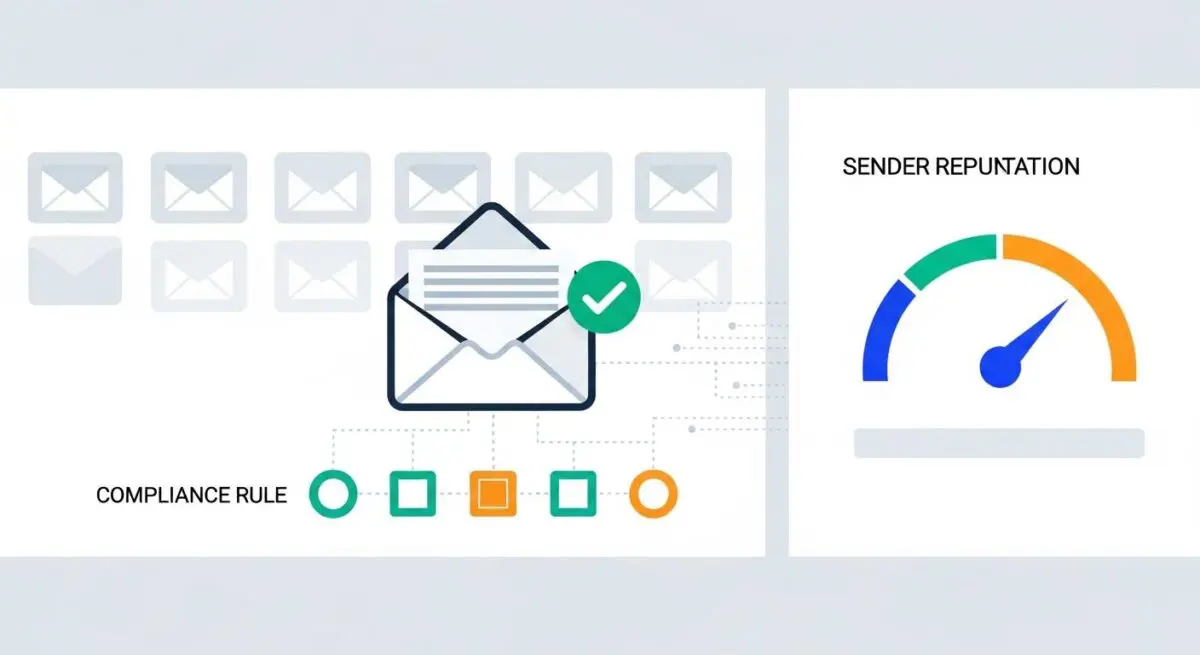
Executive Summary
- Mandates the inclusion of a clear, functional opt-out mechanism and a valid physical postal address in all commercial email communications.
- Prohibits deceptive header information, including false ‘From’ names and misleading subject lines, to ensure SMTP transparency and sender integrity.
- Requires the processing of unsubscribe requests within 10 business days, with non-compliance resulting in significant FTC-enforced financial penalties per individual email.
What is the CAN-SPAM Act?
The CAN-SPAM Act, officially known as the Controlling the Assault of Non-Solicited Pornography And Marketing Act of 2003, is a federal law in the United States that establishes the first national standards for the sending of commercial email. Administered by the Federal Trade Commission (FTC), this legislation is not merely a set of suggestions but a strict regulatory framework that governs how businesses communicate with their audiences via electronic mail. It distinguishes between ‘commercial content,’ which advertises or promotes a commercial product or service, and ‘transactional or relationship content,’ which facilitates an already agreed-upon transaction or updates a customer about an existing relationship. For MarTech professionals, the CAN-SPAM Act is the foundational layer of email deliverability and sender reputation management.
In a modern MarTech stack, the CAN-SPAM Act influences the architecture of Email Service Providers (ESPs) and Customer Data Platforms (CDPs). It necessitates the integration of automated suppression lists and robust preference centers. From a technical standpoint, compliance involves ensuring that every outgoing SMTP (Simple Mail Transfer Protocol) transmission contains specific metadata and body content that satisfies legal requirements. This includes the ‘From’, ‘To’, and ‘Reply-To’ fields, which must accurately identify the person or business who initiated the message. Failure to adhere to these technical standards can lead to domain blacklisting by Internet Service Providers (ISPs) and significant litigation risks.
The Real-World Analogy
To understand the CAN-SPAM Act, imagine a professional courier service operating in a high-security corporate building. In this scenario, the CAN-SPAM Act is the building’s strict security protocol. Every courier (the email sender) must wear a visible ID badge (the ‘From’ header), state exactly what is in the package (the subject line), and provide a physical office address where they can be reached (the physical postal address). Furthermore, every recipient has a ‘Do Not Disturb’ sign they can hang on their door. If a recipient hangs that sign (unsubscribes), the courier is legally barred from ever knocking on that door again. If the courier tries to hide their identity or ignores the sign, the building security (the FTC and ISPs) will not only ban the courier from the building but also levy heavy fines against the company that hired them.
How the CAN-SPAM Act Impacts Marketing ROI & Data Attribution?
The CAN-SPAM Act has a direct, measurable impact on Marketing ROI by serving as the primary gatekeeper for email deliverability. In the realm of Data Attribution, compliance ensures the integrity of the lead lifecycle. When a brand violates CAN-SPAM protocols, ISPs like Gmail, Outlook, and Yahoo! employ sophisticated filtering algorithms to route the brand’s emails directly to the spam folder or, in severe cases, block the sending IP address entirely. This degradation of ‘Sender Score’ leads to a catastrophic drop in open rates and click-through rates (CTR), effectively nullifying the ROI of email marketing campaigns. High bounce rates and spam complaints triggered by non-compliance also skew attribution models, as the data becomes polluted with ‘ghost’ interactions and false negatives.
Furthermore, the cost of non-compliance is a direct hit to the bottom line. With penalties exceeding $50,000 per individual email found in violation, a single non-compliant blast to a list of 10,000 subscribers could theoretically result in hundreds of millions of dollars in fines. Strategically, the CAN-SPAM Act forces marketers to focus on ‘Permission-Based Marketing.’ While this may result in smaller list sizes, the technical quality of the data is significantly higher. High-intent subscribers who have a clear path to opt-out are more likely to engage with the content, leading to higher conversion rates and a more accurate understanding of Customer Lifetime Value (LTV). By maintaining a clean, compliant list, marketers ensure that their attribution data reflects genuine consumer interest rather than forced exposure.
Strategic Implementation & Best Practices
- Automated Suppression List Synchronization: Implement real-time API hooks between your ESP and CRM to ensure that when a user unsubscribes, their status is updated across all marketing silos within 24 hours, well before the 10-day legal limit.
- Header and Metadata Validation: Configure SPF (Sender Policy Framework), DKIM (DomainKeys Identified Mail), and DMARC (Domain-based Message Authentication, Reporting, and Conformance) records to verify sender identity and prevent spoofing, which aligns with CAN-SPAM’s requirement for accurate header information.
- Granular Preference Centers: Instead of a binary ‘unsubscribe all’ option, implement a technical preference center that allows users to opt-down or select specific content frequencies, reducing total churn while remaining fully compliant.
- Physical Address Injection: Use dynamic content blocks to automatically inject the correct, legally registered physical postal address into the footer of every commercial template, ensuring global compliance across different regional offices.
- Audit Third-Party Affiliates: Establish strict contractual obligations and technical monitoring for any third-party agencies sending mail on your behalf, as the primary brand is legally responsible for any violations committed by their affiliates.
Common Pitfalls & Strategic Mistakes
One of the most frequent errors is the misclassification of ‘Commercial’ versus ‘Transactional’ emails. Many enterprise brands mistakenly believe that adding a small promotional banner to a password reset or shipping notification does not change its status; however, if the primary purpose is commercial, it must comply with all CAN-SPAM requirements, including the opt-out link. Another common pitfall is the ‘Siloed Unsubscribe’ error, where a user unsubscribes from a newsletter but continues to receive promotional offers from a different department because the company’s data architecture fails to centralize consent management. This technical failure is a direct violation of the act and a major risk factor during FTC audits.
Conclusion
The CAN-SPAM Act is a critical regulatory pillar that demands technical precision in email architecture and data management. By prioritizing transparency and user autonomy, brands can protect their sender reputation, optimize deliverability, and ensure long-term marketing scalability in an increasingly regulated digital landscape.